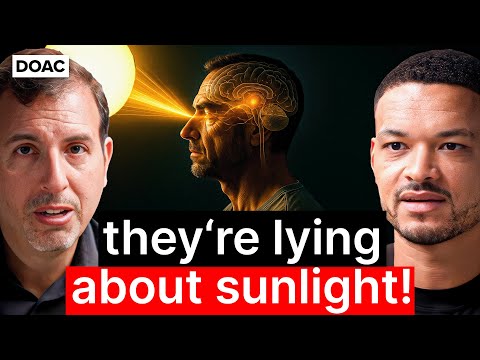
Vitamin D Expert: The Fastest Way To Dementia & The Big Lie About Sunlight!
Dr. Roger Seheult (guest), Steven Bartlett (host), Narrator, Narrator, Narrator
In this episode of The Diary of a CEO, featuring Dr. Roger Seheult and Steven Bartlett, Vitamin D Expert: The Fastest Way To Dementia & The Big Lie About Sunlight! explores sunlight, Mitochondria, And NEWSTART: Rethinking Disease, Aging, And Health Critical care physician Dr. Roger Seheult explains how everyday lifestyle factors—especially sunlight and light exposure—fundamentally affect mitochondrial function, immunity, aging, and risk of chronic disease. He frames health around eight "NEWSTART" pillars: Nutrition, Exercise, Water, Sunlight, Temperance, Air, Rest, and Trust (faith/community).
Sunlight, Mitochondria, And NEWSTART: Rethinking Disease, Aging, And Health
Critical care physician Dr. Roger Seheult explains how everyday lifestyle factors—especially sunlight and light exposure—fundamentally affect mitochondrial function, immunity, aging, and risk of chronic disease. He frames health around eight "NEWSTART" pillars: Nutrition, Exercise, Water, Sunlight, Temperance, Air, Rest, and Trust (faith/community).
Central to the discussion is the argument that sunlight’s benefits go far beyond vitamin D: infrared and red wavelengths penetrate deeply into the body, upregulate melatonin inside mitochondria, reduce oxidative stress, and may protect against dementia, cardiovascular disease, diabetes, infections, and more.
He shares striking clinical anecdotes (a near-fatal fungal lung infection and severe COVID-19 pneumonia rapidly improving after daily sun exposure) alongside human data on sauna use, green spaces, faith, and light hygiene to propose low-cost, high-yield lifestyle interventions. He also highlights the risks of "dark days, bright nights"—indoor lives, artificial light, and suppressed melatonin—on sleep, mood, and long‑term health.
Key Takeaways
Sunlight’s health impact goes far beyond vitamin D; infrared light supports mitochondria directly.
Seheult emphasizes that equating sunlight with vitamin D is a major misconception. ...
Get the full analysis with uListen AI
Brief, regular sun exposure (around 15–20 minutes) can meaningfully improve health and resilience.
Experimental and clinical data suggest that about 15 minutes of appropriate-wavelength light is enough to "flip a switch" in mitochondria, after which more exposure doesn’t add much in that session. ...
Get the full analysis with uListen AI
Indoor, artificial-light lifestyles create a "dark days, bright nights" pattern that harms sleep and health.
Most Americans and Brits now spend ~92–93% of their time indoors, under LED/fluorescent lighting that is rich in blue light but poor in red/infrared. ...
Get the full analysis with uListen AI
Heat (sauna, hot baths) and brief cold exposure can amplify innate immunity via interferon and circulation.
The innate immune system’s key antiviral molecule, interferon, is upregulated by even modest increases in core body temperature (~38°C). ...
Get the full analysis with uListen AI
Nature and green environments biologically strengthen immunity and reduce inflammation and mortality.
Trees emit phytoncides—volatile compounds shown to increase natural killer (NK) cell number and activity, with effects lasting about a week. ...
Get the full analysis with uListen AI
Faith, trust, and unconditional forgiveness correlate with lower anxiety, depression, and end‑of‑life distress.
Seheult cites research showing that people who believe a benevolent God has forgiven them are much more likely to forgive others *unconditionally*, which in turn is associated with lower depression, reduced anxiety, less somatization, and less fear about death. ...
Get the full analysis with uListen AI
Light and heat interventions are powerful, but they complement—not replace—broader lifestyle and medical care.
While the case stories (a near-fatal fungal lung infection resolving after daily outdoor light, a severe COVID-19 patient avoiding intubation with repeated sun exposure) and small trials (infrared jackets for COVID patients) are compelling, Seheult is careful to label them as preliminary and additive. ...
Get the full analysis with uListen AI
Notable Quotes
“Being in that category of not spending much time outside in the sun was the same risk factor for death as smoking.”
— Dr. Roger Seheult
“The scurvy of the 21st century is the lack of sunlight.”
— Dr. Roger Seheult
“Dark days and bright nights correlate with increased mortality. What we really should be having is bright days and dark nights.”
— Dr. Roger Seheult
“All we do in medicine is delay the inevitable. If you're interested in living the best life, you need to strengthen all of those chains.”
— Dr. Roger Seheult
“That miracle made me think twice about ever saying, 'You’ve only got two years to live.' I must have missed that day in med school.”
— Dr. Roger Seheult
Questions Answered in This Episode
You argued that vitamin D status is mainly a marker of sun exposure rather than the main causal factor in outcomes like COVID mortality. If you were designing a large randomized trial to test infrared/solar exposure directly, how would you structure it to separate the effects of vitamin D from mitochondrial photobiomodulation?
Critical care physician Dr. ...
Get the full analysis with uListen AI
For someone living at a high latitude with a predominantly indoor, screen-heavy job, what would an ideal 24‑hour "light hygiene" protocol look like—specific times for outdoor exposure, SAD lamp use, device cutoffs, and bedroom lighting—to optimize both mitochondrial function and circadian rhythm?
Central to the discussion is the argument that sunlight’s benefits go far beyond vitamin D: infrared and red wavelengths penetrate deeply into the body, upregulate melatonin inside mitochondria, reduce oxidative stress, and may protect against dementia, cardiovascular disease, diabetes, infections, and more.
Get the full analysis with uListen AI
The Finnish sauna and heat–cold data are compelling, but how do you reconcile encouraging people to let mild fevers run their course with the real risks of hyperthermia or febrile seizures, especially in children? Where would you draw practical thresholds for when to treat a fever and when to support it?
He shares striking clinical anecdotes (a near-fatal fungal lung infection and severe COVID-19 pneumonia rapidly improving after daily sun exposure) alongside human data on sauna use, green spaces, faith, and light hygiene to propose low-cost, high-yield lifestyle interventions. ...
Get the full analysis with uListen AI
The tree‑planting and forest-bathing studies suggest that phytoncides and green exposure have systemic anti‑inflammatory effects. If city planners and hospital designers took this seriously, what specific architectural and urban policies would you prioritize to make "therapeutic nature" a built‑in part of public health?
Get the full analysis with uListen AI
Your research on faith, forgiveness, and health implies that a benevolent view of God can have powerful psychological and physiological effects, while punitive images can be harmful. From a clinical and ethical standpoint, how should secular health systems engage with patients’ spiritual beliefs without proselytizing or overstepping boundaries?
Get the full analysis with uListen AI
Transcript Preview
(tense music) He was literally two days away from dying. So this is a story where a 15-year-old boy was diagnosed with blood cancer, but he developed a flesh-eating infection in his lung. He wasn't gonna make it, so he has one request. He wants to go outside, and that's exactly what they do, and this was actually mind-blowing to me. After the second day, the infection is probably 60, 70% gone, and it became clear to me that sunlight has so many important benefits. For instance, if you're the bed closer to the window, you get discharged from the hospital faster.
So I want you to give me any information you have as it relates to light health. For example, do you recommend these kinds of things?
(laughs)
Dr. Roger Seheult is a board certified critical care physician who breaks down complex science into clear, life-saving advice.
I see people at the very end of their lives, so I know what prevents them from getting this ill and how to extend life. So let's distill it down (upbeat music) into eight pillars. The first thing, exercise. It reduces stroke. It reduces depression. Next, sunlight. Did you know that infrared light from the sun is able to penetrate up to about eight millimeters and stimulate and up-regulate melatonin, which prevents a lot of diseases like dementia, cardiovascular disease, diabetes.
What if you live in a cloudy country?
There's some very actionable things that you can do, and we'll talk about that. Next one, water. For instance, people who use sauna are more likely to have less death from cardiovascular disease. Next, air. There are studies that show that just going out one day a week can elevate our immune system and make us more relaxed, and then there's (beep) (beep) But finally, trust. This is something that can't be ignored, because studies have shown that people who have a good faith and trust in a god are-
I see messages all the time in the comments section that some of you didn't realize you didn't subscribe, so if you could do me a favor and double-check if you're a subscriber to this channel, that would be tremendously appreciated. It's the simple, it's the free thing that anybody that watches this show frequently can do to help us here to keep everything going in this show and the trajectory it's on, so please do double-check if you've subscribed, and, uh, thank you so much, because in a strange way, you are, you're part of our history, and you're on this journey with us, and I appreciate you for that, so yeah. Thank you. (upbeat music) Dr. Roger Seheult, with the work that you do, what is it that you're aiming to accomplish?
Outside of my clinical duties, uh, and maybe even part of that, I would like to clearly explain very easily graspable tools that can be implemented to make people live their best life, and it's specifically in terms of their health and their wellbeing.
Install uListen to search the full transcript and get AI-powered insights
Get Full TranscriptGet more from every podcast
AI summaries, searchable transcripts, and fact-checking. Free forever.
Add to Chrome