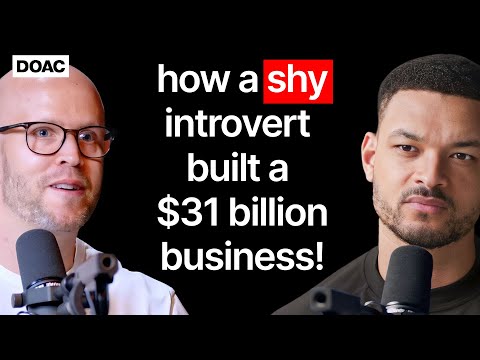
Spotify Founder: How A 23 Year Old Introvert Built A $31 Billion Business!
Daniel Ek (guest), Steven Bartlett (host), Narrator
In this episode of The Diary of a CEO, featuring Daniel Ek and Steven Bartlett, Spotify Founder: How A 23 Year Old Introvert Built A $31 Billion Business! explores introverted Misfit to Music Mogul: Daniel Ek’s Spotify Rebuilds Industry Daniel Ek shares how an introverted, academically average kid from a rough Stockholm suburb became the founder of Spotify, rebuilding the music industry and creating a multibillion‑dollar business.
Introverted Misfit to Music Mogul: Daniel Ek’s Spotify Rebuilds Industry
Daniel Ek shares how an introverted, academically average kid from a rough Stockholm suburb became the founder of Spotify, rebuilding the music industry and creating a multibillion‑dollar business.
He explains how his single mother’s focus on breadth, effort, and being a “good human” shaped his ambition and his preference for learning over traditional markers of success.
Ek describes retiring at 23, discovering the emptiness of money, status, and nightlife, and re‑orienting his life around meaningful work, learning, and genuine relationships, which led directly to founding Spotify.
The conversation covers his philosophy on ambition, education, entrepreneurship, risk‑taking, culture, competition with Apple, and why betting on yourself and building the right environment matters more than copying other entrepreneurs.
Key Takeaways
Optimize for effort and potential, not just outcomes.
Ek’s mother cared far less about grades than about whether he had truly tried. ...
Get the full analysis with uListen AI
Breadth and being a ‘good all‑rounder’ can be a superpower.
Ek was never the best at sports, arts, or maths, but he was good enough at many things to move between groups and perspectives. ...
Get the full analysis with uListen AI
You may need to ‘fail’ your happiness hypothesis to grow.
After selling his first company and retiring at 22–23, Ek did everything his younger self thought would make him happy—nightclubs, sports car, status, attention, “20 or 30 girls,” expensive bottles. ...
Get the full analysis with uListen AI
Design work around what energizes you: learning, meaning, and fit.
Ek realized he loved working and learning; he would have paid to learn from great people. ...
Get the full analysis with uListen AI
Depth of problem understanding creates ‘impossible’ opportunities.
Before committing to Spotify, Ek spent roughly 500 hours learning the music problem—copyright regimes, labels, performance rights, piracy dynamics, consumer behavior. ...
Get the full analysis with uListen AI
Share the burden with a co‑founder and complementary personalities.
During the 18‑month battle to get label deals, Ek repeatedly thought Spotify would die, lost his hair, and gained 30 pounds from stress. ...
Get the full analysis with uListen AI
Culture eventually outweighs strategy in scaling a company.
Ek’s view evolved: at 23, he thought culture meant having a ping‑pong table; at 30, he prioritized strategy; by 40, he believes culture is the most scalable asset and now treats strategy as secondary or even tertiary. ...
Get the full analysis with uListen AI
Notable Quotes
“In so many cases in life I’ve found that the difference between aiming super high versus aiming just a little bit higher than where you are, from an effort perspective, it’s about the same effort.”
— Daniel Ek
“I realized that this thing I thought I wanted, I just didn’t want at all.”
— Daniel Ek
“We tend to believe the world’s more logical than what it is, but it’s based on relationships.”
— Daniel Ek
“Betting on myself and betting on yourself would probably be the best advice I could give many people.”
— Daniel Ek
“The 40‑year‑old Daniel is all about culture, almost to the point where strategy is secondary, if not even tertiary to that.”
— Daniel Ek
Questions Answered in This Episode
You spent roughly 500 hours studying the music industry before committing to Spotify—what concrete research practices or frameworks did you use that other founders could copy when immersing themselves in a complex, regulated space?
Daniel Ek shares how an introverted, academically average kid from a rough Stockholm suburb became the founder of Spotify, rebuilding the music industry and creating a multibillion‑dollar business.
Get the full analysis with uListen AI
Looking back at the 18 months of rejections from record labels, is there a specific moment where, in hindsight, quitting would have been rational—and what subtle signals convinced you not to quit then?
He explains how his single mother’s focus on breadth, effort, and being a “good human” shaped his ambition and his preference for learning over traditional markers of success.
Get the full analysis with uListen AI
You invested about $10 million of personal wealth into Spotify; if you were 23 in today’s funding environment, with far more capital available, would you still put so much of your own money at risk or structure it differently?
Ek describes retiring at 23, discovering the emptiness of money, status, and nightlife, and re‑orienting his life around meaningful work, learning, and genuine relationships, which led directly to founding Spotify.
Get the full analysis with uListen AI
You’re critical of Apple’s 30% tax and control over communication—if you were suddenly running Apple, what exact policy changes would you implement to maintain platform quality while genuinely fostering competition?
The conversation covers his philosophy on ambition, education, entrepreneurship, risk‑taking, culture, competition with Apple, and why betting on yourself and building the right environment matters more than copying other entrepreneurs.
Get the full analysis with uListen AI
You’ve come to see culture as more important than strategy at scale; if a founder with 50–100 employees asked you for one specific cultural mechanism (ritual, process, or policy) that most accelerates innovation while keeping risk responsible, what would you advise them to implement first and why?
Get the full analysis with uListen AI
Transcript Preview
I'm an introvert. Not amazing, academically. Didn't feel like I belonged anywhere. Average, at best. (music)
And yet you created Spotify.
Yeah.
Daniel Ek.
Spotify founder and CEO.
He's not only saved the music industry, he's created a $50 billion company, and he himself is worth more than $4 billion.
I flunked high school, then started on my first company that later got acquired.
And you retired at 23? (laughs)
Yeah. The first month was fun. Night clubs, sports car, 20 or 30 girls throwing around money. Six months in, realized that this thing I thought I wanted, I just didn't want at all. I was just empty. Just thinking, "Am I ever gonna get out of this depression?" And, "What to do with life?" What if you can work on something you actually care about, what would you pick? Music. But the industry's going down the drain. I honestly did not think we would succeed. But if we succeed, I knew it was gonna be a big thing. Spotify is here. A one-stop shop for music. Big ones who use Spotify? I love it.
I read the journey to that success, had multiple near-death experiences.
It was awful. Ran out of money. I lost all of the hair, gained 30 pounds. And the problem was I modeled myself on the Mark Zuckerbergs of the world, run every meeting, be the best product person. It just wasn't me. Share the burden with someone. It is so important. We tend to believe the world's more logical than what it is, but it's based on relationships. Be the easiest person to deal with and you'd be surprised how many problems it solves.
One of those problems was Apple. What's your opinion on Apple?
(inhales deeply) (upbeat music)
Daniel, what is the most important context that I need to know about you to understand the man that sits in front of me today? And when I ask about context, I wanna go right back to where you come from and that earliest environment that... I almost, I almost see it like an oven. I see our earliest context as like an oven that-
Mm.
... baked us into who we are today.
Yeah.
What is that context?
I'm a product of a very, very strong single mom. Um, a woman that probably had a chip on her shoulder, um, against her sibling, her brother, her older brother, who kind of said, "You can't do this. You can't raise, uh, a child to be productive." Um, and I think, uh, she kind of, uh, just, well, hell-bent on making a point, uh, of showing that, you know, um, I was going to be successful in her definition, and successful meant, uh, well-educated, well-read, uh, and be able to handle almost, um, anything thrown at me. And just to give you an example of that, while I was brought up in the suburb of Stockholm, very much a working-class, rough neighborhood, one of the big things that my mother did was she had me, um, doing pentathlon. And the pentathlon was like the classic pentathlon. So that means fencing, horseback riding, uh, shooting, uh, running, and swimming. Um, doesn't sound like what someone basically from the projects-
Install uListen to search the full transcript and get AI-powered insights
Get Full TranscriptGet more from every podcast
AI summaries, searchable transcripts, and fact-checking. Free forever.
Add to Chrome