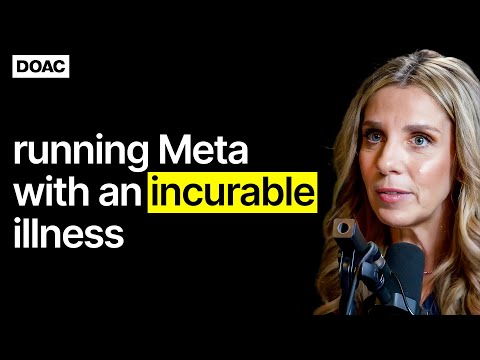
Meta’s VP on Leadership, Resilience, and Overcoming Challenges While Battling Cancer!
Nicola Mendelsohn (guest), Steven Bartlett (host)
In this episode of The Diary of a CEO, featuring Nicola Mendelsohn and Steven Bartlett, Meta’s VP on Leadership, Resilience, and Overcoming Challenges While Battling Cancer! explores meta VP Nicola Mendelsohn: Leadership, Cancer, Courage, And The Metaverse Meta’s VP for EMEA, Nicola Mendelsohn, traces her journey from a curious, underestimated schoolgirl in Manchester to one of the most senior women in global tech, and how family support and self-belief shaped her leadership. She details the shock of being diagnosed with incurable blood cancer at 45, the psychological rollercoaster that followed, and the intentional choices she made about work, health, and family. Nicola explains how Meta’s culture, Mark Zuckerberg’s high‑conviction pivots, and products like Facebook, Instagram and the metaverse are built, including both opportunities and risks. Throughout, she offers concrete lessons on career decisions, asking for what you want, managing chaos and fear, and building more humane workplaces where people can bring their whole selves.
Meta VP Nicola Mendelsohn: Leadership, Cancer, Courage, And The Metaverse
Meta’s VP for EMEA, Nicola Mendelsohn, traces her journey from a curious, underestimated schoolgirl in Manchester to one of the most senior women in global tech, and how family support and self-belief shaped her leadership. She details the shock of being diagnosed with incurable blood cancer at 45, the psychological rollercoaster that followed, and the intentional choices she made about work, health, and family. Nicola explains how Meta’s culture, Mark Zuckerberg’s high‑conviction pivots, and products like Facebook, Instagram and the metaverse are built, including both opportunities and risks. Throughout, she offers concrete lessons on career decisions, asking for what you want, managing chaos and fear, and building more humane workplaces where people can bring their whole selves.
Key Takeaways
Curiosity and supportive belief early in life can override damaging narratives from authority figures.
Nicola describes being penalized at school for “talking too much” and “asking too many questions,” and even being told by a teacher that her personality would hold her back. ...
Get the full analysis with uListen AI
Intentional career moves and relentless learning create steep growth, even if it means leaving comfort.
Nicola left a beloved, prestigious agency (BBH) after 12 years when she realized her bosses would always remain above her and her learning curve had flattened. ...
Get the full analysis with uListen AI
Managing chaos and fear means shrinking problems to controllable steps and avoiding “secondary worrying.”
In both her cancer journey and Meta’s constant change, Nicola applies the same framework: focus on what you can control today and define the next small milestone, rather than trying to “climb Everest” in one go. ...
Get the full analysis with uListen AI
Radical openness about illness at work can reduce stigma and strengthen culture, but many workplaces still punish it.
Nicola told Meta leadership and her broader team about her incurable blood cancer almost immediately, and in return received unambiguous support: “We’ve got your back. ...
Get the full analysis with uListen AI
You must design your life with the same rigor you design your career.
Nicola took a 20% pay cut to move to a four‑day week when her first child was one, after realizing she was failing herself across roles—mother, partner, friend—because work was all‑consuming. ...
Get the full analysis with uListen AI
High‑conviction leadership combines bold pivots with cultural safety to fail and learn quickly.
Nicola cites Mark Zuckerberg’s mobile pivot—refusing to review desktop work until teams brought mobile products—as the archetype of a decisive shift backed by action. ...
Get the full analysis with uListen AI
Career advancement isn’t only via people management or the ‘next rung,’ and you must actively ask for what you want.
Nicola regrets early pay‑review meetings where she simply said ‘thank you’ instead of arriving with market data, evidence of impact, and a clear ask. ...
Get the full analysis with uListen AI
Notable Quotes
“I think it'll be my daughter's personality that gets her on in life, not what she does with Latin.”
— Nicola Mendelsohn (quoting her father)
“You don't climb Everest. You get to base camp one, and that's your thing.”
— Nicola Mendelsohn
“I got the diagnosis that I had follicular lymphoma, which is an incurable blood cancer.”
— Nicola Mendelsohn
“I’ve come to tell you that you could’ve destroyed my life. The power that you wielded on others really could destroy.”
— Nicola Mendelsohn
“We often don't put the discipline into our personal lives that we do in our work lives.”
— Nicola Mendelsohn
Questions Answered in This Episode
You’ve described confronting your English teacher years later about the damage her bias nearly caused—what specific wording or approach would you recommend to someone today who wants to challenge a powerful person who undermined them, without burning every bridge?
Meta’s VP for EMEA, Nicola Mendelsohn, traces her journey from a curious, underestimated schoolgirl in Manchester to one of the most senior women in global tech, and how family support and self-belief shaped her leadership. ...
Get the full analysis with uListen AI
When Meta made the mobile pivot and later the shift to Reels, what were one or two concrete internal metrics or signals that convinced leadership you had to fully reallocate resources, rather than treating those bets as side projects?
Get the full analysis with uListen AI
In the Facebook group you helped create for people with follicular lymphoma, what patterns do you see in who copes better or worse mentally, and what could health systems or employers practically copy from the ‘strong copers’ to support others?
Get the full analysis with uListen AI
You chose to keep working through chemo because your job energised you; for someone facing serious illness who doesn’t love their job but needs the income, what decision‑making framework would you suggest for whether to continue, pivot, or pause their career?
Get the full analysis with uListen AI
Meta is investing heavily in metaverse guardrails like personal boundaries and diverse avatars; given what we’ve learned about misinformation and polarization in Web 2.0, what radical design choices—maybe even business‑model sacrifices—would you be willing to make in the metaverse to prevent those problems from being amplified?
Get the full analysis with uListen AI
Transcript Preview
Zuck was 11. He's our youngest. H- h- he asked me if I w-, you know, if I was gonna die. "Finish me off." As Facebook's Vice President for Europe, the Middle East, and Africa, Nicola is one of the most powerful women working in tech.
Facebook is this huge company. The prospect of leading so many regions, is there any element of, "What the fuck am I doing here?"
You don't climb Everest. You get to base camp one, and that's your thing. Certainly in chaotic moments, it's like, what are the things you can control in order to either get out of the chaos or to hit the North Star?
So this Meta shift, people are understandably scared. Do you have any concerns that we're taking away what it is to be a human?
I think it's an important question. I think- (music stops)
Three years into your career at Facebook, and then you get some awful news.
(melancholy music plays) I got the diagnosis that I had follicular lymphoma, which is an incurable blood cancer. So we gathered the kids on the Sunday morning. Um, I couldn't... I just couldn't get the words out. When I told my story on, on World Cancer Day, so many people sharing having a similar disease, but were scared to show that because it was a sign of weakness. I mean, it sounds ridiculous, but there are still companies where that sort of behavior i- is happening. We often don't put the discipline into our personal lives that we do in our work lives, and often our work lives are dictated by others. These things aren't mutually exclusive.
So without further ado, I'm Steven Bartlett, and this is The Diary of a CEO. I hope nobody's listening, but if you are, then please keep this to yourself. Nicola, you've had, um, a- an extremely extraordinary career. I've, I've followed you for many, many years, for many, many years, I think about six or seven years throughout my career. Um, and I've watched... And I've also gone back and looked at the previous 21-odd years you spent in advertising and agencies, because my background is in advertising and agencies. My first question is, when you think about why you, why you were able to lead that career, what are the circumstances of your early years that went into shaping who you became and the success you then saw for the next 30, 40 years of your career?
Well, first, can I just say I am so excited to be here in your dining room-
(laughs)
... uh, and having, um, having this conversation with you and, and fear of this turning into a great big love-in, I've been following you too (laughs) .
Oh, God (laughs) .
So, um, yeah, I couldn't be more thrilled to have this conversation. That's a great big question to, um, to start with. I think from a very early age, I was always very curious. I was always that kid that was putting their hand up and just going, "Well, hang on. What about... Can I ask a question?" And to be honest, it didn't play so well in school. Um, the school that I was at at the time really just wanted, like, a cookie-cutter, that you came in, you learnt by rote, you passed your exams. And I, I wanted always to just push the question a little bit, understand a little bit more. And I think that kind of desire for knowledge, that curiosity, wanting to know what might happen, has probably been a part of shaping who I am.
Install uListen to search the full transcript and get AI-powered insights
Get Full TranscriptGet more from every podcast
AI summaries, searchable transcripts, and fact-checking. Free forever.
Add to Chrome