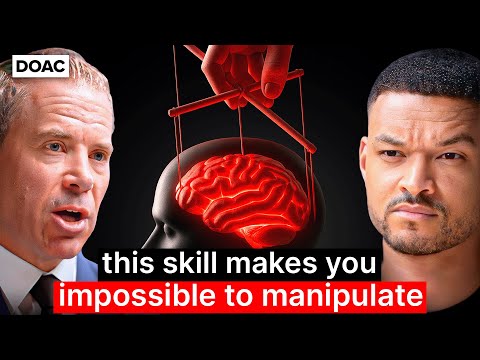
Secret Service Agent: How To Stay In Control When Someone Is Trying To Manipulate You!
Steven Bartlett (host), Desmond O’Neill (guest), Steven Bartlett (host)
In this episode of The Diary of a CEO, featuring Steven Bartlett and Desmond O’Neill, Secret Service Agent: How To Stay In Control When Someone Is Trying To Manipulate You! explores ex–Secret Service Agent Reveals Framework For Tough, Truthful Conversations Former Secret Service agent and interrogation trainer Desmond O’Neill explains how science-backed interviewing techniques translate into everyday communication, especially for emotionally charged ‘dark conversations’.
Ex–Secret Service Agent Reveals Framework For Tough, Truthful Conversations
Former Secret Service agent and interrogation trainer Desmond O’Neill explains how science-backed interviewing techniques translate into everyday communication, especially for emotionally charged ‘dark conversations’.
He introduces the PLAN framework—Purpose, Listen, Ask, Next steps—to stay grounded with difficult people, resist gaslighting and insults, and keep your cool when emotions spike.
O’Neill distinguishes manipulation from genuine influence, shows how to read and use body language without over-interpreting it, and unpacks how trust is built, lost, and rebuilt in relationships and leadership.
Throughout, he emphasizes owning your decisions under uncertainty, dropping labels like “narcissist,” and overcoming “me, me, me” syndrome by focusing more on others’ perspectives than your own.
Key Takeaways
Go into every hard conversation with a clear PURPOSE or you’ll get dragged into emotional chaos.
Before you start, define why you’re there and what success looks like (e. ...
Get the full analysis with uListen AI
Drop labels like “narcissist” and “gaslighter” or you shut down real understanding.
O’Neill challenges Steven’s instinct to call someone a narcissist or gaslighter, pointing out that it mainly makes blame easier and curiosity harder. ...
Get the full analysis with uListen AI
Listening—not talking—is how you actually control high-stakes conversations.
Because our brains process speech far faster than people talk, we have “extra bandwidth” that often gets filled with planning our reply instead of listening. ...
Get the full analysis with uListen AI
Use questions to deepen understanding and correct your low ‘empathy accuracy’.
Research shows we’re only about 20% accurate reading strangers’ internal states, ~30% for friends, and no more than 40% for partners—and this can drop to ~15% when emotions run hot. ...
Get the full analysis with uListen AI
Treat body language as a cue for curiosity, not a lie detector.
O’Neill rejects the idea that specific gestures automatically prove deception. ...
Get the full analysis with uListen AI
When insulted or provoked, name the behavior and stay emotionally composed.
If someone calls you an “asshole” or gets aggressive, go back to purpose instead of retaliating. ...
Get the full analysis with uListen AI
Influence is mutual and honest; manipulation is self-serving and often relies on lies.
O’Neill defines influence as nudging someone in a direction that benefits both of you, grounded in transparency and truth. ...
Get the full analysis with uListen AI
Notable Quotes
“If you lose your cool, you lose control.”
— Desmond O’Neill
“Controlling conversation comes from listening, not talking.”
— Desmond O’Neill
“Stop trying to be right, stop telling people you understand, and stop giving people your unsolicited opinion.”
— Desmond O’Neill
“There is a difference between having a profession and being a professional.”
— Desmond O’Neill
“Influence is nudging a person in a certain direction that’s beneficial for both you and them. Manipulation is when it’s just good for you.”
— Desmond O’Neill
Questions Answered in This Episode
In the Garrido case, you were confident enough to tell the prosecutor you’d ‘bet your career’ he wasn’t the offender—what specific inconsistencies or missing elements would have had to show up in his story for you to reach the opposite conclusion?
Former Secret Service agent and interrogation trainer Desmond O’Neill explains how science-backed interviewing techniques translate into everyday communication, especially for emotionally charged ‘dark conversations’.
Get the full analysis with uListen AI
You cautioned against loosely using the term ‘gaslighting’; could you walk through a real-life example where someone thought they were being gaslit but, on closer analysis, it was actually a different dynamic?
He introduces the PLAN framework—Purpose, Listen, Ask, Next steps—to stay grounded with difficult people, resist gaslighting and insults, and keep your cool when emotions spike.
Get the full analysis with uListen AI
When you advise calling out insults directly (“You just called me X; why?”), how would you adapt that strategy if the power dynamic is heavily imbalanced—for example, with a volatile boss who controls your job security?
O’Neill distinguishes manipulation from genuine influence, shows how to read and use body language without over-interpreting it, and unpacks how trust is built, lost, and rebuilt in relationships and leadership.
Get the full analysis with uListen AI
You choose not to use legal but deceptive tactics in interrogations; how would you respond to critics who argue that in cases of severe public danger (terrorism, serial offenders), foregoing manipulation could cost innocent lives?
Throughout, he emphasizes owning your decisions under uncertainty, dropping labels like “narcissist,” and overcoming “me, me, me” syndrome by focusing more on others’ perspectives than your own.
Get the full analysis with uListen AI
You advocate not telling people ‘I understand’ because we can’t fully know their inner experience—how should therapists, coaches, or leaders balance that caution with the need for people to feel deeply validated and empathized with?
Get the full analysis with uListen AI
Transcript Preview
I've got a difficult conversation I wanna have with someone.
Yeah.
And they might be a narcissist.
So let's stop there, because if you just blatantly label somebody as being a narcissist, you're not going to be able to really understand who this person is and, and why they are the way they are. But when you need to go into a dark conversation, to make things simple, there are four things that you can do, because we all have those conversations. We have a supervisor who we feel is overlooking us in a promotion. Maybe our spouse, we got in a fight with. Your friend who's betrayed us. Now, they're cloaked in so much emotion or so much tension that you don't know how to handle that. But there's also three things that you should stop doing, such as stop telling people you understand.
Telling them you understand?
Yep, yep.
Why?
This is where we're gonna talk about it.
For over 30 years, former Secret Service agent Desmond O'Neill has used science-backed interrogation techniques against some of the world's biggest liars. He's trained elite teams from the FBI to the CIA. And now, in his first public conversation, he's laying out the frameworks you need to communicate effectively, how to lead-
And how to get anyone to open up. When it comes to being able to communicate with somebody, the victory lies in the little things that you do. So you need to have a plan. P is for purpose. So why are you there? What is the goal of the conversation? Because especially in emotional conversations, it becomes really easy to get distracted. And if you lose your cool, you lose control. And then there's the A, which is ask, because most of us think we know what our partner's thinking, right? But the research shows we're only accurate about 40% of the time. And if that conversation gets emotional, that 40% can go down as low as 15. It's called empathy accuracy. And so the power of asking questions is important, but when you fail to do that, you are gonna have a really hard time having a deep, honest relationship with somebody. And then there's the L, in the end, which most people do wrong, and we'll go into that.
And then what about body language? Can you tell if I'm being deceptive by how much I look at someone?
So there's a few indicators of somebody telling the truth, and we'll talk about them.
And what about leadership principles?
So I learned the true essence of leadership when I was on a SWAT team, from situations like when you're hunting someone and they're hunting you as well. So let's get into the details.
I see messages all the time in the comments section that some of you didn't realize you didn't subscribe, so if you could do me a favor and double-check if you're a subscriber to this channel, that would be tremendously appreciated. It's the simple, it's the free thing that anybody that watches this show frequently can do to help us here to keep everything going in this show and the trajectory it's on. So please do double-check if you've subscribed, and, uh, thank you so much, because in a strange way, you are- you're part of our history, and you're on this journey with us, and I appreciate you for that. So yeah, thank you. (instrumental music plays) Desmond O'Neill, for those people that have just clicked onto this conversation, what are they gonna walk away from our discussion with?
Install uListen to search the full transcript and get AI-powered insights
Get Full TranscriptGet more from every podcast
AI summaries, searchable transcripts, and fact-checking. Free forever.
Add to Chrome