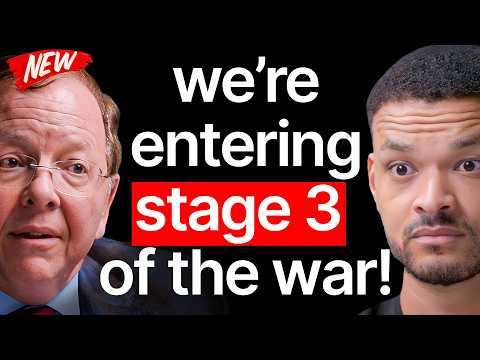
The Iran War Expert: I Simulated The Iran War for 20 Years. Here’s What Happens Next
Steven Bartlett (host), Robert Pape (guest), Steven Bartlett (host), Robert Pape (guest)
In this episode of The Diary of a CEO, featuring Steven Bartlett and Robert Pape, The Iran War Expert: I Simulated The Iran War for 20 Years. Here’s What Happens Next explores iran strike risks escalation trap: dispersed uranium, wider war, China benefits Robert Pape says precision strikes can destroy facilities but often fail strategically because “bombs change politics,” hardening adversaries and altering incentives in ways that drive escalation.
Iran strike risks escalation trap: dispersed uranium, wider war, China benefits
Robert Pape says precision strikes can destroy facilities but often fail strategically because “bombs change politics,” hardening adversaries and altering incentives in ways that drive escalation.
He claims the core problem after bombing Iranian nuclear sites is uncertainty: enriched uranium (enough, he says, for ~16 bombs) may have been moved and dispersed, creating pressure for regime-change logic and possibly a limited U.S. ground deployment to search for material.
Pape outlines a three-stage conflict pathway: (1) airstrikes and immediate retaliation (largely against Israel), (2) “horizontal escalation” using drones/missiles to hit coalition partners’ economic nodes (UAE/Saudi, shipping, tourism), and (3) expansion toward homeland risk and protracted war dynamics if U.S. boots go in.
He warns prolonged Middle East conflict would sap U.S. resources and attention, advantage China and Russia, and compound domestic U.S. instability—while recommending Trump “take the deal” to remove enriched uranium rather than deepen escalation.
Key Takeaways
Tactical bombing success can produce strategic failure.
Pape argues modern precision strikes reliably destroy buildings, but the decisive effects are political: adversaries adapt, publics react, and leaders face incentives to escalate to “fix” unresolved objectives.
Get the full analysis with uListen AI
The unresolved objective is the uranium, not the facilities.
He contends the key risk is not whether Fordow/Natanz structures were cratered, but that enriched uranium may have been moved beforehand—leaving the bomb-making material intact and harder to locate over time.
Get the full analysis with uListen AI
Leader removal may harden the regime instead of collapsing it.
Pape describes Iran as a resilient “matrix,” not a brittle Jenga tower; decapitation can elevate more extreme successors and empower security organs (e. ...
Get the full analysis with uListen AI
Escalation may pause, then resume with a ratchet effect.
He warns that months-long lulls can be misread as “it’s over,” but the underlying driver—uncertainty about nuclear material and political pressure not to “lose”—can restart escalation later, as seen in other conflicts.
Get the full analysis with uListen AI
Stage two pressure targets coalition partners’ economies and politics.
“Horizontal escalation” aims to fracture regional support by striking airports, hotels, and infrastructure, raising domestic/public pressure on Gulf leaders to distance themselves from the U. ...
Get the full analysis with uListen AI
A limited ground deployment is the likely gateway to stage three.
Pape assigns ~75% odds to U. ...
Get the full analysis with uListen AI
Prolonged Middle East war helps U.S. rivals and harms U.S. readiness.
He claims China benefits if the U. ...
Get the full analysis with uListen AI
Notable Quotes
“Bombs don't just hit targets, they change politics.”
— Robert Pape
“We don't know where that nuclear material is… they have the material for sixteen nuclear bombs.”
— Robert Pape
“We're stuck in a trap of our own making… we are losing control of the situation.”
— Robert Pape
“The Supreme Leader that we took out was against nuclear weapons. The new Supreme Leader… he's way more aggressive.”
— Robert Pape
“Take the deal… get as much of the 60% enriched uranium out of the country as possible.”
— Robert Pape
Questions Answered in This Episode
What specific evidence supports the claim that Iran dispersed enriched uranium before the strikes, and what are the key intelligence gaps that remain?
Robert Pape says precision strikes can destroy facilities but often fail strategically because “bombs change politics,” hardening adversaries and altering incentives in ways that drive escalation.
Get the full analysis with uListen AI
In your three-stage model, what observable indicators would confirm the transition from stage two (horizontal escalation) to stage three (homeland/global retaliation)?
He claims the core problem after bombing Iranian nuclear sites is uncertainty: enriched uranium (enough, he says, for ~16 bombs) may have been moved and dispersed, creating pressure for regime-change logic and possibly a limited U. ...
Get the full analysis with uListen AI
How would a “limited” U.S. ground mission around nuclear sites avoid mission creep—what would be the operational end-state and timeline?
Pape outlines a three-stage conflict pathway: (1) airstrikes and immediate retaliation (largely against Israel), (2) “horizontal escalation” using drones/missiles to hit coalition partners’ economic nodes (UAE/Saudi, shipping, tourism), and (3) expansion toward homeland risk and protracted war dynamics if U. ...
Get the full analysis with uListen AI
You argue decapitation can backfire; under what conditions has leader targeting succeeded historically, and why would Iran be different?
He warns prolonged Middle East conflict would sap U. ...
Get the full analysis with uListen AI
If the best off-ramp is a deal, what verification and removal mechanisms would be realistic now that trust and leadership guardrails have changed?
Get the full analysis with uListen AI
Transcript Preview
You've been running simulations on a war with Iran
Yep, every strategy for twenty years, and it's playing out right now, so I can tell you that we are losing control of the situation. Like, we don't know where that nuclear material is, but they have the material for sixteen nuclear bombs, and we've given them every incentive to develop them.
Professor Robert Pape might be the single most important credible person we all need to listen to right now.
The Supreme Leader that we took out was against nuclear weapons. The new Supreme Leader, and he's way more aggressive.
He's advised two decades of presidents in the White House.
President Trump is really stuck, but he thrives in chaos.
And spent thirty years building the curriculum that trains the Air Force for the exact type of war that's taking place now in Iran. And one of the most mind-blowing things I've learned is that there are three stages to this conflict. Unfortunately, Professor Robert Pape, who has two decades of being correct with his predictions, gives a seventy-five percent chance that Trump is about to escalate to stage three. In this episode, we're gonna explain exactly what this means. Guys, I've got a quick favor to ask you. We're approaching a significant subscriber milestone on this show, and roughly sixty-nine percent of you that listen and love this show haven't yet subscribed for whatever reason. If there was ever a time for you to do us a favor, if we've ever done anything for you, given you value in any way, it is simply hitting that subscribe button. And it means so much to myself but also to my team because when we hit these milestones, we go away as a team and celebrate. And it's the thing, the simple free, easy thing you can do to help make this show a little bit better every single week. So that's a favor I would ask you. And, um, if you do hit the subscribe button, I won't let you down, and we'll continue to find small ways to make this whole production better. Thank you so much for being part of this journey. It means the world, and, uh, yeah, let's do this. [upbeat music] Professor Robert Pape, what the hell is going on in the world? Now, I should ask, I should ask first, who are you and what have you spent the last several decades of your life studying and doing, and how does that relate to what's happening in the world right now?
We are going through a crisis, uh, more in-- very intense right now, but it's a crisis that we have been through before, um, twenty years ago with the Iraq War. Uh, even before that, um, we saw the bombing of Gaddafi. We saw the reactions there. Now, I have been studying military strategy, air power, international terrorism, now terrorism inside the United States and also political violence in the United States that's not related to particular groups. So I've been studying political violence for forty years.
Install uListen to search the full transcript and get AI-powered insights
Get Full TranscriptGet more from every podcast
AI summaries, searchable transcripts, and fact-checking. Free forever.
Add to Chrome