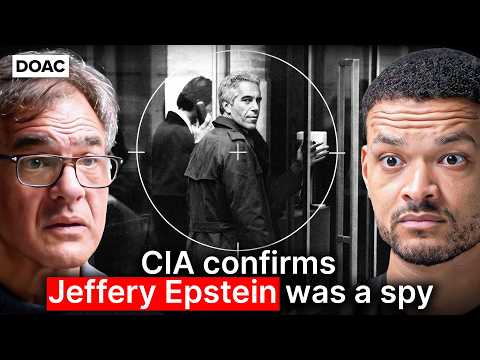
CIA Whistleblower: They Can See All Your Messages! I Was Under Surveillance In Pakistan!
John Kiriakou (guest), Steven Bartlett (host)
In this episode of The Diary of a CEO, featuring John Kiriakou and Steven Bartlett, CIA Whistleblower: They Can See All Your Messages! I Was Under Surveillance In Pakistan! explores cIA whistleblower warns on surveillance, ethics, espionage, and modern geopolitics John Kiriakou recounts his 15-year CIA career—starting as an Iraq analyst briefing senior U.S. leaders and later running counterterrorism operations in Pakistan—then explains why he publicly exposed the CIA’s torture program and went to prison.
CIA whistleblower warns on surveillance, ethics, espionage, and modern geopolitics
John Kiriakou recounts his 15-year CIA career—starting as an Iraq analyst briefing senior U.S. leaders and later running counterterrorism operations in Pakistan—then explains why he publicly exposed the CIA’s torture program and went to prison.
He details how spies are recruited (spot-assess-develop-recruit), what motivates assets (mostly money, plus ideology/family/revenge/excitement), and how tradecraft often relies on exploiting “vulnerabilities” and sustained relationships rather than coercion.
Kiriakou argues modern digital life is broadly surveillable: metadata can be purchased, devices can be compromised (citing WikiLeaks “Vault 7”), and citizens are over-criminalized enough to be easily targeted if authorities decide to pursue them.
The conversation expands to sleeper agents, the scale of espionage in the U.S., historic CIA abuses (MKUltra), alleged Israeli intelligence boldness, Epstein-as-spy speculation, and Kiriakou’s view that China is the primary long-term adversary while U.S. military spending risks national insolvency.
Key Takeaways
Spy recruitment is a relationship process, not a movie moment.
Kiriakou frames core tradecraft as “spot, assess, develop, recruit,” often requiring weeks of subtle contact and trust-building before any explicit pitch—illustrated by his coffee-shop approach to an al-Qaeda-linked target.
Get the full analysis with uListen AI
Most human betrayal, in espionage, is driven by money—but motives cluster behind it.
He claims internal CIA studies found ~95% of recruits act for money, with the remainder driven by love/family, ideology, revenge, or excitement; the discussion notes money is frequently a proxy for family security or status.
Get the full analysis with uListen AI
CIA culture rewards comfort with ethical gray zones—and that can damage personal lives.
Kiriakou says the agency selects for “sociopathic tendencies” (not sociopathy) that enable rule-bending, deception, and high-risk acts; he links “trained lying” to an extremely high divorce rate among officers.
Get the full analysis with uListen AI
Digital privacy is structurally weak because data is commoditized.
Beyond hacking, he emphasizes that law enforcement can “buy” metadata rather than obtain warrants, and that people’s online exhaust makes them broadly vulnerable to targeting or leverage.
Get the full analysis with uListen AI
Offensive cyber capabilities include covert attribution and device weaponization.
Citing WikiLeaks “Vault 7,” he alleges capabilities such as planting foreign-language “clues” to frame other actors, turning smart TVs into microphones, and remotely interfering with car systems—while noting many countries possess similar toolsets.
Get the full analysis with uListen AI
Whistleblowers can be pressured through overcharging and financial attrition.
He describes being charged with multiple felonies including espionage, accruing massive legal costs, and then facing a plea bargain after the most severe charges were dropped—an approach he portrays as ‘make him defend himself.’
Get the full analysis with uListen AI
Intelligence abuses fuel public cynicism—and some ‘wild’ claims have historical precedent.
He points to MKUltra-era experiments (LSD dosing, ‘Midnight Climax,’ disease/virus release claims) and argues the term “conspiracy theory” was used to discredit scrutiny, making it harder for the public to separate real misconduct from fantasy.
Get the full analysis with uListen AI
Notable Quotes
““I blew the whistle… and I would do it again tomorrow. I would let them send me to prison again because it was the right thing to do.””
— John Kiriakou
““Nothing is secret. Nothing! … All they have to do is just buy your metadata.””
— John Kiriakou
““Don’t ever put anything in a text message.””
— John Kiriakou (quoting Eliot Spitzer)
““At the CIA… they told us not to ever say or do anything that we would be ashamed to see on the front page of The Washington Post.””
— John Kiriakou
““The Israelis have no rules. They’ll kill anybody… It was totally illegal. But it was genius.””
— John Kiriakou
Questions Answered in This Episode
On torture: What specific evidence convinced you internally that ‘torture worked’ was false, and what did leadership cite to claim the opposite?
John Kiriakou recounts his 15-year CIA career—starting as an Iraq analyst briefing senior U. ...
Get the full analysis with uListen AI
On your prosecution: What do you believe the government most wanted to deter—future leaks, internal dissent, or public legitimacy challenges?
He details how spies are recruited (spot-assess-develop-recruit), what motivates assets (mostly money, plus ideology/family/revenge/excitement), and how tradecraft often relies on exploiting “vulnerabilities” and sustained relationships rather than coercion.
Get the full analysis with uListen AI
On surveillance: You say agencies can ‘buy metadata’ without warrants—what are the concrete legal pathways and common vendors involved (as you understand them)?
Kiriakou argues modern digital life is broadly surveillable: metadata can be purchased, devices can be compromised (citing WikiLeaks “Vault 7”), and citizens are over-criminalized enough to be easily targeted if authorities decide to pursue them.
Get the full analysis with uListen AI
On Vault 7 claims: Which of the smart-TV/car-control capabilities do you view as most credible versus most speculative, and why?
The conversation expands to sleeper agents, the scale of espionage in the U. ...
Get the full analysis with uListen AI
On recruitment ethics: Where is your personal line between ‘building trust’ and ‘manipulation,’ especially when leveraging someone’s loneliness, family, or identity?
Get the full analysis with uListen AI
Transcript Preview
Billions of dollars are spent spying on Americans, whether it's NSA or CIA or the FBI. And to make matters worse, we know that the CIA can take control remotely of a car's computer system in order to crash the car, take it off a bridge, or take control of your smart TV and turn the speaker into a microphone, even though the TV is off, and broadcast back to the CIA.
Can they do that with devices?
Absolutely, and I'll tell you how we know. There was a CIA software engineer who was disgruntled, and he downloaded tens of thousands of documents classified above top secret. And instead of going to the Russians or the Chinese, he went to WikiLeaks, and they became the Vault 7 documents. So our whole lives are out there, potentially, for someone to use against us, and every country has these capabilities. Listen, I spent fifteen years in the CIA. I love this country, but one of the most important things in my life is the issue of ethics, which is why I blew the whistle on the CIA's torture program because my superiors kept repeating that torture worked. But besides being illegal, immoral, unethical, it just wasn't true, and I would let them send me to prison again because it was the right thing to do. I mean, we know that they were experimenting on American citizens and spreading diseases in American cities.
This is the stuff of movies.
It is.
And because you've been in this world that the average person really has no idea about, I have to ask you, who do you think is the real adversary of the West? What are you most concerned about in the world at the moment? And what about everything that's going on with Trump and Venezuela and Greenland? And then do you think Jeffrey Epstein was a spy?
Yes.
Who do you think he was working for?
The Israelis.
Why? [upbeat music] Listen, my, my team gave me a script that they asked me to read, but I'm just gonna ask you, um, in the nicest way I possibly can. Thank you, first and foremost, for choosing to subscribe to this channel. It is, um... It's been one of the most incredible, crazy years of my life. I never could have imagined. I had so many dreams in my life, but this was not one of them. And the very fact that these conversations have resonated with you and you've given me so much feedback is something I will always be appreciative of, and I almost carry a weight, a sort of burden of, uh, responsibility to pay you back. And the favor I would like to ask from you today is to subscribe to the channel, if you, um, would be so obliged. It's completely free to do that. Roughly about forty-seven percent of you that listen to this channel frequently currently don't subscribe to this channel. So if you're one of those people, please come and join us. Hit the subscribe button. It's the single free thing you can do to make this channel better, and every subscriber sort of pays into this show and allows us to do things bigger and better and to push ourselves even more. And I will not let you down if you hit the subscribe button, I promise you. And if I do, please do unsubscribe, but I promise I won't. Thank you. [upbeat music] John Kiriakou, the world knows your name. Why [laughing] Why does the world know your name?
Install uListen to search the full transcript and get AI-powered insights
Get Full TranscriptGet more from every podcast
AI summaries, searchable transcripts, and fact-checking. Free forever.
Add to Chrome