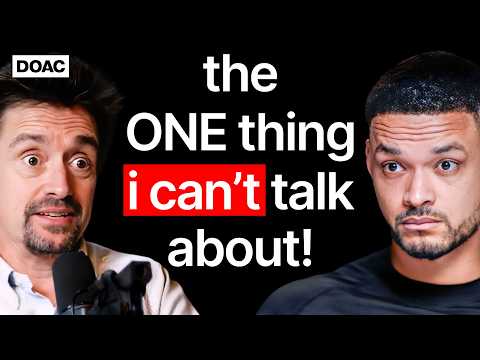
Richard Hammond: The Untold Story Of My 320mph Crash & My 1 Minute Memory! | E221
Richard Hammond (guest), Steven Bartlett (host), Narrator
In this episode of The Diary of a CEO, featuring Richard Hammond and Steven Bartlett, Richard Hammond: The Untold Story Of My 320mph Crash & My 1 Minute Memory! | E221 explores richard Hammond Confronts Fame, Mortality, Brain Damage And Second Chances Richard Hammond reflects on his unlikely journey from insecure, diminutive kid in Birmingham to global fame on Top Gear and The Grand Tour, and how much of it he still attributes to luck. He dissects the insecurity and overcompensation that drove him into broadcasting, and the psychological cost of seeking validation through work, risk and fame.
Richard Hammond Confronts Fame, Mortality, Brain Damage And Second Chances
Richard Hammond reflects on his unlikely journey from insecure, diminutive kid in Birmingham to global fame on Top Gear and The Grand Tour, and how much of it he still attributes to luck. He dissects the insecurity and overcompensation that drove him into broadcasting, and the psychological cost of seeking validation through work, risk and fame.
The conversation dives deeply into his 320mph jet‑car crash: the moment he thought he was going to die, the induced coma, his 'morphine dream' under a crooked tree, and the long, messy recovery from frontal‑lobe brain injury, including memory loss, depression, anger and personality changes.
Hammond talks candidly about guilt around success, being an absent father and husband, addiction to work, and his fear of investigating potential long‑term brain damage, despite knowing he should. Along the way he explores broader themes: the analog vs digital world, the symbolic power of cars, masculinity, emotional openness, and what a 'good life' might mean for his daughters.
Ultimately, he argues that while luck and mortality define the edges of our lives, what matters is being present, taking the chances you can while you can, and staying connected and honest with the people who matter most.
Key Takeaways
Insecurity can be an enormous career engine—but it makes success harder to handle.
Hammond describes classic 'short man' overcompensation: being louder, funnier, disruptive to be 'a bigger noise in the room'. ...
Get the full analysis with uListen AI
Authentic passion and subject expertise are what make entertainment truly compelling.
Top Gear’s success, in Hammond’s view, rested on the trio’s genuine obsession with cars and a commitment to treat the subject seriously even when the show was ridiculous. ...
Get the full analysis with uListen AI
Near‑death experiences can feel oddly calm and matter‑of‑fact, not cinematic.
In the jet‑car crash, Hammond recalls no terror—only the clear thought, 'Oh, it's now. ...
Get the full analysis with uListen AI
Brain injuries can distort emotions and memory in ways that feel real but aren’t 'you'.
After his frontal‑lobe injury, Hammond had a one‑minute memory, profound confusion, depression, paranoia and unpredictable emotional surges—like overwhelming 'love' triggered by simply walking past his old Land Rover. ...
Get the full analysis with uListen AI
Avoiding difficult medical checks is common—but dangerous—and rooted in fear for others as much as self.
Hammond admits he’s afraid to get an MRI or full cognitive check despite worrying about his memory, because he dreads having to tell his family, 'This is what's coming. ...
Get the full analysis with uListen AI
Workaholism delivers validation but taxes relationships—and money can’t substitute for presence.
He’s proud to have provided a good life and rooted home for his daughters, yet openly regrets not 'just being there' more instead of constantly filming in jungles and on glaciers. ...
Get the full analysis with uListen AI
When you can take a risk now that you may not be able to take later, seriously consider taking it.
Hammond’s old boss, Tim Jackson, encouraged him to leave a secure corporate job at Renault for uncertain TV work—twice—saying he had to 'follow it while you can. ...
Get the full analysis with uListen AI
Notable Quotes
“It was answering a question that I'd always wondered: when am I gonna die? And it was like, 'Oh, it's now.'”
— Richard Hammond
“Only the man or woman who are so desperate for it will have hung on long enough to achieve it—and they’re the least able to deal with it when it arrives.”
— Richard Hammond
“If somebody is in that confused state and they’re happy, they’re happy. Then all you've got to do is cope to support them in that happiness.”
— Richard Hammond
“I want to prove I'm not a lucky idiot.”
— Richard Hammond
“You are only in your world for as long as you're in it. And that's eternity as far as you're concerned.”
— Richard Hammond
Questions Answered in This Episode
You’ve described Top Gear’s success as largely 'luck'—are there any specific decisions or moments where, looking back, you now think, 'No, that really was skill and judgment, not luck'?
Richard Hammond reflects on his unlikely journey from insecure, diminutive kid in Birmingham to global fame on Top Gear and The Grand Tour, and how much of it he still attributes to luck. ...
Get the full analysis with uListen AI
When you say the best bits of Top Gear were unscripted, can you recall a particular scene or joke that completely changed the course of an episode or special in the moment?
The conversation dives deeply into his 320mph jet‑car crash: the moment he thought he was going to die, the induced coma, his 'morphine dream' under a crooked tree, and the long, messy recovery from frontal‑lobe brain injury, including memory loss, depression, anger and personality changes.
Get the full analysis with uListen AI
Having felt that eerie calm of 'Oh, it’s now' in your crash, how has that changed your response to everyday fears—like flying, medical procedures, or even public speaking?
Hammond talks candidly about guilt around success, being an absent father and husband, addiction to work, and his fear of investigating potential long‑term brain damage, despite knowing he should. ...
Get the full analysis with uListen AI
You admitted you’ve been too scared to get an MRI or cognitive assessment—what, concretely, would you need (from doctors, family, or yourself) to actually book and attend that appointment?
Ultimately, he argues that while luck and mortality define the edges of our lives, what matters is being present, taking the chances you can while you can, and staying connected and honest with the people who matter most.
Get the full analysis with uListen AI
If one of your daughters became as work‑obsessed and validation‑driven as you were in your 30s, what, if anything, would you actively try to do differently as her father compared to how you lived your own career?
Get the full analysis with uListen AI
Transcript Preview
It was answering a question that I'd always wondered: when am I gonna die? (tires screeching) Oh, crap! It was like, "Oh, it's now."
(dramatic music) Would you please welcome Richard Hammond! BBC Top Gear presenter.
Grand Tour presenter.
One of the biggest TV shows in history. And it's fair to say that he- Has the best job- In the world.
(laughs) Be funny, quicker, angrier. Every compensatory measure that anybody who's diminutive in height has ever made, I've done. It's one of the reasons I'm a broadcaster now, for sure.
There's a cost to that, though?
Yeah.
What's the cost?
(sighs) .
Was there a moment in the journey of Top Gear where you thought to yourself, "This is big"?
We went out in front of 60,000 people, and just before we went out, I said, "Lads, have three guys with less talent ever gone out in front of more people?" (laughs)
(laughs) Is there any guilt associated with your success?
Yeah, there is. I wanna prove I'm not a lucky idiot, so I took some risky decisions.
Have you ever pondered that you might-
Might have overdone it? (laughs)
Yeah.
(cars crashing) Oh, crap! Richard Hammond has been seriously injured in a car crash. They had called Mindy in. They said, "I think we're losing him." I had very bad post-traumatic amnesia. I've, like, a one-minute memory.
Wow.
I have to consciously write memories down and work hard to recall them.
Do you worry about that?
I do. The damage was done. Should probably have a look, find out...
Are you scared to find out?
Yeah.
I just wanna start this episode with a message of thanks. A thank you to everybody that tunes in to listen to this podcast. By doing so, you've enabled me to live out my dream, but also for many members of our team to live out their dreams too. It's one of the greatest privileges I could never have dreamed of or imagined in my life, to get to do this. To get to learn from these people, to get to have these conversations, to get to interrogate them from a very selfish perspective, trying to solve problems I have in my life. So, I feel like I owe you a huge thank you for being here and for listening to these episodes, and for making this platform what it is. Can I ask you a favor? I can't tell you how much, um, you can change the course of this podcast, the, the course of the guests we're able to invite to the show, and to the course of everything that we do here just by doing one simple thing. And that simple thing is hitting that subscribe button. Helps this channel more than I could ever explain. The guests on this platform are incredible because so many of you have hit that button. And I know when we think about what we wanna do together over the next year on this show, a lot of it is gonna be fueled by the amount of you that are subscribed and that tune into this show every week. So, thank you. Let's keep doing this. And I can't wait to see what this year brings for this show, for us as a community, and for this platform. (upbeat music) Richard, can we start by you giving me your, your context? Your earliest context?
Install uListen to search the full transcript and get AI-powered insights
Get Full TranscriptGet more from every podcast
AI summaries, searchable transcripts, and fact-checking. Free forever.
Add to Chrome