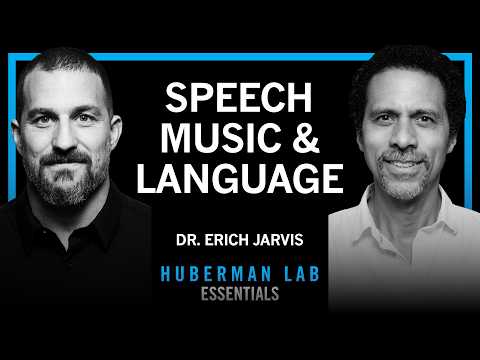
Essentials: The Neuroscience of Speech, Language & Music | Dr. Erich Jarvis
Andrew Huberman (host), Dr. Erich Jarvis (guest)
In this episode of Huberman Lab, featuring Andrew Huberman and Dr. Erich Jarvis, Essentials: The Neuroscience of Speech, Language & Music | Dr. Erich Jarvis explores how speech, birdsong, genes, and movement shape human communication Jarvis argues there is no separate “language module,” but rather specialized speech-production and auditory-perception pathways that together enable spoken language.
How speech, birdsong, genes, and movement shape human communication
Jarvis argues there is no separate “language module,” but rather specialized speech-production and auditory-perception pathways that together enable spoken language.
He explains speech likely evolved from adjacent motor/gesture circuitry, with vocal learning requiring forebrain control over brainstem vocal circuits beyond innate emotional sounds.
Comparisons to songbirds/parrots/hummingbirds show striking convergent evolution: similar circuit motifs, gene-expression programs (e.g., FOXP2-related effects), and shared learning features like critical periods and deafness-induced deterioration.
Critical periods reflect whole-brain developmental constraints and consolidation; early multilingual exposure preserves broader phoneme repertoires that can ease later language learning.
The episode connects communication to broader motor systems (face, hands, writing) and highlights stuttering’s links to basal ganglia circuitry, plus practical emphasis on movement/dance to support cognitive health.
Key Takeaways
Speech and language are better viewed as distributed pathways, not a single “language module.”
Jarvis emphasizes a speech-production pathway (motor control of larynx/jaw) and an auditory-perception pathway that each contain sophisticated computations, rather than a separate centralized language organ.
Get the full analysis with uListen
Vocal learning is rare; innate emotional sounds are common across vertebrates.
Many species produce inborn calls (crying, barking), but only a few lineages can imitate and learn new vocalizations—an ability central to human speech and to certain birds and other animals.
Get the full analysis with uListen
Speech circuitry likely evolved from general motor-control circuits adjacent to gesture systems.
Hand/gesture pathways sit next to speech areas, and humans gesture even when unseen; Jarvis argues vocal-learning circuitry emerged by adapting movement-control networks to control vocal apparatus.
Get the full analysis with uListen
Human speech shares deep parallels with songbird/parrot/hummingbird song via convergent evolution.
Despite ~300 million years of separation, vocal learners show similar circuit connectivity patterns and similar specialized gene-expression signatures in those circuits, aligning behavior, anatomy, and molecular biology.
Get the full analysis with uListen
Some “speech genes” may enable new connections by turning off repulsive guidance signals.
Jarvis describes finding axon-guidance/repulsion molecules reduced in speech circuits, which can permit novel cortical-to-motor-neuron connections needed for fine vocal control.
Get the full analysis with uListen
High-speed vocal control demands neuroprotection and plasticity-related molecular programs.
Because laryngeal control requires extremely fast firing and precise timing, speech circuits may upregulate calcium buffering, heat-shock/neuroprotective pathways, and plasticity genes to support intense activity and learning.
Get the full analysis with uListen
Critical periods are a whole-brain phenomenon; early multilingualism may help by preserving phoneme range.
Jarvis frames critical periods as balancing rapid learning with circuit stabilization and memory constraints; childhood exposure to multiple phoneme sets can make later languages easier by maintaining a broader sound repertoire.
Get the full analysis with uListen
Writing/reading recruits multiple translation steps across vision, speech motor plans, audition, and hand motor control.
He proposes reading involves visual input driving silent “inner speech,” then routing to auditory perception (“hearing” your inner voice), while writing requires hand circuitry to convert those representations into marks on a page.
Get the full analysis with uListen
Stuttering is strongly linked to basal ganglia disruption and sensorimotor integration strategies can help.
Bird studies showed stutter-like output during basal ganglia recovery; in humans, basal ganglia involvement is common, and therapies often work by improving timing and coupling between what you hear and what you produce.
Get the full analysis with uListen
Movement practice (e.g., dance) may support cognition by exercising adjacent motor–communication circuitry.
Jarvis argues consistent whole-body movement engages large-scale brain networks near speech systems, helping keep cognitive functions “fresh,” alongside practicing speaking/singing/oratory.
Get the full analysis with uListen
Notable Quotes
““I don't think there is any good evidence for a separate language module.””
— Dr. Erich Jarvis
““The brain pathways that control speech evolved out of the brain pathways that control body movement.””
— Dr. Erich Jarvis
““Hummingbirds hum with their wings and sing with their syrinx.””
— Dr. Erich Jarvis
““Cultural evolution remarkably tracks genetic evolution.””
— Dr. Erich Jarvis
““Texting actually has allowed for more rapid communication… It’s more like a use it or lose it kind of a thing with the brain.””
— Dr. Erich Jarvis
Questions Answered in This Episode
If there’s no distinct “language module,” what specific computations belong to the speech-production pathway vs. the auditory-perception pathway?
Jarvis argues there is no separate “language module,” but rather specialized speech-production and auditory-perception pathways that together enable spoken language.
Get the full analysis with uListen AI
Which circuit feature is most essential for vocal learning: the direct cortical-to-laryngeal/syrinx motor-neuron connection, basal ganglia loops, or something else?
He explains speech likely evolved from adjacent motor/gesture circuitry, with vocal learning requiring forebrain control over brainstem vocal circuits beyond innate emotional sounds.
Get the full analysis with uListen AI
You noted some axon-guidance genes are turned off in speech circuits—what are the best candidate molecules, and how might this be tested causally in animal models?
Comparisons to songbirds/parrots/hummingbirds show striking convergent evolution: similar circuit motifs, gene-expression programs (e. ...
Get the full analysis with uListen AI
What evidence most strongly supports (or challenges) the claim that Neanderthals had spoken language beyond shared gene sequences?
Critical periods reflect whole-brain developmental constraints and consolidation; early multilingual exposure preserves broader phoneme repertoires that can ease later language learning.
Get the full analysis with uListen AI
In birds, deafness degrades learned song but not innate calls—what does that imply about maintenance mechanisms for human speech and rehabilitation after hearing loss?
The episode connects communication to broader motor systems (face, hands, writing) and highlights stuttering’s links to basal ganglia circuitry, plus practical emphasis on movement/dance to support cognitive health.
Get the full analysis with uListen AI
Transcript Preview
Welcome to Huberman Lab Essentials, where we revisit past episodes for the most potent and actionable science-based tools for mental health, physical health, and performance. I'm Andrew Huberman, and I'm a professor of neurobiology and ophthalmology at Stanford School of Medicine. And now for my discussion with Dr. Erich Jarvis. Erich, so great to have you here.
Thank you.
Yeah. Very interested in learning from you about speech and language. In terms of the study of speech and language and thinking about how the brain organizes speech and language, uh, what are the similarities? What are the differences? How should we think about speech and language?
There really isn't such a sharp distinction. Now, let me tell you how some people think of it now, that there's a separate language module in the brain that has all the algorithms and computations that influence the speech pathway on how to produce sound and the auditory pathway on how to perceive and interpret it, uh, for speech or for, you know, s-sound that we call speech. I don't think there is any good evidence for a separate language module. Instead, there is a speech production pathway that's controlling our larynx, controlling our jaw muscles, that has built within it all the complex algorithms for spoken language, and there's the auditory pathway that has built within it all the complex algorithms for understanding speech, not separate from a language module. And this speech production pathway is specialized to humans and parrots and songbirds, whereas this auditory perception pathway is more ubiquitous amongst the animal kingdom, and this is why dogs can understand sit, [foreign language] , come here ball, boy, get the ball, and so forth. Dogs can understand several hundred human speech words. Great apes, you can teach them for several thousand, but they can't say a word.
What do we understand about modes of communication that are like language but might not be what would classically be called language?
Yes. Right. So next to the brain regions that are controlling spoken language are the brain regions for gesturing with the hands. And that hand parallel pathway has also complex algorithms that we can utilize. And some species are more advanced in these circuits, whether it's sound or gesturing with hands, and some are less advanced. Humans are the most advanced at spoken language, but not necessarily as big a difference at gestural language compared to some other species. So as you and I are talking here today, and people who are listening but can't see us, we're actually gesturing with our hands as we talk, uh, without knowing it. We're doing it unconsciously. And if we were talking on a telephone, I would have one hand here, and I would be gesturing with the other hand [laughing] without even you seeing me, right? And so why is that? Uh, some have argued, and I would agree with based upon what we've seen, is that there's an evolutionary relationship between the brain pathways that control speech production and gesturing. Uh, and, and the brain regions I mentioned are directly adjacent to each other. And why is that? I think that the brain pathways that control speech evolved out of the brain pathways that control body movement. All right? And, um, [clears throat] that, uh, when you talk about Italian, French, English, and so forth, um, each one of those languages come with a learned set of gestures that, uh, you can communicate with. Now, how is that related to other animals? Well, Coco, a gorilla who was raised with humans for thirty-nine years or more, uh, learned how to do gesture communication, learned how to sign language, so to speak, right? But Coco couldn't produce those sounds. Coco could understand them as well by si- by seeing somebody sign or hearing somebody produce speech, but Coco couldn't produce it with her voice. And so what's going on there is that a number of species, not all of them, a number of species have motor pathways in the brain where you can do learned gesturing, rudimentary language if you wanted, say, with your limbs, even if it's not as advanced as humans. But they don't have this extra brain pathway for the sound, so they can't gesture with their voice in the way that they gesture with their hands.
Install uListen to search the full transcript and get AI-powered insights
Get Full TranscriptGet more from every podcast
AI summaries, searchable transcripts, and fact-checking. Free forever.
Add to Chrome