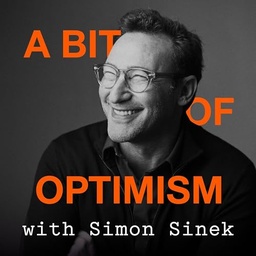
 Simon Sinek
The Real Goal of Storytelling (Hint: It’s Not Being Right) | A Bit of Optimism Podcast
Simon Sinek and Ken Burns on storytelling embraces complexity, shaping history without forcing certainty or binaries.
In this episode of Simon Sinek, featuring Simon Sinek and Ken Burns, The Real Goal of Storytelling (Hint: It’s Not Being Right) | A Bit of Optimism Podcast explores storytelling embraces complexity, shaping history without forcing certainty or binaries Ken Burns argues documentaries can’t be objective, only more or less subjective, so his approach is to start as a “blank slate” and remain willing to destabilize a good scene when new contradictory evidence appears.
At a glance
WHAT IT’S REALLY ABOUT
Storytelling embraces complexity, shaping history without forcing certainty or binaries
- Ken Burns argues documentaries can’t be objective, only more or less subjective, so his approach is to start as a “blank slate” and remain willing to destabilize a good scene when new contradictory evidence appears.
- Both speakers critique modern binary thinking—especially in politics and media—and emphasize that real life, relationships, and history are inherently contradictory and complex.
- Burns explains storytelling’s power as the only reliable way to shift minds, because arguments rarely change opinions while stories can hold tensions without prescribing conclusions.
- They use the American Revolution and Vietnam as examples of “infinite games,” showing how finite mindsets (winning, metrics, certainty) create quagmires against opponents focused on endurance and legitimacy.
- The conversation frames filmmaking as subtraction—distilling hundreds of hours into a coherent narrative—while preserving “the mystery” in what’s left out, which is where empathy and meaning live.
IDEAS WORTH REMEMBERING
7 ideasThere is no objective documentary—only degrees of subjectivity.
Burns notes that even cinema verité makes choices (where the camera points), so credibility comes from rigor, transparency, and a disciplined willingness to revise rather than claims of neutrality.
Good storytelling holds contradictions instead of resolving them.
Burns cites Shakespeare’s “negative capability” and Marsalis’s idea that “a thing and the opposite” can both be true; stories let audiences sit with tension rather than being “force-fed” conclusions.
Accuracy is often preserved through relentless humility about uncertainty.
Burns describes changing narration from definitive claims to “perhaps” when new scholarship complicates a fact, arguing that small corrections repeated “a million times” create broad trustworthiness.
Binary thinking is a simplification tool—but dangerous when it becomes identity.
Sinek and Burns agree simplification helps humans function, yet over-editing reality into black-and-white judgments (people, politics, history) destroys empathy and understanding.
Infinite games punish finite mindsets.
Using Vietnam and the Revolution, they show that opponents playing to endure (not “win”) can outlast metric-driven strategies; “we conquer by the drawn game” becomes a core strategic lesson.
American identity is aspirational and improvisational, but exceptionalism is a trap.
They explore America’s “pursuit” and “more perfect union” as striving ideals while warning that believing America is a priori right leads to moral and strategic failures.
Meaning often lives in what’s omitted—the ‘cuts’ between the shots.
Burns frames filmmaking as subtracting 500 hours into 12 while leaving space for mystery; Sinek extends this to relationships, where acknowledging unseen context creates empathy.
WORDS WORTH SAVING
6 quotes“There’s nothing objective, no matter what a documentary may claim. … What you have are degrees of subjectivity.”
— Ken Burns
“Sometimes a thing and the opposite of a thing are true at the same time.”
— Ken Burns (quoting Wynton Marsalis)
“The best arguments in the world won’t change anybody’s point of view. The only thing that can do it is a good story.”
— Ken Burns (quoting Richard Powers)
“It’s complicated.”
— Ken Burns (editing-room maxim)
“You don’t build a film, you subtract a film.”
— Ken Burns
“The opposite of faith is not doubt… The opposite of faith is certainty.”
— Ken Burns
QUESTIONS ANSWERED IN THIS EPISODE
5 questionsWhen you say you begin as a “blank slate,” what concrete steps in research and edit sessions prevent a hidden agenda from creeping in?
Ken Burns argues documentaries can’t be objective, only more or less subjective, so his approach is to start as a “blank slate” and remain willing to destabilize a good scene when new contradictory evidence appears.
How do you decide when contradictory information is important enough to “destabilize” a scene versus too marginal to include?
Both speakers critique modern binary thinking—especially in politics and media—and emphasize that real life, relationships, and history are inherently contradictory and complex.
What are examples from your Revolution series where the popular myth had to be preserved for coherence but reframed for complexity?
Burns explains storytelling’s power as the only reliable way to shift minds, because arguments rarely change opinions while stories can hold tensions without prescribing conclusions.
You warned that exceptionalism drives many American flaws—where do you see that most clearly in the Revolution-to-Vietnam arc?
They use the American Revolution and Vietnam as examples of “infinite games,” showing how finite mindsets (winning, metrics, certainty) create quagmires against opponents focused on endurance and legitimacy.
If “good stories” change minds more than arguments, what ethical guardrails should storytellers follow to avoid manipulation?
The conversation frames filmmaking as subtraction—distilling hundreds of hours into a coherent narrative—while preserving “the mystery” in what’s left out, which is where empathy and meaning live.
EVERY SPOKEN WORD
Install uListen for AI-powered chat & search across the full episode — Get Full Transcript
Get more out of YouTube videos.
High quality summaries for YouTube videos. Accurate transcripts to search & find moments. Powered by ChatGPT & Claude AI.
Add to Chrome