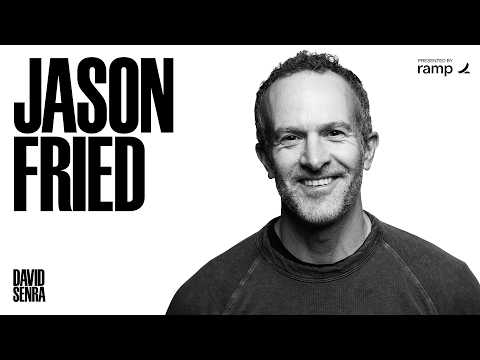
Jason Fried: Build for Yourself, Keep Costs Low and Stay Small
David Senra (host), Jason Fried (guest), David Senra (host)
In this episode of David Senra, featuring David Senra and Jason Fried, Jason Fried: Build for Yourself, Keep Costs Low and Stay Small explores jason Fried on building products, simplicity, and sustainable independence long-term Jason Fried argues the best products come from being your own customer: build what you personally want, then find “enough” people like you rather than chasing everyone. His core business principle is that your only real competition is your costs—keeping teams small, overhead low, and margins healthy creates freedom, longevity, and optionality.
Jason Fried on building products, simplicity, and sustainable independence long-term
Jason Fried argues the best products come from being your own customer: build what you personally want, then find “enough” people like you rather than chasing everyone. His core business principle is that your only real competition is your costs—keeping teams small, overhead low, and margins healthy creates freedom, longevity, and optionality.
He describes 37signals’ lean structure (tiny product teams, minimal management layers, no board/VC pressure) and a consistent effort to fight software bloat by periodically rethinking Basecamp’s assumptions and simplifying the experience. Fried rejects growth-for-growth, numerical optimization, and enterprise “whale hunting,” preferring stable, interchangeable small customers and a business that can be held in one’s head.
Across the conversation he emphasizes authenticity (direct writing, unedited demos, “no tricks” marketing), deep customer proximity (public email, doing support), and intuition-driven building inspired more by timeless physical design than competitor feature-parity. Success, for him, is pride in the work and the desire to keep doing it—sustained by profitability, margin-of-safety “blubber,” and many small reversible decisions over long horizons.
Key Takeaways
Build what you want; your market is people like you.
Fried’s origin story (tracking his music collection, selling for $20) reinforces a repeatable model: make something you genuinely need, then make it available—because you’re rarely unique in your desires.
Get the full analysis with uListen AI
Your only competition is your costs.
Competitors’ features and pricing are uncontrollable; costs are controllable. ...
Get the full analysis with uListen AI
Small teams reduce miscommunication and prevent overbuilding.
37signals often uses two-person feature teams (designer + programmer). ...
Get the full analysis with uListen AI
Management layers can be net-negative in product companies.
After experimenting with COO/management roles, 37signals found telephone-game translation, unnecessary work creation, and increased organizational “thickness. ...
Get the full analysis with uListen AI
Fight the natural downhill slide of software bloat.
Because software lacks physical constraints, it expands endlessly unless actively resisted. ...
Get the full analysis with uListen AI
“So what?” is a strategic filter against needless optimization.
Fried is uninterested in marginal revenue wins (pricing tests, constant A/B optimization) once the business is healthy. ...
Get the full analysis with uListen AI
Independence comes from profitability—and creates optionality.
Refusing outside funding avoids a single forced outcome (“build a huge business or fail”). ...
Get the full analysis with uListen AI
Notable Quotes
“Make stuff for yourself. There's probably other people out there like you who want what you want.”
— Jason Fried
“Your only competition is your costs.”
— Jason Fried
“I built the company I wanna work at.”
— Jason Fried
“I don’t optimize around numbers… I am interested in optimizing a product to make it better.”
— Jason Fried
“All a great life is just a string of great days.”
— Jason Fried
Questions Answered in This Episode
When you say “build for yourself,” how do you avoid overfitting to your own preferences when customers diverge from you?
Jason Fried argues the best products come from being your own customer: build what you personally want, then find “enough” people like you rather than chasing everyone. ...
Get the full analysis with uListen AI
You cap Basecamp at $299/month—what specific tradeoffs did you accept by refusing enterprise “whales,” and what did you gain in durability?
He describes 37signals’ lean structure (tiny product teams, minimal management layers, no board/VC pressure) and a consistent effort to fight software bloat by periodically rethinking Basecamp’s assumptions and simplifying the experience. ...
Get the full analysis with uListen AI
What are concrete examples where removing a management layer directly improved product decisions or speed at 37signals?
Across the conversation he emphasizes authenticity (direct writing, unedited demos, “no tricks” marketing), deep customer proximity (public email, doing support), and intuition-driven building inspired more by timeless physical design than competitor feature-parity. ...
Get the full analysis with uListen AI
In Basecamp rewrites, what are the most common “fundamental assumptions” you revisit—and how do you decide what to keep vs. kill?
Get the full analysis with uListen AI
How do you reconcile “intuition-led” decisions with the risk of blind spots—what signals tell you your intuition is wrong?
Get the full analysis with uListen AI
Transcript Preview
[upbeat music] I wanna start with what you told me last night, that you feel the best way to make a product, or the best way to make a product for you, is by you are the actual customer. You are making the products that you want to use.
Yeah, I don't know how to do it any other way. Like, I-- this is how I've always done it. So back when I was fifteen, sixteen, I started in software, making stuff, actually, something called FileMaker Pro, which is, like, way back when, where you can make these databases for yourself. And I, I made this database to keep track of my music collection because I was loaning out tapes and CDs to friends and never getting them back. So I'm like: I need a way to keep track of this stuff, because I keep losing these things. So I made this product, which I eventually called AudioFile, but I made it for myself. It was just this, this database, right? And I made a nice interface because I liked art, I liked making stuff, and so I made this thing, and, uh, I, I eventually just decided that, like, I'll put a little text file in this, in this archive of the software that said, "If you like this, send me twenty bucks." And I put it up on AOL, so this is, like, pre-internet, right? Put it up on AOL, and I got this envelope, actually, an airmail envelope, the one of those with, like, the red and blue check marks, like, old school, like, envelope from... And it's from Germany. And I open it up, and someone had printed out this, this piece of paper, uh, which was the thing I included with the software and gave me a twenty-dollar crisp US bill, right? And that was the moment I think it all clicked for me, which is, make stuff for yourself. There's probably other people out there like you who want what you want, and make it available to sell. So you are the customer, you are the audience. It's you, you, you, and then there'll be other people just like you. We're not all that unique. There's plenty of people who like what we like, plenty of people who don't, and there's plenty of products for them, too. But there's enough that like what you like, and so that's where I got started.
Yeah, you have this, uh, this interesting idea where if you're just making what you want, right, doesn't matter-- You just have to go and collect more people that like the things that you like and kind of ignore the people that don't.
Yes, and this is all tied into, like, keeping your costs low. So, you know, you-- if you have a lot of costs, high costs, big company, you have to find a lot of people like you. But if you keep your costs low, keep your company small, at the time, it was just me, you know, when I was doing the software thing, and I was making, like, I don't know, twenty grand a year, like, selling software as a solo person when I was, like, sixteen years old or something like that, or seventeen, then I went into college a little bit as well. And it's like, that's an amazing little small side business, a huge side business when you're that age, right? Because I had no expenses. And so, so it's easy. I only had to find, like, you know, a few thousand people to, to pay me that money, twenty bucks, right, to, to, to, to get that eventually. But if I had a big business and had a lot of people and a lot of overhead, I'd have to find a lot of people like me, and that's harder. So the whole game for me is to make things as simple as possible, as easy for me as possible. So keep your costs low, keep your company as small as you possibly can, and make great stuff, and then you don't have to find as many people just like you, but the ones you find who really love what you do. And that's like, that's enough. Like, that is enough. You can stop there, keep doing stuff, but you can kind of stop there conceptually and go, "I'm gonna make stuff for me, people like me. I don't need the whole world to like what I like. I need, like, enough of a small world to like what I like, and we're, we're golden."
Install uListen to search the full transcript and get AI-powered insights
Get Full TranscriptGet more from every podcast
AI summaries, searchable transcripts, and fact-checking. Free forever.
Add to Chrome