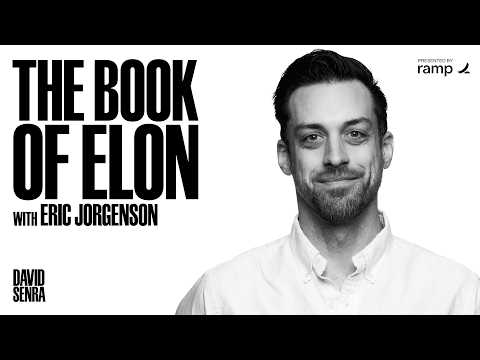
How Elon Thinks
David Senra (host), Eric Jorgenson (guest)
In this episode of David Senra, featuring David Senra and Eric Jorgenson, How Elon Thinks explores elon Musk’s operating system: mission, speed, first principles, execution Elon chooses problems based on usefulness and future impact rather than risk-adjusted returns, repeatedly “burning the boats” behind mission-critical bets.
Elon Musk’s operating system: mission, speed, first principles, execution
Elon chooses problems based on usefulness and future impact rather than risk-adjusted returns, repeatedly “burning the boats” behind mission-critical bets.
Exceptional engineering talent is treated as the true constraint, so hiring emphasizes proven problem-solving, high accountability, and rapid responsibility increases.
Musk’s “algorithm” (question requirements, delete/simplify, optimize, accelerate, automate) drives product design and org design by forcing fast learning through small failures.
Speed and time are framed as the ultimate competitive advantage—minimize meetings, attack bottlenecks immediately, avoid serialized dependencies, and align teams around one metric.
Vertical integration, cost obsession, and “reality/physics as judge” underpin SpaceX/Tesla’s ability to out-iterate incumbents and unlock frontier opportunities like Starlink.
Key Takeaways
Pick missions by importance, not “safe” returns.
Musk’s stated filter is solving necessary, high-impact problems that few others will attempt; the willingness to lose money is justified by the mission’s value.
Get the full analysis with uListen AI
Treat great engineers as the scarcest resource.
The conversation emphasizes that capital is often available, but truly excellent engineers are not; hiring focuses on detailed past problem-solving and then giving unusually high responsibility early.
Get the full analysis with uListen AI
Install a repeatable operating system: question, delete, then optimize.
Musk’s algorithm pushes teams to challenge requirements, remove parts/processes aggressively, and only then optimize, speed up, and automate—preventing “optimizing what shouldn’t exist.”
Get the full analysis with uListen AI
Engineer organizations to create many small failures quickly.
Deadlines designed to be missed ~50% of the time and “add back 10% of what you removed” are mechanisms to force learning, prevent fragility, and converge on elegant designs.
Get the full analysis with uListen AI
Speed is both defense and offense—make time the prime directive.
From meeting rules (“leave if you’re not adding value”) to physically relocating to bottlenecks, Musk treats time as the only non-renewable currency and uses urgency to compound advantage.
Get the full analysis with uListen AI
Align the whole company with one metric and one constraint.
Examples include autonomy miles without interventions or Neuralink electrodes per minute; this simplifies decisions, coordinates teams (vector-sum alignment), and keeps focus on the true limiter.
Get the full analysis with uListen AI
Vertical integration isn’t ideology; it’s a speed and cost strategy.
Relying on legacy supply chains inherits their cost/pace constraints; integrating key components enables faster iteration, lower costs, and fewer handoffs (especially vs. ...
Get the full analysis with uListen AI
Notable Quotes
“I do not start companies with the standpoint of what is the best risk-adjusted rate of return… I just find things that need to happen, and I try to make them happen.”
— Elon Musk (quoted)
“Physics is a law. Everything else is a recommendation.”
— Elon Musk (quoted)
“The best part is no part. The best process is no process.”
— Elon Musk (quoted)
“Speeding up something that shouldn't exist is absurd. If you're digging your grave, don't dig it faster. Stop digging.”
— Elon Musk (quoted)
“If we don't make stuff, there's no stuff.”
— Elon Musk (quoted)
Questions Answered in This Episode
Where does Musk’s “mission over money” philosophy produce blind spots or justify harmful tradeoffs, and how should founders guard against that?
Elon chooses problems based on usefulness and future impact rather than risk-adjusted returns, repeatedly “burning the boats” behind mission-critical bets.
Get the full analysis with uListen AI
In practice, how do you distinguish a “requirement that must exist” (safety/regulatory) from one that should be challenged or removed—what tests did SpaceX/Tesla use?
Exceptional engineering talent is treated as the true constraint, so hiring emphasizes proven problem-solving, high accountability, and rapid responsibility increases.
Get the full analysis with uListen AI
The algorithm starts with “question requirements.” What are common requirement sources inside normal companies (legal, legacy customers, internal politics), and how can leaders attach clear ownership to each?
Musk’s “algorithm” (question requirements, delete/simplify, optimize, accelerate, automate) drives product design and org design by forcing fast learning through small failures.
Get the full analysis with uListen AI
SpaceX’s “flash mob” problem-solving sounds powerful—but how do you prevent it from becoming chaos or burnout as headcount grows?
Speed and time are framed as the ultimate competitive advantage—minimize meetings, attack bottlenecks immediately, avoid serialized dependencies, and align teams around one metric.
Get the full analysis with uListen AI
What are concrete ways a small startup can apply ‘tip of the spear’ bottleneck focus without Elon-level authority or the ability to move people instantly?
Vertical integration, cost obsession, and “reality/physics as judge” underpin SpaceX/Tesla’s ability to out-iterate incumbents and unlock frontier opportunities like Starlink.
Get the full analysis with uListen AI
Transcript Preview
[whooshing] All right, so I have an advanced copy of your book, The Book of Elon: Elon Musk's Most Useful Ideas in His Own Words. You just said something that there's only four of these copies in the world. Who has them?
It's a, it's a pretty special list. It's like Naval Ravikant, MrBeast, Ivanka Trump, and you.
[laughing]
[laughing]
Okay, so the idea for this is you spent five years, thousands of hours studying Elon. He's been a hero, a personal hero of yours for a very long time. I just wanna, like, I r- obviously read and reread the book. I'm just gonna, like, run through a bunch of highlights and ideas, like, that I thought were interesting, and just kinda throw them to you, and you see, like, what, uh, like, what you find interesting about it-
Yeah
... or, like, add additional context. So something we were talking about when we were having coffee this morning is the importance of encouraging as many people as possible. Like, we have enough deal makers. We need people making products and building companies.
Yeah.
You don't need to be doing deals all day long, and that is, like, a main theme that Elon talks about all the time. And so he says this, right, uh, this quote in the book, which I loved, "I do not start companies with the standpoint of what is the best risk-adjusted rate of return or what I think could be successful. I just find things that need to happen, and I try to make them happen. I thought these things needed to get done. If the money was lost, okay, it was still worth trying." What is his mindset around what he chooses to spend his time and energy on?
He seems to attack problems that nobody else is working on that have a positive impact on the future. That's his philosophy and mindset going into everything he does, which is, I think, unique. A lot of people assume that he's money motivated, or a lot of people are money motivated, and you hear all ent- entrepreneurs all the time talk about, like, oh, like, "This is a great business model. This is a good place to go in. I'm gonna go start self-storage because, like, the failure rate is so low." And it is just not how he thinks in any way, shape, or form. He literally says, "Nobody else is crazy enough to try space, so that's the company I have to go build, 'cause nobody else is working on it, and I can."
He has a great line in here. He's like, "Don't start a company because you wanna be an entrepreneur or because you wanna make money. It is better to approach from this angle. What is a useful thing you could build that you wish existed in the world?"
Yeah. I think there's a paradox there of, like, the thing that you can do that nobody else is working on is actually more likely to be successful. Like, it forces you to try to do something unique that also ends up being more valuable for everybody else, because you're solving a problem, you're adding a capability to humanity. You're not just starting another commodity business of some sort.
Install uListen to search the full transcript and get AI-powered insights
Get Full TranscriptGet more from every podcast
AI summaries, searchable transcripts, and fact-checking. Free forever.
Add to Chrome