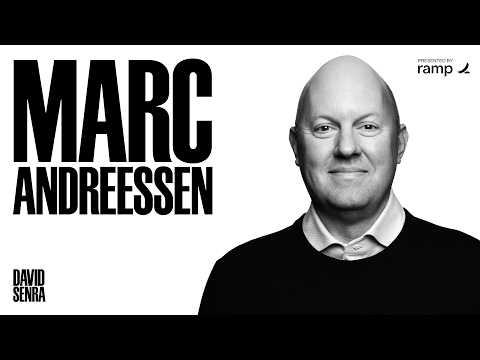
Marc Andreessen: The World Is More Malleable Than You Think
David Senra (host), Marc Andreessen (guest), David Senra (host), David Senra (host), David Senra (host), David Senra (host)
In this episode of David Senra, featuring David Senra and Marc Andreessen, Marc Andreessen: The World Is More Malleable Than You Think explores marc Andreessen on founders, venture scale, and Musk-style execution methods Andreessen argues that low introspection and forward motion are common traits among many high-performing founders, while excessive inward focus can stall action or redirect ambition.
Marc Andreessen on founders, venture scale, and Musk-style execution methods
Andreessen argues that low introspection and forward motion are common traits among many high-performing founders, while excessive inward focus can stall action or redirect ambition.
He frames technology and entrepreneurship as the primary engines of societal progress, especially in an era he views as institutionally stagnant and manager-led systems failing to adapt.
He explains a16z’s origin as a response to structural weaknesses in traditional VC partnerships, adopting a “platform” model inspired by talent agencies and other relationship businesses.
Using Netscape and early internet history, he describes how commercialization, usability, and recurring “moral panics” reliably shape adoption of new technologies.
He analyzes Elon Musk’s management approach as a rare synthesis of invention and operational rigor: direct access to engineering truth, bottleneck-hunting, and extreme cycle-time compression across multiple companies.
Key Takeaways
Many elite builders minimize introspection to preserve momentum.
Andreessen claims dwelling on the past correlates with getting stuck; he ties modern introspection culture to 20th-century psychological movements and contrasts it with historical “founder-led” norms.
Get the full analysis with uListen AI
Founder-led leadership is often better at navigating rapid change than managerialism.
Managers can optimize stable systems, but when technology resets assumptions, founders (or founder-trained leaders) are more likely to adapt and re-architect organizations.
Get the full analysis with uListen AI
a16z was designed as a scaled “firm” rather than a loose partnership of lone-wolf investors.
Andreessen describes legacy VC as internally fragmented and hard to coordinate; a16z borrowed from CAA’s “phalanx” approach so founders access a unified platform, not just one partner.
Get the full analysis with uListen AI
Industry structures tend to polarize into a “barbell.”
He argues the middle collapses across sectors (retail, banking, private equity, hedge funds): small agile operators on one end and scaled platforms on the other, with mid-tier generalists squeezed out.
Get the full analysis with uListen AI
Great disruptors win by questioning embedded assumptions with first-principles thinking.
The CAA story (moving meetings earlier, calling clients faster) illustrates how incumbents normalize outdated workflows; challengers can reframe the game by changing timing, coordination, and incentives.
Get the full analysis with uListen AI
The early internet’s success required embracing commercialization despite backlash.
Andreessen recounts NSFNet’s ban on commercial use, the shift after AOL’s “Eternal September,” and early controversies over images, ads, spam, and e-commerce—patterns that mirror today’s tech debates.
Get the full analysis with uListen AI
Musk’s edge is operational cycle time: relentlessly fix the bottleneck with the people who know the truth.
Andreessen contrasts IBM’s multi-layer “compounding lies” with Musk going directly to engineers, running rapid design reviews, and personally unblocking the constraint repeatedly—creating compounding speed advantages.
Get the full analysis with uListen AI
Notable Quotes
“The world is way more malleable than you think, and if you just pursue something with maximum effort… the world will recalibrate around you easier than you think.”
— David Senra (quoting Marc Andreessen’s idea)
“Great men of history didn’t sit around doing this stuff at any prior point… it never resonated with me.”
— Marc Andreessen
“We just have this fundamental view that technology is… an enormously powerful force… the big problem with the world is that there’s not enough technology, there’s not enough information, there’s not enough intelligence.”
— Marc Andreessen
“Imagine being a professionally trained manager… competing with SpaceX… what good are your management skills at that point?”
— Marc Andreessen
“It’s like being dropped into a zone of shocking competence.”
— Marc Andreessen
Questions Answered in This Episode
On “zero introspection”: where’s the line between productive forward-motion and repeating avoidable mistakes?
Andreessen argues that low introspection and forward motion are common traits among many high-performing founders, while excessive inward focus can stall action or redirect ambition.
Get the full analysis with uListen AI
You describe founders as the antidote to stagnation—what measurable indicators tell you a society or sector is entering a stagnation regime?
He frames technology and entrepreneurship as the primary engines of societal progress, especially in an era he views as institutionally stagnant and manager-led systems failing to adapt.
Get the full analysis with uListen AI
In the VC “barbell,” what specifically killed the middle: economics, coordination costs, reputation, or founder expectations?
He explains a16z’s origin as a response to structural weaknesses in traditional VC partnerships, adopting a “platform” model inspired by talent agencies and other relationship businesses.
Get the full analysis with uListen AI
What parts of the CAA “phalanx” model translate cleanly to venture, and what parts fail because founders aren’t Hollywood talent?
Using Netscape and early internet history, he describes how commercialization, usability, and recurring “moral panics” reliably shape adoption of new technologies.
Get the full analysis with uListen AI
You credit founder-led scaling—what are the most common skill gaps that determine whether a founder can actually learn to run at scale?
He analyzes Elon Musk’s management approach as a rare synthesis of invention and operational rigor: direct access to engineering truth, bottleneck-hunting, and extreme cycle-time compression across multiple companies.
Get the full analysis with uListen AI
Transcript Preview
[static] I wasn't expecting to start here. I wanna talk about why you were consuming so much caffeine that you noticed that your heart was skipping a beat. [laughing]
[laughing] So I love caffeine. So for, for a very long time, I always said that the ultimate day, like the perfect day was twelve hours of caffeine followed by four hours of alcohol. Like, [laughs] like that, that's just like the ultimate. I did, I did, I did, I did cut out, or at least for now, I've cut out, cut out the, the four hours of alcohol. But, um, yeah, caffeine is just like one of, one of nature's most, most marvelous things. But y- y- it turns out you can overdo it. And so, uh, yeah, a while ago, I was drinking, uh, so much coffee at work that, um, I was sitting in a meeting a couple of years ago, and I started to feel just a little bit-- Something felt off, and I just took my pulse and about-- I was-- realized I was skipping about every tenth heartbeat. So I had, I had like, um, an existential crisis 'cause I'm like, all right, how-- you know, do I need to call nine one one? It's just like, am I about to have a heart attack? Am I about to die? And so I go under the table and I Google, and I'm like, "Is this a problem?" And, and Goog-- and for-- Dr. Google said, "No, it's okay. It's fine. You just might wanna cut back [laughs] a little bit on the caffeine."
You said something that I love and I never hear other entrepreneurs think about, uh, talk about, but I think it's super important, that you don't have any levels of introspection.
Yes. Zero. As little as possible.
Why?
[laughs] Move forward. Go. Yeah, I don't, I don't know. I've just, I've found people who dwell in the past get stuck in the past. It's, it's just, it's a real problem, and it's a, it's a problem at work, and it's a problem at home.
So I've read obviously four hundred and I think now ten biographies of history's greatest entrepreneurs.
Yeah.
And that was one of the most surprising things. Like, what's the most surprising thing that you've learned from this? They're like, "Oh, they have little or zero introspection."
Yeah.
Like, Sam Walton didn't wake up thinking about his internal self. He just woke up, he's like, "I like building Walmart. I'm gonna keep building Walmart. I'm gonna make more Walmarts," and just kept doing it over and over again.
And you probably know if you go back, like before a hundred years ago, it never, it never would have occurred to anybody to be introspective. Like, it's, the, the whole idea of, I mean, just all of the modern conceptions around introspection and therapy and all the things that kind of result from that are, you know, kind of manufactured in the nineteen tens, nineteen twenties.
Install uListen to search the full transcript and get AI-powered insights
Get Full TranscriptGet more from every podcast
AI summaries, searchable transcripts, and fact-checking. Free forever.
Add to Chrome