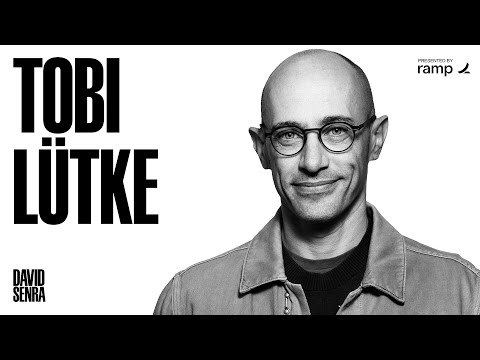
My Conversation With Tobi Lütke, Co-founder & CEO of Shopify | David Senra
David Senra (host), Tobi Lütke (guest), David Senra (host), David Senra (host), David Senra (host), David Senra (host)
In this episode of David Senra, featuring David Senra and Tobi Lütke, My Conversation With Tobi Lütke, Co-founder & CEO of Shopify | David Senra explores tobi Lütke on engineering companies, founders, craft, and AI’s future Tobi Lütke argues that companies are a form of “social technology” that let people pursue ambitious counterfactuals and test them against market reality. After Shopify’s IPO, he says he nearly harmed the business by “cosplaying” a traditional CEO, then used COVID as a forcing function to rebuild leadership, cancel misaligned projects, and re-derive decisions from first principles.
Tobi Lütke on engineering companies, founders, craft, and AI’s future
Tobi Lütke argues that companies are a form of “social technology” that let people pursue ambitious counterfactuals and test them against market reality. After Shopify’s IPO, he says he nearly harmed the business by “cosplaying” a traditional CEO, then used COVID as a forcing function to rebuild leadership, cancel misaligned projects, and re-derive decisions from first principles.
He describes “Shopify OS,” an internal, software-addressable model of the org that reduces politics, makes tradeoffs explicit, and operationalizes a desired-state system for structure, titles, resourcing, and incentives. Lütke emphasizes differentiation over mimicry, hiring high-agency “spiky” people (often founders), and designing environments that make good behavior intuitive rather than enforced by policy.
The conversation closes on craft, identity shaping (affirmations), documenting decision context, and why AI/agents will make 2026+ unusually “hard and interesting,” rewarding rapid adaptation and entrepreneurial thinking.
Key Takeaways
A company is a tool for running counterfactuals.
Lütke frames company-building as a socially accepted way to go “all in” on an idea, test it against the market, and let the feedback loop (money/energy) finance iteration and learning.
Get the full analysis with uListen AI
Progress means being embarrassed by your old work.
He compares companies to code: you should look back and see flaws. ...
Get the full analysis with uListen AI
Cosplaying leadership can quietly break product quality and focus.
Post-IPO, he tried to emulate a conventional public-company CEO and “trust-fell” into delegation, which allowed boondoggles, islands of functionality, and misaligned projects to proliferate.
Get the full analysis with uListen AI
Rivalry inspires excellence; competitor obsession creates mimicry.
Competitive-analysis fixation makes companies reactive and copy-driven. ...
Get the full analysis with uListen AI
Crises reveal who adapts—founders often outperform managers.
During COVID, Lütke found some leaders went to “zero” while unexpected people went to “100. ...
Get the full analysis with uListen AI
Engineer the company: make structure and tradeoffs computable.
“Shopify OS” models titles, levels, reporting constraints, comp bands, etc. ...
Get the full analysis with uListen AI
Give employees agency over compensation to fix option psychology.
After an 80% stock drop put many options underwater, Shopify shifted to a quarterly-adjustable mix (cash/RSUs/stock) via “sliders,” making risk/choice explicit and rebalancing exposure over time.
Get the full analysis with uListen AI
Policies are often ‘corporate baby-proofing’ that punishes the best people.
Processes tend to be downside protection that limits high performers. ...
Get the full analysis with uListen AI
Document the ‘why’ because context decays and quotes fossilize.
His internal podcast “Context” revisits major decisions and their rationale, countering the common failure mode of “Tobi said…” without time/context—and helping teams reason, not cargo-cult.
Get the full analysis with uListen AI
Differentiation beats perfection—start with ‘yours’ even if worse.
A copied 7/10 product is hard to surpass because you don’t own the mental model. ...
Get the full analysis with uListen AI
Design details shape culture—down to doors and sound.
He treats product as “millions of details,” extending craft standards to office design (pods sized for 5-person teams, meeting rooms placed to discourage meeting addiction, ‘Norman doors’ as intolerable design failures).
Get the full analysis with uListen AI
AI work is becoming an attention-and-feedback-loop game.
He likens multi-agent workflows to StarCraft: attention is a resource, coordination matters, and rapid feedback loops reward those who can micro/macro effectively. ...
Get the full analysis with uListen AI
Notable Quotes
““Companies are technologies themselves… social technology… the perfect excuse to go all in.””
— Tobi Lütke
““One of the saddest days of my life was when I opened old code and was really impressed with how good it was.””
— Tobi Lütke
““I cosplay a… public company CEO… and it just worked really poorly for me.””
— Tobi Lütke
““I cancelled probably sixty percent of the projects, and… turned over every one of my executives.””
— Tobi Lütke
““Affirmations work… which is the dumbest trick that works.””
— Tobi Lütke
Questions Answered in This Episode
How exactly did the “trust was broken” dynamic show up in the exec team—what behaviors were the clearest signals that Shopify was drifting?
Tobi Lütke argues that companies are a form of “social technology” that let people pursue ambitious counterfactuals and test them against market reality. ...
Get the full analysis with uListen AI
Shopify OS sounds powerful: what were the first 3–5 constraints/toggles you encoded, and which ones were surprisingly hard to agree on culturally?
He describes “Shopify OS,” an internal, software-addressable model of the org that reduces politics, makes tradeoffs explicit, and operationalizes a desired-state system for structure, titles, resourcing, and incentives. ...
Get the full analysis with uListen AI
When you cancelled ~60% of projects, what criteria did you use (mission alignment, modularity, ROI, ‘island’ risk, opportunity cost)? Any example that was painful but correct?
The conversation closes on craft, identity shaping (affirmations), documenting decision context, and why AI/agents will make 2026+ unusually “hard and interesting,” rewarding rapid adaptation and entrepreneurial thinking.
Get the full analysis with uListen AI
You say ‘rivalry’ is healthier than competitor obsession—how do you operationalize that inside Shopify without becoming complacent or blind to threats?
Get the full analysis with uListen AI
On hiring founders: what are the failure modes of putting founders into exec roles, and how do you prevent ‘irritants’ from becoming corrosive instead of catalytic?
Get the full analysis with uListen AI
Transcript Preview
[static] One of the things I admire most about you-
Yeah
... is like you've been running your company for twenty-one years, something like that. I love people that do things for a long time, people that chase excellence, that try to be great. My entire life is founders, right? So during the day, I read biographies of history's greatest founders. I've read, like, four hundred and ten of them, and then at night I hang out with founders. I don't think I have a single friend-
[chuckles]
-that's not an entrepreneur. And then-
Love it
... I'm always asking the founders I most admire-
Yeah
... who are the founders they most admire, and your goddamn name comes up over [chuckles] and over and over again. And what they talk about is that you have very unique ideas on company building and management, and you're, uh, they-
Yeah
... use the word singular a lot. So I wanna kind of like lay out how you think about building companies, building products, building technology, and then, you know, spreading the gospel of, uh, of entrepreneurship. I want to start with one thing that you said. You said, "Companies are technologies themselves." What do you mean by that?
In a lot of ways, like, I mean, uh, like, take the social angle. Like, um, a lot of, like, companies are social technology in, in the sense that they allow us to go all in. Like, the only time you're really allowed to, uh, spend, I don't know, eight-- I, I'm gonna say eight, because that's the right number to say, really, like fucking fourteen hours a day, right? Um, just singularly pursuing a thing is like, um, I, I mean, we want kids to spend this time in school, and that's okay, and then university, you know, dedicate yourself. Um, other than that, like, you can't just, like, n- not have a job, uh, but just be, like, really, really in, into, into things. It's socially not acceptable. So, like, company building turns out to be the perfect excuse. Once you call it a company, it's not like tinkering around anymore with a few ideas, and, um, you get to, you get to explore things. What a company fundamentally allows you to do is, like, just run the counterfactual to the world you see around you, right? Like, you, you, you get to, um, try to build a thing that you think ought to be there, and, um, then you means test it against the market, and if, if the market, uh, um, agrees with you that this thing needs to exist, it, it, it moves energy in the form of money back to you, so you can do more of the thing that, uh, you, you were pursuing all along. And not only that, it's like self-financing. Like, if you find out-- Like, again, I started a company which I didn't think was gonna be, um, uh, like, h- have this very, very big market, and along the way, it just like, the market sort, like, pulled Shopify out of the project I started, essentially. You know, that's an incredible intelligence to, uh, to, to tap into. So you put all these things together, and, um, you say, like, "Well, look, t- companies, the concept of company is not that old." It's like, um, we, we are on a five-hundred-year run and sort of, kind of extra- extracted from things called companies, which weren't, which were actually more like quasi-governments, like the East India Company. And so, um, the modern company is not that old. I find that if you take that mindset that, like, companies are just sort of a path-dependent solution to a social and somewhat legal problems, they allow thousands of people to join the th- your project, and, um, it's called a job, and therefore, everyone accepts this. Um, [chuckles] and, uh, um, uh, you, like, obviously, you can make money, so it's a good deal. And, um, then, um, you can figure out if this counterfactual of yours m- might be correct or needs updating along the way, or any of these kind of things. And you could, at the end of the day, if you are lucky, you, um, work with other people who are really all in and, like, inspiring and, like, taking it further than you ever think. And I just like the whole thing, it's just like, I, I just like, I, I marvel at the institution of a company in a way, like, because if it wouldn't exist for some reason, and someone would propose the whole idea now, it would sound insane. Like, from first principles, none of this makes sense, really.
Install uListen to search the full transcript and get AI-powered insights
Get Full TranscriptGet more from every podcast
AI summaries, searchable transcripts, and fact-checking. Free forever.
Add to Chrome