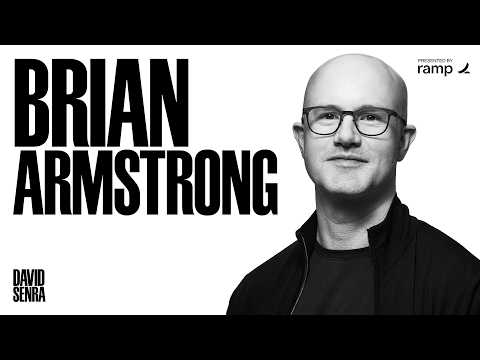
My Conversation With Brian Armstrong, Co-founder & CEO of Coinbase
David Senra (host), Brian Armstrong (guest), David Senra (host)
In this episode of David Senra, featuring David Senra and Brian Armstrong, My Conversation With Brian Armstrong, Co-founder & CEO of Coinbase explores brian Armstrong on regulation battles, founder mindset, and Coinbase evolution Armstrong describes how ambiguous U.S. crypto jurisdiction (SEC vs CFTC) enabled what he calls “lawfare,” culminating in Coinbase suing the SEC and ultimately prevailing without fines or operational changes.
Brian Armstrong on regulation battles, founder mindset, and Coinbase evolution
Armstrong describes how ambiguous U.S. crypto jurisdiction (SEC vs CFTC) enabled what he calls “lawfare,” culminating in Coinbase suing the SEC and ultimately prevailing without fines or operational changes.
He explains his long-term, mission-first orientation—“increasing economic freedom”—and how that philosophy shaped key decisions like remaining internally “apolitical” during 2020–2021 workplace activism pressures.
The conversation traces Coinbase’s scrappy early years: discovering the “buy button” insight, battling banking/compliance hurdles, surviving support and operational near-death moments, and finding complementary co-founder Fred Ehrsam.
Armstrong also outlines Coinbase’s current operating model (fast decision-making, internal venture-style bets, internet-native marketing, direct-to-public communications), plus emerging bets in AI agents, Base, and his longevity startup New Limit.
Key Takeaways
Regulatory ambiguity became a strategic weapon in U.S. crypto.
Armstrong argues that uncertainty over whether tokens are commodities or securities enabled the SEC to pursue enforcement without clear rulemaking, motivating the push for Congressional “market structure” clarity.
Get the full analysis with uListen AI
Suing your regulator is rare—but sometimes necessary.
He frames Coinbase’s decision to sue the SEC (alongside defending against SEC action) as a long-term, mission-driven choice that hurt near-term stock sentiment but protected the industry’s future.
Get the full analysis with uListen AI
Coinbase’s SEC win was costly but precedent-setting.
Armstrong cites $50–$100M in legal spend and large market-cap pressure, but says Coinbase paid no fines, changed nothing, and benefited from judicial criticism of SEC behavior as “arbitrary and capricious.”
Get the full analysis with uListen AI
Founder mindset includes willingness to rebuild from scratch.
In the “mission first” culture moment, Armstrong says he was prepared to lose half the company and rebuild, distinguishing founders from “presiders” who fear contraction more than misalignment.
Get the full analysis with uListen AI
Mission-first culture is also a focus mechanism.
His “apolitical at work” stance emerged from employee activism pressures; he argues companies should avoid performative social positioning and instead concentrate on their core mission unless issues directly relate to it.
Get the full analysis with uListen AI
“Follow your nose” is a CEO operating principle.
Armstrong describes intuition/pattern matching as noticing repeated “weird signals” and then digging—via calls, reading, and direct investigation—to find bottlenecks and hidden misalignment.
Get the full analysis with uListen AI
Coinbase found product-market fit by adding the obvious missing step.
Early wallet users churned because they had no Bitcoin; customer conversations revealed that a simple in-app buy flow (ACH) was the wedge that unlocked explosive demand.
Get the full analysis with uListen AI
Banking and compliance can be existential constraints, not back-office details.
He recounts needing a $30K legal opinion to open an account, then racing to raise capital when ACH flows threatened insolvency—highlighting finance/compliance as early survival bottlenecks.
Get the full analysis with uListen AI
Complementary co-founders can change trajectory.
Armstrong credits Fred Ehrsam’s finance/trading perspective for quickly fixing unit economics and navigating near-death periods, saying Coinbase likely wouldn’t have succeeded without him.
Get the full analysis with uListen AI
Hiring for spikes beats hiring for credentials in frontier markets.
He prefers high-agency outliers with demonstrated excellence, citing early hires like Olaf Carlson-Wee (ex-lumberjack, Bitcoin thesis) outperforming more credentialed candidates.
Get the full analysis with uListen AI
Centralization vs decentralization is a user-experience tradeoff, not a moral binary.
Armstrong likens crypto to email: the protocol can be decentralized while service providers compete; Coinbase added self-custody to serve users who want zero trust, while institutions often require trusted custody.
Get the full analysis with uListen AI
Coinbase’s expansion is a wedge-to-platform strategy.
He says Bitcoin buying was the entry point; over time Coinbase aims to become an “Everything Exchange” where users can trade multiple assets, borrow, pay, and access modern financial services.
Get the full analysis with uListen AI
Speed and risk tolerance must be designed into large orgs.
Armstrong emphasizes clear DRIs and short decision windows, plus executive “air cover” for high expected-value bets (e. ...
Get the full analysis with uListen AI
Internal venture funding reduces institutional risk aversion.
Coinbase’s “next bets” allow any employee to pitch twice yearly and get funded with a single internal ‘yes,’ preventing good ideas from dying in multi-layer approval chains.
Get the full analysis with uListen AI
Going direct beats reliance on traditional media filters.
After experiencing what he views as biased hit pieces, Armstrong prefers publishing company narratives via shareholder letters, social clips, podcasts, and first-party channels—treating every company as a media company.
Get the full analysis with uListen AI
AI agents are pushing crypto into machine-to-machine payments.
Beyond code and support automation, Armstrong highlights a uniquely crypto-native shift: agents needing wallets to pay for resources autonomously, which stablecoins enable because traditional cards require human identity.
Get the full analysis with uListen AI
Base is Coinbase’s self-custodial ‘end-user OS’—still searching for the right killer loop.
He describes Base app as the self-custody counterpart to Coinbase; its SocialFi ‘post coins’ experiment was polarizing and, in his view, didn’t yet solve durable token economics.
Get the full analysis with uListen AI
Armstrong is building a portfolio around ‘civilizational progress.’
Alongside Coinbase, he’s funding longevity (New Limit), scientific research incentives (ResearchHub), and exploring special economic zones as a structural way to lower regulatory barriers to innovation.
Get the full analysis with uListen AI
Notable Quotes
“This ambiguity… was really weaponized… to unlawfully kill the industry in the United States.”
— Brian Armstrong
“Very few [companies sue their regulator].”
— Brian Armstrong
“We won that case… We didn’t pay a single dollar in fines. We didn’t have to change a single thing about the company.”
— Brian Armstrong
“If we need to go from two thousand to one thousand, that’s not a big deal to me. I could go back to being on my laptop again if I had to.”
— Brian Armstrong
“You just need to follow your nose… ‘Something feels really off over here.’”
— Brian Armstrong
Questions Answered in This Episode
What exactly would the new “market structure” legislation change operationally for Coinbase (listing standards, disclosures, custody, enforcement process)?
Armstrong describes how ambiguous U. ...
Get the full analysis with uListen AI
Armstrong says the SEC ‘weaponized ambiguity’—what concrete actions or communications best support that claim, and what would critics say in response?
He explains his long-term, mission-first orientation—“increasing economic freedom”—and how that philosophy shaped key decisions like remaining internally “apolitical” during 2020–2021 workplace activism pressures.
Get the full analysis with uListen AI
Coinbase spent $50–$100M on legal costs: what decision framework did you use to justify that expense to shareholders during the drawdown?
The conversation traces Coinbase’s scrappy early years: discovering the “buy button” insight, battling banking/compliance hurdles, surviving support and operational near-death moments, and finding complementary co-founder Fred Ehrsam.
Get the full analysis with uListen AI
In the mission-first/apolitical policy, where is the boundary between ‘apolitical’ and ‘mission-relevant politics’ (e.g., voting rights, sanctions, war, DEI laws)?
Armstrong also outlines Coinbase’s current operating model (fast decision-making, internal venture-style bets, internet-native marketing, direct-to-public communications), plus emerging bets in AI agents, Base, and his longevity startup New Limit.
Get the full analysis with uListen AI
What did Armstrong learn from the 5% employee exit package—what signals indicated it was a vocal minority vs broader cultural misalignment?
Get the full analysis with uListen AI
Transcript Preview
[camera clicking] How much of your job is building political power f- as an advocate for, like, the crypto industry?
Yeah, I mean, I, I don't have to go, but I, I, I think it's worth it for the business. I don't mind going. I like doing... In some ways, I like doing it. There's some pretty interesting people there. Uh, so I go about once a quarter, um, maybe once or twice a quarter recently 'cause we're right at the, the crux of this, this key moment for market structure legislation. But I'd say over the last few years, yeah, about once a quarter.
What's the key moment for the market structure?
Well, uh, the crypto industry has been working for a long time on getting in the Senate. A whole bunch of people have been trying to get this, uh, piece of legislation passed, um, in the House. It was called the Clarity Act. In the Senate, um, they're drafting their own version of it, but it's, it's essentially clarifying this question about which of these crypto assets are commodities versus securities. And the... You know, someone might say, "Well, why does it matter?" It matters because in the United States, we have two different regul- federal regulators, the CFTC and the SEC. The CFTC regulates commodities. The SEC regulates securities. And so it turns out in the past, uh, this ambiguity about where crypto assets set, you know, sit between the two federal regulators, that lack of clarity was really weaponized and, uh, by Gary Gensler, the former SEC chair, and Elizabeth Warren, and some people like that who tried to, in my view, unlawfully kill the industry in the United States. So in other countries where we operate, like in the UK or in Singapore, they only have one federal regulator for financial services, so they actually don't care whether these are commodities or securities. It's a totally, uh, parochial issue in the United States that's kinda like this turf war between two federal agencies in the past. So anyway, we just decided we need to get legislation passed by Congress to clarify once and for all which of them go in which bucket, so that a future Gary Gensler couldn't come in and try to kill the industry.
So what was the lawfare they were trying to do?
Well, okay, so s- long story, but, um, you know, essentially this was around, like, the twenty twenty, twenty twenty-one timeframe. Um, Coinbase, we decided we wanted to become, become a public company. We had been operating for about nine years at that point, and we went in and went through the normal process with the SEC. You have to describe your entire company, how it works. You know, how do we decide which assets to list, which do we not list? Um, at that time, we, we wanted there to be a path to have crypto securities be traded. Simple way to think of it is a security is, like, a way to raise money for a company that you wanna start. A commodity is something that's d-decentralized, kinda like oil or gold or copper or something like that, right? So Bitcoin is decentralized. Nobody controls it. Everyone pretty much agrees Bitcoin is a commodity. But there were people issuing tokens which were raising money for different projects they were doing, um, that were in various stage-stages of decentralization. So was it a commodity? Was it a security des- And then Gary Gensler, uh, the SEC chair at that time, um, my understanding is that, you know, he, he and Elizabeth Warren essentially, um, decided they wanted to use this to, uh, curtail the crypto industry. And if you wanna know why-
Install uListen to search the full transcript and get AI-powered insights
Get Full TranscriptGet more from every podcast
AI summaries, searchable transcripts, and fact-checking. Free forever.
Add to Chrome