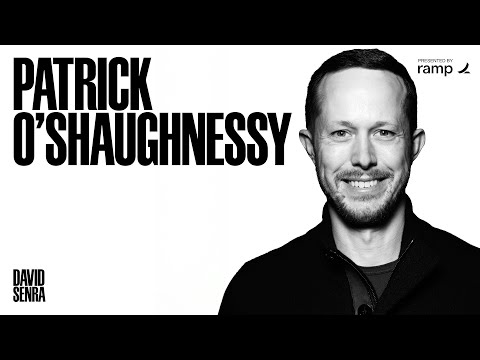
My Conversation With Patrick O'Shaughnessy, Founder of Colossus & Positive Sum | David Senra
David Senra (host), David Senra (host), David Senra (host)
In this episode of David Senra, featuring David Senra and David Senra, My Conversation With Patrick O'Shaughnessy, Founder of Colossus & Positive Sum | David Senra explores positive-sum principles, deep relationships, and building enduring media businesses together Patrick explains his core principle: spotting unrealized talent and feeling obligated to help it become visible, which he links to a formative Upanishads passage and a lifelong preference for “positive-sum” behavior.
Positive-sum principles, deep relationships, and building enduring media businesses together
Patrick explains his core principle: spotting unrealized talent and feeling obligated to help it become visible, which he links to a formative Upanishads passage and a lifelong preference for “positive-sum” behavior.
They contrast goal-setting with principle-driven growth—Patrick argues goals create blinders, while principles keep you open to peripheral opportunities that create unpredictable “daisy chains” of outcomes.
They explore how biography, long conversations, and podcasting create “professional learners” with compounding advantages—plus why relationships and over-communication are central to leadership and sustained success.
Patrick details why he built Colossus and long-form profiles (despite skepticism): scarce, high-quality units of attention that spotlight people, are hard to copy, and scale beyond his own time—ending with stories about kindness, mentorship, and the roles that endure.
Key Takeaways
A personal principle can replace goals—and guide every daily decision.
Patrick describes discovering (over years) a principle akin to Bret Victor’s “Inventing on Principle”: when you see something important violated or missing, you feel obligated to correct it in service of others, not yourself.
Get the full analysis with uListen AI
Patrick’s principle: find unrealized potential and champion it publicly.
He gets “abiding joy” from seeing talent early, building relationships, then using capital/media/network to help the world see what he sees—without needing direct personal gain as the motive.
Get the full analysis with uListen AI
Goals can create blinders; openness creates better outcomes.
Patrick argues that most of his best opportunities (like promoting Founders) arrived from the periphery, not from planned targets—so he optimizes for readiness, curiosity, and responsiveness instead of fixed endpoints.
Get the full analysis with uListen AI
Biographies and long conversations are “truth-seeking” tools.
Senra emphasizes slowing down for understanding—biographies reduce the incentive to self-mythologize and reveal recurring human patterns, helping listeners see their own lives more clearly.
Get the full analysis with uListen AI
Ambition quality matters: “clean fuel” sustains; “dirty fuel” consumes.
They contrast generative motivation (service, love of craft) with negative drivers (insecurity, fame, resentment). ...
Get the full analysis with uListen AI
Podcasting creates an unfair advantage: you become a professional learner.
Both describe compounding benefits from repeated deep study and multi-hour conversations—ideas are “stolen” ethically through learning, then applied to new contexts (software, investing, media, hiring).
Get the full analysis with uListen AI
Colossus profiles are a scalable spotlight: scarce attention as a product.
Patrick built long-form profiles and a “magazine in 2025” to create hard-to-copy, high-trust units of attention (covers, definitive stories) that can elevate worthy people—and scale beyond his personal bandwidth via a great team.
Get the full analysis with uListen AI
Notable Quotes
““By far, my favorite thing in the world is championing other people.””
— Patrick O’Shaughnessy
““Those who feed the hungry protect me. Those who don’t are consumed by me.””
— Patrick O’Shaughnessy (quoting the Upanishads)
““I’m not chasing anything. I have no goals.””
— Patrick O’Shaughnessy
““The world is desperate for some stuff like that… everyone’s so sick of this crap.””
— Patrick O’Shaughnessy (on high-effort profiles vs low-quality content)
““A lifelong quest to build something for others that expresses who you are.””
— Patrick O’Shaughnessy (definition of ‘life’s work’)
Questions Answered in This Episode
Patrick says principles create an “obligation” to act. What are 2–3 concrete examples where you felt that obligation most strongly—and what did you do?
Patrick explains his core principle: spotting unrealized talent and feeling obligated to help it become visible, which he links to a formative Upanishads passage and a lifelong preference for “positive-sum” behavior.
Get the full analysis with uListen AI
How do you distinguish “seeing unrealized potential” from being merely early or contrarian—what signals make you confident?
They contrast goal-setting with principle-driven growth—Patrick argues goals create blinders, while principles keep you open to peripheral opportunities that create unpredictable “daisy chains” of outcomes.
Get the full analysis with uListen AI
In ‘Growth Without Goals,’ what practices replace traditional planning (weekly reviews, constraints, decision rules) to avoid drifting?
They explore how biography, long conversations, and podcasting create “professional learners” with compounding advantages—plus why relationships and over-communication are central to leadership and sustained success.
Get the full analysis with uListen AI
You claim media and investing are ‘the same thing.’ What is the shared process step-by-step (sourcing, diligence, conviction, distribution, feedback)?
Patrick details why he built Colossus and long-form profiles (despite skepticism): scarce, high-quality units of attention that spotlight people, are hard to copy, and scale beyond his own time—ending with stories about kindness, mentorship, and the roles that endure.
Get the full analysis with uListen AI
For creators: how can someone design a ‘daisy chain’ like yours (reading → sharing → relationships → opportunities) without your privileged starting conditions?
Get the full analysis with uListen AI
Transcript Preview
[static] You have this almost obsession with finding talented but not well-known or relatively unknown people.
Mm-hmm.
And then you essentially spend a lot of time talking to them, developing relationships, and then putting all of your resources behind that person.
Yeah.
What is going on there?
Well, uh, for how my personality is wired, that is the most exciting possible thing to do, because it means I get to learn about a person and whatever they're doing before other people do, and I like that. I like being at the frontier of what's going on and learning things that aren't widely known. I just, I just enjoy that. I, I read so much and sp- I've spent my whole life just as a constant learning-type person, so to find something fresh and new is, uh, very exciting to me, and you can usually do that with people like this. And then I've just learned about myself that by far, my favorite thing in the world is championing other people. That's just what I enjoy doing. If I look back on my life, the, the sort of, like, wins that I've had, the, the things that if you were to write, like, a Wikipedia article about me would be, like, the accolades or the accomplishments, I don't care about those things. I don't think about them. When they happened, they didn't do anything for me, emotionally or otherwise. Um, uh, uh, for whatever reason, I just- that's just not what I enjoy. But when your success happens or when many other people that I and my team have championed have a win, I feel that deep in my, like, soul, and heart, and gut in a way that is just more gratifying to me than anything else in the world, and this extends to my kids, my wife, my friends, my... You know, the CEOs of companies that we've invested in, um, people that we have on, on our show that we tell the world about, that's the repeated thing that I, I love. And I also kind of like picking sides. I like saying, "I like this person," and, and, and by extension, I like them more than the other available options in this field or this industry or whatever, and I just get tremendous joy out of that. So now I'm architecting my life to just be able to do as much of that as possible, and, and, uh, I hope I get to do it for a long time.
I screenshotted this text. This was, like, many years ago. Somebody was asking me-- I can't remember who it was now, but they were asking me, like, what Patrick is like, and I was just like: Well, positive sum is definitely, like, a way to describe him. I was like, "And he doesn't do things for money." Like, that doesn't mean he's not commercial. Like, he makes a lot of money. He's gonna continue to make a lot of money, but that's, like, not the driver behind it. Let me go back to, like, the cr- one of the craziest days of my life has directly involved you, right? Like, I was, like, in the middle of this, like, five-and-a-half-year struggle of, like, being obsessed with something I know I truly cared and thought was really good.
Install uListen to search the full transcript and get AI-powered insights
Get Full TranscriptGet more from every podcast
AI summaries, searchable transcripts, and fact-checking. Free forever.
Add to Chrome