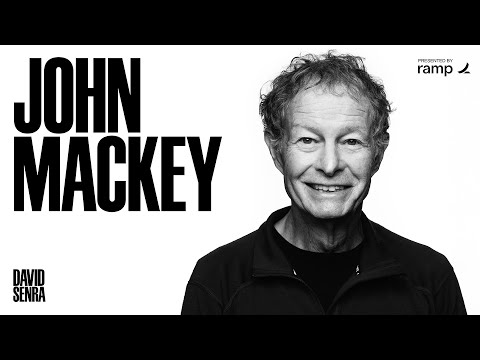
My Conversation with John Mackey, co-founder of Whole Foods Market | David Senra
John Mackey (guest), David Senra (host), David Senra (host), David Senra (host), David Senra (host)
In this episode of David Senra, featuring John Mackey and David Senra, My Conversation with John Mackey, co-founder of Whole Foods Market | David Senra explores john Mackey on Whole Foods growth, mission, and entrepreneur spirituality journey John Mackey and David Senra explore what separates enduring founders from short-term operators: fanatic focus, a “missionary” mindset, and confidence that problems are solvable with enough iteration and time.
John Mackey on Whole Foods growth, mission, and entrepreneur spirituality journey
John Mackey and David Senra explore what separates enduring founders from short-term operators: fanatic focus, a “missionary” mindset, and confidence that problems are solvable with enough iteration and time.
Mackey explains how Whole Foods won by refusing to compete with Walmart-led price wars—doubling down instead on quality, service, and a beautiful in-store experience—while incumbents ignored them for decades.
They unpack scaling mechanics (especially platform acquisitions), the early “Natural Foods Network” that shared financials and trust, and why going public created liquidity and a powerful acquisition currency.
The conversation also turns personal and philosophical: family conflict (including firing his father from the board), regret around his mother’s disapproval, and Mackey’s belief that entrepreneurship is a hero’s journey tied to inner work, learning, and forgiveness.
Key Takeaways
Enduring founders often don’t separate work from play.
Mackey echoes Michael Dell’s “all the time” work ethic: when founders love the mission, the hours don’t register as sacrifice—focus compounds into mastery.
Get the full analysis with uListen AI
Missionary ambition can create inevitable co-founder conflict.
Early partners may want to “not screw it up” once profitability appears, while a missionary wants to expand the vision; Mackey bought out a mercenary-minded co-founder (Mark) to keep building.
Get the full analysis with uListen AI
Entrepreneurial confidence is faith in your ability to solve puzzles, not certainty about outcomes.
Mackey frames business as constant iteration: test, learn, adjust; entrepreneurs move forward because they trust they’ll “crack the code” as new information arrives.
Get the full analysis with uListen AI
If you can’t patent the model, scale and differentiation become your moat.
Whole Foods was easy to copy in theory (retail), so the company pursued scale for pricing power and doubled down on a distinctive product mix and customer experience to stay ahead.
Get the full analysis with uListen AI
Incumbents’ misdirected competition can create an open runway.
Traditional grocers became obsessed with Walmart and tried (and failed) to win on price, cutting store quality and service—leaving Whole Foods “wide open downfield” to capture customers seeking a better experience.
Get the full analysis with uListen AI
VC money can help you start, but misaligned incentives can destroy control and long-term value.
Mackey calls VCs “hitchhikers with credit cards”: they push for rapid scaling to fit fund timelines and blockbuster returns, which can lead to down rounds, dilution, or founder replacement.
Get the full analysis with uListen AI
Acquisitions can be a shortcut to geographic platforms, not just store count.
Whole Foods often bought small regional players to acquire teams, infrastructure, and local know-how—then expanded from that base; most of today’s store count was built after platform entry.
Get the full analysis with uListen AI
Networks beat isolation—until ambition changes the trust equation.
The Natural Foods Network shared financial statements and friendships across regions, raising the industry’s competence; it fractured when Whole Foods expanded into others’ perceived territories and information-sharing stopped.
Get the full analysis with uListen AI
Cult brands are built by evangelists—inside and outside the company.
Mackey describes early Whole Foods “jaw-drop” moments and customers driving 100 miles; brand love showed up in crises (flood cleanup volunteers) and later in employee wealth creation through broad stock options.
Get the full analysis with uListen AI
Time is the ultimate validator, and costs are the quiet killer in good times.
Senra argues “time is the only filter,” and notes Mackey’s reflection that tighter cost discipline—especially during boom periods—might have helped Whole Foods remain independent longer.
Get the full analysis with uListen AI
Capitalism is positive-sum when entrepreneurs create value for all stakeholders.
Mackey rejects zero-sum narratives about billionaires, arguing entrepreneurs capture only a small fraction of the value they create for customers, employees, suppliers, investors, and society (taxes/philanthropy).
Get the full analysis with uListen AI
The founder journey often demands painful maturity in relationships and self-governance.
Mackey describes firing his father from the board as his hardest act and a turning point toward independent decision-making; he also shares lasting regret about his mother dying disappointed.
Get the full analysis with uListen AI
Inner work—forgiveness, breathwork, altered states—can be part of founder performance and meaning.
Mackey views entrepreneurship as a hero’s/spiritual journey; he recommends forgiveness ceremonies and breathwork to access repressed emotions and reduce guilt/fear that unconsciously drives behavior.
Get the full analysis with uListen AI
Notable Quotes
“Michael doesn't make a distinction, I don't think, between work and play. Neither do I.”
— John Mackey
“Venture capitalists are hitchhikers with credit cards.”
— John Mackey
“They were so scared about Walmart that they ignored us.”
— John Mackey
“For at least twenty years… their jaw would drop. It was like, 'I've never been in a store like this.'”
— John Mackey
“Time is the only filter that I trust.”
— David Senra
Questions Answered in This Episode
In the early Mark-vs-mission conflict, what specific moments made you realize the partnership was irreconcilable—and what would you advise a founder to do before it reaches a buyout?
John Mackey and David Senra explore what separates enduring founders from short-term operators: fanatic focus, a “missionary” mindset, and confidence that problems are solvable with enough iteration and time.
Get the full analysis with uListen AI
You say retailers have no patents; beyond scale and service, what were the *non-obvious* moats Whole Foods built (supplier relationships, culture, hiring, store design standards, etc.)?
Mackey explains how Whole Foods won by refusing to compete with Walmart-led price wars—doubling down instead on quality, service, and a beautiful in-store experience—while incumbents ignored them for decades.
Get the full analysis with uListen AI
What were the internal metrics you watched to know a new store that “started slow” would eventually compound—what signaled patience vs. a real failure?
They unpack scaling mechanics (especially platform acquisitions), the early “Natural Foods Network” that shared financials and trust, and why going public created liquidity and a powerful acquisition currency.
Get the full analysis with uListen AI
How exactly did Walmart’s pressure change conventional grocers’ capex and labor decisions, and which of those trade-offs most directly handed you the upper-middle-class customer?
The conversation also turns personal and philosophical: family conflict (including firing his father from the board), regret around his mother’s disapproval, and Mackey’s belief that entrepreneurship is a hero’s journey tied to inner work, learning, and forgiveness.
Get the full analysis with uListen AI
You describe a 20–25 year period where supermarkets ignored you; what changed after Columbus Circle—was it publicity, investor attention, or competitors finally understanding the margin structure?
Get the full analysis with uListen AI
Transcript Preview
[static] Well, one of your themes that comes out in, in listening to a lot of your... is you admire entrepreneurs, and you find one of the common threads for the successful entrepreneurs to be those who are basically fanatics. They just are into their businesses. I just listened to Michael Dell. I mean, Michael, you know, it's, it's like he, he, he says, and y- even started off the episode by quoting him. He says: "Well, how much time did you work?" And he said, "All the time. All of the time." And, uh, that's a theme for oftentimes for entrepreneurs, that they are so- it's not like they're even thinking about working. Michael doesn't make a distinction, I don't think, between work and play. Neither do I, 'cause when you're really enjoying it, is it work? I mean, it's-- you're doing what you want to do, and it's playful. So it takes a lot of time, but you're not thinking about it because you're loving every minute of it. You're enjoying it. That comes through with the Todd Graves one as well, you know? I mean, he just loved his business so much. And so all these entrepreneurs, they're a hundred percent in, and that's where their time goes. They're not-- You ask Michael if he was kind of like a Renaissance man or if he was doing a lot of different things, and it's like: "No. No, not really." I think that's also true for most entrepreneurs. They're pretty focused on a few things, and mostly they're focused on their business.
Yeah, to the, with the conversation we were just having- [chuckles]
Yes, exactly.
-before we started recording, which, you know, I'm essentially seeking your counsel because I think I'm just like these kind of people. Like, you wouldn't spend ten years making this podcast, reading four hundred of these books. Your book is excellent, by the way, which we'll talk a lot about today. I wasn't expecting to start here. If you didn't think that you were similar or there was something about them that was attractive, and I feel like essentially my, my entire life is my work. Now, I think one thing that we share together, and we, we spent several hours, uh, together, too, it's very obvious in your book, but also with you, you viewed yourself... I don't know if you use this word, but to me, you're definitely a missionary.
Mm.
And one of the things I want to talk to you about, I talk to a lot of founders about this, so it's a lot, a lot of co-founder conflict. And it's very obvious that especially when you're a missionary, you aren't like, "Oh, I just want to, like, start, you know, one grocery store so people eat healthier and better food." You're like: "We're going to change the way that the country eats." And that was a very d- distinct philosophical mismatch from some of your early co-founders.
Yeah.
Install uListen to search the full transcript and get AI-powered insights
Get Full TranscriptGet more from every podcast
AI summaries, searchable transcripts, and fact-checking. Free forever.
Add to Chrome