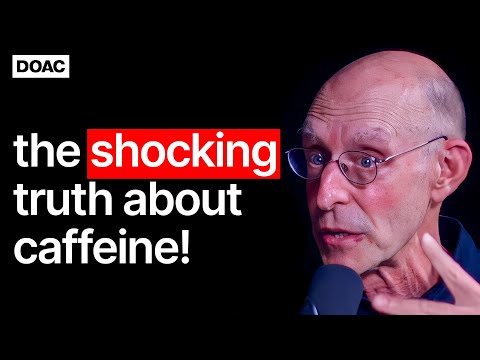
Michael Pollan: How To Change Your Mind | E158
Michael Pollan (guest), Steven Bartlett (host)
In this episode of The Diary of a CEO, featuring Michael Pollan and Steven Bartlett, Michael Pollan: How To Change Your Mind | E158 explores michael Pollan On Psychedelics, Caffeine, Consciousness, and Breaking Habits Michael Pollan discusses how his curiosity‑driven, immersive journalism led him from food systems and agriculture reform to psychedelics and now to the science of consciousness. He explains how psychedelics may help alleviate conditions like depression, anxiety, and addiction by disrupting rigid patterns of thought and increasing mental flexibility and awe. Pollan also explores our cultural dependence on caffeine, its hidden costs for sleep and natural rhythms, and how breath work and travel can non‑pharmacologically alter consciousness. Throughout, he returns to the themes of systems versus symbols, the limits of shame‑based social change, and the importance of deliberately breaking habits to stay alive, resilient, and open‑minded.
Michael Pollan On Psychedelics, Caffeine, Consciousness, and Breaking Habits
Michael Pollan discusses how his curiosity‑driven, immersive journalism led him from food systems and agriculture reform to psychedelics and now to the science of consciousness. He explains how psychedelics may help alleviate conditions like depression, anxiety, and addiction by disrupting rigid patterns of thought and increasing mental flexibility and awe. Pollan also explores our cultural dependence on caffeine, its hidden costs for sleep and natural rhythms, and how breath work and travel can non‑pharmacologically alter consciousness. Throughout, he returns to the themes of systems versus symbols, the limits of shame‑based social change, and the importance of deliberately breaking habits to stay alive, resilient, and open‑minded.
Key Takeaways
Pursue curiosity ruthlessly and structure work as a journey, not a lecture.
Pollan attributes his success to choosing underexplored topics (industrial meat, psychedelics) and writing as a detective story where he begins as ‘an idiot on page one’ with questions, not answers. ...
Get the full analysis with uListen
Target systems, not symbols, when you want real change.
His ‘Power Steer’ investigation followed a single cow through the meat system, revealing how feedlots, drugs, and slaughter practices work. ...
Get the full analysis with uListen
Caffeine is powerful, useful, and far from cost‑free—especially for sleep.
Caffeine blocks adenosine receptors, preventing the brain from registering accumulated ‘sleep pressure’. ...
Get the full analysis with uListen
Temporarily giving up a substance reveals your real level of dependence.
Quitting caffeine for three months left Pollan feeling ‘like an unsharpened pencil’ for over a week—sluggish, mentally veiled, and unable to write—despite being past basic withdrawal. ...
Get the full analysis with uListen
Psychedelics may work by disrupting rigid mental patterns, not by adding euphoria.
Across disorders—depression, anxiety, OCD, addiction—the common feature is rigid, repetitive rumination and fixed narratives (‘I’m a bad person’, ‘I need this drug’). ...
Get the full analysis with uListen
Awe, love, and a renewed sense of connection are central, not fringe, outcomes.
Pollan’s psilocybin experiences convinced him that spirituality need not imply supernatural beliefs; instead, it can mean deep felt connection with something larger (nature, music, others). ...
Get the full analysis with uListen
You can ‘change your mind’ without drugs: leverage breath, travel, and novelty.
Breath work (e. ...
Get the full analysis with uListen
Notable Quotes
“Questions are always more interesting than answers.”
— Michael Pollan
“Systems are hard to deal with. We evolved to deal with individuals and stories of individuals.”
— Michael Pollan
“There is no free lunch. Caffeine lets you borrow energy from the future, it doesn’t create it.”
— Michael Pollan
“If I feel more normal on this drug than off this drug, what does that say?”
— Michael Pollan
“Think of a psychedelic experience as fresh snowfall, filling the grooves, allowing you to take any path you want down the hill.”
— Michael Pollan
Questions Answered in This Episode
You argue that law and systems matter more than symbolic acts like black tiles; what specific legal or institutional reforms do you think would most effectively address racial injustice in the U.S. right now?
Michael Pollan discusses how his curiosity‑driven, immersive journalism led him from food systems and agriculture reform to psychedelics and now to the science of consciousness. ...
Get the full analysis with uListen AI
In your caffeine fast, did you notice any changes beyond sleep and focus—such as mood, creativity, or social behavior—that made you reconsider how much caffeine you’ll use long‑term?
Get the full analysis with uListen AI
Given your concern about a psychedelics investment bubble, what concrete guardrails or regulations would you put in place to protect patients while still allowing innovation in psychedelic therapy?
Get the full analysis with uListen AI
The Hopkins study you mentioned shows increased attribution of consciousness to plants and animals after psychedelic use; how should this shift in perception translate into everyday ethical decisions, like diet, gardening, or conservation priorities?
Get the full analysis with uListen AI
As you dive into consciousness research, how will you reconcile hard scientific models of the brain with the deeply subjective, ineffable qualities of experiences like ego dissolution and mystical union that you describe from your own trips?
Get the full analysis with uListen AI
Transcript Preview
Depression, anxiety, addiction, mental disorders that involve a rigidity of thought, what psychedelics appear to do is break those habits of thought.
What is the cost of this though?
That's a great question. (dramatic music) One of the 100 most influential people in the world. Please welcome Michael Pollan.
You've written six New York Times bestsellers.
Yeah.
And they're on such a diverse range of topics.
Two of the topics I've worked on have turned into movements. I was writing a piece on the meat industry and how fucked up it is, and it led to this movement to try to reform agriculture. Then I got into psychedelics. They're much better than the results for antidepressants when they came on the scene, and we're talking about potential cures, not simply symptoms. There are risks with this, and we don't talk about them nearly enough, and people are gonna get hurt.
One of the immersive journalistic pursuits you embarked on was this topic of caffeine.
It allows us to function better. It allows us to work harder, longer. You're feeling the clearing of the mental fog.
I can tell you the cost of doing heroin every day, but no one can seem to tell me the cost of having three cups of coffee a day.
If you really want to understand your relationship to this drug, you have to- (record screeches)
So without further ado, I'm Steven Bartlett, and this is The Diary of a CEO USA Edition. I hope nobody's listening, but if you are, then please keep this to yourself. (upbeat music) Michael, I have to say, it's a real, a huge honor to speak to you. When I departed from my company and I started investigating what I was interested in, one of the things, alongside DJing and this podcast and many others, was psychedelics. I was so compelled by, um, this apparent, and I didn't have confirmation, this apparent increase in mental health disorders in my country.
Mm-hmm.
In the UK, as you know, as I know you've talked about many times, is that suicide is the single biggest ki- uh, killer of men under the age of 45. And I thought that the most sort of fulfilling thing I could do with the next chapter of my life was start a company in that space. That's how I came to the psychedelics industry.
Mm-hmm.
That's how I came to actually work in the psychedelics industry. And when I arrived in that industry, people said your name over and over and over again, and they told me, and I'm not blowing smoke up your ass, they told me that I had to... it was like I wasn't allowed in the industry until I'd read your book.
(laughs)
Right? Um, How To Change Your Mind, it was that much of a pivotal book for my colleagues at the time. You've written six New York Times bestsellers, and they're on such a diverse arrange of topics. To be so successful in such a diverse range of topics in writing, my first question to you that I wanted to ask is, as you look back on your life and your career, why were you successful? What was it about you that made you successful?
Install uListen to search the full transcript and get AI-powered insights
Get Full TranscriptGet more from every podcast
AI summaries, searchable transcripts, and fact-checking. Free forever.
Add to Chrome