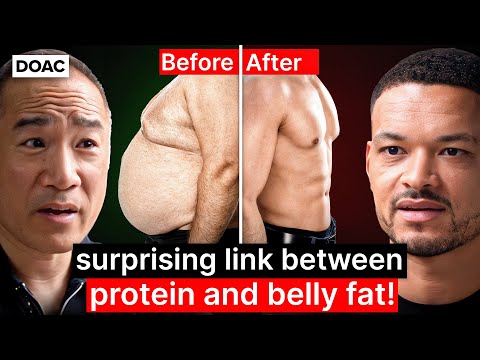
The Fat Burning Expert: The REAL Reason You’re Not Losing Belly Fat (and How To Fix It Fast!)
Steven Bartlett (host), Alan Aragon (guest), Narrator
In this episode of The Diary of a CEO, featuring Steven Bartlett and Alan Aragon, The Fat Burning Expert: The REAL Reason You’re Not Losing Belly Fat (and How To Fix It Fast!) explores science-Backed Fat Loss, Protein, and Creatine Myths Destroyed by Veteran Coach Nutrition researcher and coach Alan Aragon distills 30 years of experience working with elite athletes and everyday clients into practical guidance on fat loss, muscle gain, and sustainable dieting. He dismantles common myths about protein timing, keto, fasting, artificial sweeteners, and “damaged metabolism,” emphasizing total daily intake, resistance training, and realistic expectations.
Science-Backed Fat Loss, Protein, and Creatine Myths Destroyed by Veteran Coach
Nutrition researcher and coach Alan Aragon distills 30 years of experience working with elite athletes and everyday clients into practical guidance on fat loss, muscle gain, and sustainable dieting. He dismantles common myths about protein timing, keto, fasting, artificial sweeteners, and “damaged metabolism,” emphasizing total daily intake, resistance training, and realistic expectations.
Aragon explains how high protein and proper resistance training protect muscle during weight loss, why diet “plateaus” are normal and even useful, and how tools like diet breaks, GLP‑1 drugs, and fasting should be seen as optional aids rather than magic solutions.
He gives specific prescriptions for women, including those with menopause and PCOS, clarifies the real impact of gut health and sugar, and outlines when hormone replacement therapy and creatine make sense.
Finally, Aragon shares his own transformation from alcohol addiction in his 40s to a leaner, healthier 53-year-old, illustrating how prioritization and habit redirection drive lasting change.
Key Takeaways
Total daily protein is far more important than timing or meal frequency.
Aragon emphasizes that the “cake” is your total daily protein intake; timing and distribution are just a thin “icing” layer. ...
Get the full analysis with uListen
High protein during a calorie deficit helps preserve muscle and accelerates fat loss.
Studies with very high protein intakes (≈3. ...
Get the full analysis with uListen
Most people’s “slow metabolism” is really reduced movement (NEAT), not a broken engine.
In a deficit, people unconsciously move less—burning 200–300 fewer calories per day via reduced fidgeting, walking slower, and sitting more. ...
Get the full analysis with uListen
Diet plateaus are normal, necessary, and should be used as “maintenance practice.”
Weight loss naturally follows a pattern of “surge, slow, stop,” with plateaus (maintenance phases) getting progressively longer as you get leaner. ...
Get the full analysis with uListen
Keto, carnivore, and fasting can work—but primarily because they control calories, not because they’re magical.
Keto and carnivore often work short-term because they eliminate hyper‑palatable carb–fat junk and raise protein, which cuts calories automatically. ...
Get the full analysis with uListen
For women (menopause, PCOS), fundamentals still rule; expectations and carb control matter more than exotic protocols.
Menopause doesn’t doom women to major fat gain or muscle loss: the SWAN study found only ~3. ...
Get the full analysis with uListen
Creatine is uniquely powerful and safe; other supplements are optional “bets.”
Aragon calls creatine “King Creatine” because it has a huge evidence base for increasing strength (e. ...
Get the full analysis with uListen
Notable Quotes
“The daily total for protein, that is the cake. The distribution through the day is the icing on the cake, and it’s a very thin layer of icing.”
— Alan Aragon
“Almost everybody who has some degree of an issue with their body fat levels under-consume protein.”
— Alan Aragon
“We automatically look at progress plateaus as something negative, when people need to reorganize their perception. The plateau is just the body doing its job.”
— Alan Aragon
“The people in the physique contests will always hit their goal… They’re not a different species. They just have different priorities.”
— Alan Aragon
“There’s almost nothing creatine can’t do.”
— Alan Aragon
Questions Answered in This Episode
You mentioned very high protein intakes (3.3–4.4 g/kg) supporting fat loss in trained individuals—how would you adapt that approach for someone who’s obese, sedentary, and has borderline kidney function?
Nutrition researcher and coach Alan Aragon distills 30 years of experience working with elite athletes and everyday clients into practical guidance on fat loss, muscle gain, and sustainable dieting. ...
Get the full analysis with uListen AI
For a woman with PCOS who is already doing low-carb and lifting but still not losing significant fat, what specific lab markers, dietary tweaks, or carb thresholds would you examine next before considering medications?
Aragon explains how high protein and proper resistance training protect muscle during weight loss, why diet “plateaus” are normal and even useful, and how tools like diet breaks, GLP‑1 drugs, and fasting should be seen as optional aids rather than magic solutions.
Get the full analysis with uListen AI
You showed how keto studies often see carb creep from 50 g to ~150 g over a year—if you were designing a more sustainable “keto-adjacent” protocol for the average person, what concrete rules and food lists would you use?
He gives specific prescriptions for women, including those with menopause and PCOS, clarifies the real impact of gut health and sugar, and outlines when hormone replacement therapy and creatine make sense.
Get the full analysis with uListen AI
In the alternate-day fasting study where lean men lost more muscle, what exact training and protein strategies could have minimized that lean-mass loss, and do you think fasting can ever be optimal—not just acceptable—for physique athletes?
Finally, Aragon shares his own transformation from alcohol addiction in his 40s to a leaner, healthier 53-year-old, illustrating how prioritization and habit redirection drive lasting change.
Get the full analysis with uListen AI
You reframed plateaus as ‘maintenance practice,’ which is psychologically powerful; how would you build a 12-month periodized plan for someone with 40+ pounds to lose that explicitly cycles deficits, diet breaks, and maintenance phases from day one?
Get the full analysis with uListen AI
Transcript Preview
I asked my audience for their 15 most popular unanswered questions about how to lose fat or to gain muscle mass. The first one, how do I lose weight fast? But we just answered that.
Yeah.
The second one, is creatine this miracle thing that everybody should be taking in?
There's almost nothing creatine can't do.
Wow, some statement.
(laughs)
Next, is there any harm in eating too much protein?
It's rare. And in fact, almost everybody who has some degree of an issue with their body fat levels underconsume protein.
The next question's about PCOS. What would you say to a woman struggling with PCOS in terms of dietary prescription?
That's a damn good question, man. Can I go into detail with this? Because a lot of people are very misinformed about this stuff.
The floor is yours.
Okay, so...
Alan Aragun has been using science to help elite athletes unlock peak performance for over 30 years.
And now, he's breaking down the nutrition and training strategies that actually deliver results.
It's important to take an evidence-based approach to diet, nutrition, training, supplementation, because if you don't, then you end up wasting a lot of time.
So let's start with protein. So how much protein should I be eating to gain muscle?
What is your goal body weight?
Around 90.
Take 90 and multiply that by (beep) . There's your protein target.
What about calorie restriction? I've heard you say that 10 or 20% of your calories can come from pretty much anything you want.
Literally anything. (laughs)
So I could eat McDonald's or something, and I could still lose weight theoretically?
That's true. And this is reflected in research, along with diet breaks. That's one of the tactics that you can use for long-term adherence to a plan, and I'll explain how.
I also want to talk about the ketogenic diet, menopause, fasting, sugars, and this.
That, that always gets me, man. That, that picture always gets me.
Why?
I used to drink heavily. I was overworked and trying to be the best father and the best husband, huh, and it got real bad. I just needed to stop, and I did.
How?
I just...
Wow, really?
Yes.
I see messages all the time in the comments section that some of you didn't realize you didn't subscribe, so if you could do me a favor and double-check if you're a subscriber to this channel, that would be tremendously appreciated. It's the simple, it's the free thing that anybody that watches this show frequently can do to help us here to keep everything going in this show and the trajectory it's on. So, please do double-check if you've subscribed, and, uh, thank you so much. Because in a strange way, you are- you're part of our history, and you're on this journey with us, and I appreciate you for that. So, yeah, thank you. Alan, why should I listen to you? What have you done in your career in over the last 30 years that has given you the knowledge, the information, the wisdom that you have on nutrition, dieting, fitness, et cetera? Who is Alan?
Install uListen to search the full transcript and get AI-powered insights
Get Full TranscriptGet more from every podcast
AI summaries, searchable transcripts, and fact-checking. Free forever.
Add to Chrome