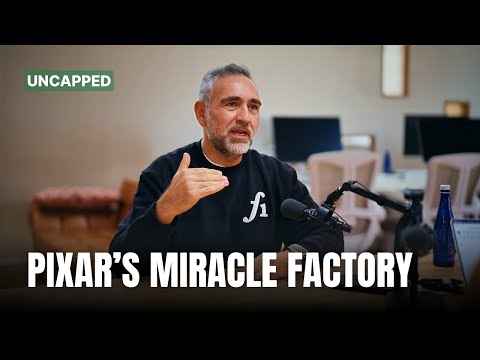
Pixar’s Golden Age, Twitter through IPO, and Building YC’s Growth Fund | Ali Rowghani | Ep. 26
Ali Rowghani (guest), Jack Altman (host)
In this episode of Uncapped with Jack Altman, featuring Ali Rowghani and Jack Altman, Pixar’s Golden Age, Twitter through IPO, and Building YC’s Growth Fund | Ali Rowghani | Ep. 26 explores ali Rowghani on miracle factories, Twitter scale, and startup saplings Rowghani frames Pixar as a “miracle factory” built on director-led passion, an uncompromising quality bar with no hedging, rapid iterative prototyping, and psychologically safe, candid feedback loops.
Ali Rowghani on miracle factories, Twitter scale, and startup saplings
Rowghani frames Pixar as a “miracle factory” built on director-led passion, an uncompromising quality bar with no hedging, rapid iterative prototyping, and psychologically safe, candid feedback loops.
He shares what made Steve Jobs exceptional in day-to-day work: relentless refinement of basic skills, building clear real-time “maps of reality,” and treating the quality of one’s own thinking as a craft to be sharpened.
At Twitter (2010–2014), he recounts going from ~<100 employees and no revenue to $2B revenue and global scale, crediting the ad/content-unit match (tweets) and rapid international expansion—while regretting insufficient curiosity about users and clinging to sacred cows like 140 characters and reverse chronology.
He argues the venture ecosystem scales well at “seed” and “tree” stages, but not in the “sapling” phase (pre/post Series A), where repeatability, retention, and carefully choosing initial customers matter more than broad, fast growth or blitz fundraising timelines.
Key Takeaways
Sustained excellence comes from “no hedging” and a brutally high bar.
Pixar committed fully once a director and story were chosen, then paid real costs (time, money, emotional strain) to ensure releases met the studio’s standard—e. ...
Get the full analysis with uListen AI
Passion-driven ownership beats committee-designed product decisions.
Pixar only made films directors deeply wanted to make, avoiding “filmmaking by committee,” focus-group Mad Libs, or executive-ordered concepts—preserving coherence and creative conviction.
Get the full analysis with uListen AI
Rapid, public prototyping accelerates quality—if you measure improvement, not initial polish.
The story-reel process forced teams to produce multiple rough versions each year and focus on trajectory between screenings, enabling course correction long before a polished final locked in mistakes.
Get the full analysis with uListen AI
Great feedback cultures require psychological safety and visible vulnerability from leaders.
Pixar normalized showing unfinished work and receiving open critique; when top creators demonstrated imperfect drafts publicly, it made iteration safe and continuous instead of rare and shattering.
Get the full analysis with uListen AI
Elite operators obsess over the “quality of their own thinking.”
Rowghani describes Jobs as continuously refining communication, urgency, and problem decomposition—building a shared map of reality in discussions and revising it quickly with new data.
Get the full analysis with uListen AI
Twitter’s winning monetization insight was making ads feel like native participation.
By aligning the ad unit with the content unit (tweets), promoted tweets could be judged on relevance and timeliness (e. ...
Get the full analysis with uListen AI
The biggest scaling risk is an outdated mental model of your users.
Rowghani regrets Twitter’s lack of disciplined curiosity about who users had become; features like the early “conversations” UI broke power-user behavior because the team built for itself, not reality.
Get the full analysis with uListen AI
The “sapling” phase is where startups die—and it doesn’t scale to support it.
Between initial traction and proven repeatability (often closer to $5–10M revenue than $1M), problems are bespoke: choosing the right initial customer, proving retention/expansion, and finding repeatable go-to-market motion.
Get the full analysis with uListen AI
Founders should choose customers; customers shouldn’t choose founders.
Accepting anyone who will pay broadens demands beyond what a small team and immature product can satisfy; turning down “wrong” growth takes courage but increases the odds of deep satisfaction and renewal.
Get the full analysis with uListen AI
In fast, preemptive fundraising markets, founders must protect decision quality.
Preemption reduces process time, but especially in the sapling phase it can rush a critical long-term partnership; founders should resist investors “hijacking” timelines and create enough time to simulate working together.
Get the full analysis with uListen AI
Notable Quotes
““Pixar was a miracle factory.””
— Ali Rowghani
““Do we release something we’re not proud of, or do we kill ourselves to release something we’re really proud of?””
— Ali Rowghani
““Steve was obsessed with the nature and quality of his own thinking.””
— Ali Rowghani
““The company never showed enough curiosity about its own users.””
— Ali Rowghani
““At this sapling stage, everything is much more bespoke… it’s where all the death lurks.””
— Ali Rowghani
Questions Answered in This Episode
At Pixar, what specific rituals or meeting formats made the “brain trust” feedback both candid and psychologically safe—without devolving into committee decision-making?
Rowghani frames Pixar as a “miracle factory” built on director-led passion, an uncompromising quality bar with no hedging, rapid iterative prototyping, and psychologically safe, candid feedback loops.
Get the full analysis with uListen AI
In the Toy Story 2 restart story, what concrete signals told leadership the film wasn’t good enough, and how did they decide the restart was worth the risk?
He shares what made Steve Jobs exceptional in day-to-day work: relentless refinement of basic skills, building clear real-time “maps of reality,” and treating the quality of one’s own thinking as a craft to be sharpened.
Get the full analysis with uListen AI
You describe founders as not needing “thinking in bets.” How should a founder balance all-in conviction with real uncertainty (e.g., when to pivot vs. persist)?
At Twitter (2010–2014), he recounts going from ~<100 employees and no revenue to $2B revenue and global scale, crediting the ad/content-unit match (tweets) and rapid international expansion—while regretting insufficient curiosity about users and clinging to sacred cows like 140 characters and reverse chronology.
Get the full analysis with uListen AI
At Twitter, what would a disciplined “curiosity about users” practice have looked like—weekly research, data dashboards, founder ride-alongs, something else?
He argues the venture ecosystem scales well at “seed” and “tree” stages, but not in the “sapling” phase (pre/post Series A), where repeatability, retention, and carefully choosing initial customers matter more than broad, fast growth or blitz fundraising timelines.
Get the full analysis with uListen AI
On the conversations/blue-line feature: what user research would have surfaced the subtweet/identity use case earlier, and how could the product have evolved without breaking it?
Get the full analysis with uListen AI
Transcript Preview
We live in a world of hedging. We live in a world of thinking with bets, backup plans, you know, contingencies-
Yeah.
-et cetera. And in a sense, that's very rational, okay? Um, but what if you didn't live in that world? Like, what if you, like, positioned yourself against that? And what if, like, you tortured everything you worked on to try to be great-
Yeah
... you know, within the context of a company?
Yeah.
And I think that is the core of a miracle factory.
[music] All right. I'm super excited to be here with Ali Rowghani. He was the COO at Twitter in some of the most formative years. You had exec roles at Pixar, worked directly with Steve Jobs for many years. You started and ran the YC Growth Fund. You've been an angel investor in amazing current companies like Cursor, Decagon. You've got your own fund now. You've also been, like, an advisor to a bunch of people in our ecosystem, like me, over the years, and so many others. Um, and so you're just someone I've looked up to and wanting to talk to you on the show for a long time, so thank you for doing this.
Oh, it's a pleasure. I'm psyched to be here.
The thing I want to start with that is so interesting to me is the Pixar experience, and you were there for ten years, around 2000 to 2010, give or take, and what's shocking to me, above all, is it seems like year after year after year, they just released, like, bangers, and everyone was good. And most movie studios, I feel like some of the products are good, some are not. But, like, here we had, we had Monsters, Inc., Finding Nemo, The Incredibles, Cars, Ratatouille, WALL-E, Toy Story. Like, it's just-
Up.
Up. It's just crazy.
Yeah.
And so I guess my first question is... And I don't think I skipped, like, a bunch of misses or something. How did that happen? Like, how is the quality bar-- What, what went into making that happen time after time?
You know, Pixar was a miracle factory. That's, that's how I thought of it. Um, you know, you start with a blank sheet of paper, and then four years later, you have Finding Nemo, and then, then you start with another blank sheet of paper, and four years later, you have The Incredibles, Ratatouille, Up, and so on. So, like, the interesting question is exactly what you asked: Like, how is that possible? And I think for me-- I've thought a lot about this question, and I think for me, it kind of boils down to really three big things. One of them is, we only made movies that the directors themselves felt really passionate about. It wasn't, uh, filmmaking by committee. It wasn't, like, some executives ordering up a movie or like, "Let's do a Madl- Mad Libs style with focus groups," or whatever else. None of that. It was like, what was the story that somebody who was really talented truly wanted to tell? And then we put all of our eggs in one basket. Like, there was no thinking in bets.
Install uListen to search the full transcript and get AI-powered insights
Get Full TranscriptGet more from every podcast
AI summaries, searchable transcripts, and fact-checking. Free forever.
Add to Chrome