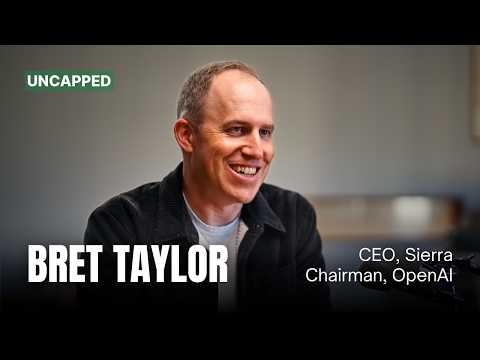
Bret Taylor on AI and the Future of Software | Ep. 42
Bret Taylor (guest), Jack Altman (host)
In this episode of Uncapped with Jack Altman, featuring Bret Taylor and Jack Altman, Bret Taylor on AI and the Future of Software | Ep. 42 explores bret Taylor: AI agents reshape SaaS moats, pricing, and teams fast Taylor frames the “SaaSmageddon” narrative as market anxiety about shifting moats, not a blanket indictment of SaaS companies.
Bret Taylor: AI agents reshape SaaS moats, pricing, and teams fast
Taylor frames the “SaaSmageddon” narrative as market anxiety about shifting moats, not a blanket indictment of SaaS companies.
He argues that systems of record (CRM/ERP/ITSM) remain important, but their value may shift from UI/workflows to data as agents do the work—forcing incumbents to reinvent or risk irrelevance.
At Sierra, he sees rapid enterprise pull (RFP-driven), with differentiation coming from “industrial-grade” agents for complex, regulated industries and an outcomes-based business model.
He predicts major changes in software team best practices due to coding agents (e.g., Codex), expects broad economic impacts to be uneven (bits vs atoms), and defends tasteful ads as a mission-aligned way to distribute AI widely.
Key Takeaways
Moats shift from workflow UI to agent leverage and outcomes.
If users stop “logging into” CRM/ERP and instead delegate tasks to agents, the UI/workflow layer becomes less central; value may concentrate in data access, agent performance, and who controls the agent ecosystem around the system of record.
Get the full analysis with uListen AI
Systems of record stay—but risk becoming ‘just databases.’
Taylor thinks systems of record will still matter as the source of truth, but their gravity could diminish if agents deliver the user-facing value (lead gen, resolution, negotiation) and treat the database as plumbing.
Get the full analysis with uListen AI
Incumbents are slowed by a ‘strategy tax’ during platform shifts.
Legacy strengths (installed base, on-prem commitments, revenue model, sales incentives) become constraints, pushing incumbents toward compromise strategies rather than a clean-slate product—creating a window for best-of-breed entrants.
Get the full analysis with uListen AI
Enterprise AI has moved from education to execution.
Sierra’s sales motion shifted from explaining what an agent is to competing in formal RFPs where large enterprises already decided they need agents and now evaluate vendors on reliability, speed-to-live, and differentiation.
Get the full analysis with uListen AI
‘Industrial-grade’ agents are differentiated by last-mile operational reliability.
Demos are cheap; deploying into banks/healthcare requires multilingual voice, noisy environments, speaker detection, risk controls, and integration into messy enterprise stacks—capabilities that determine real adoption.
Get the full analysis with uListen AI
Outcomes-based pricing matches how autonomous agents create value.
Charging per token prices an input that’s often uncorrelated with what customers want (issues resolved, sales closed, leads qualified). ...
Get the full analysis with uListen AI
Agent-building platforms will commoditize; vertical agents will capture value.
Taylor expects generic “build an agent” tooling to become widely available (foundation labs + open source), making differentiation harder; defensibility accrues to agents that do specific jobs (support, legal review, audits, procurement).
Get the full analysis with uListen AI
Coding agents will reward teams that redesign their engineering system first.
Like the shift to CI/CD, AI-native software development will require new best practices and organizational design. ...
Get the full analysis with uListen AI
AI-driven efficiency won’t automatically create tiny mega-companies.
In competitive markets, cost savings tend to get reinvested into competition (price cuts, customer acquisition, better products). ...
Get the full analysis with uListen AI
Regulation may flip from ‘AI is risky’ to ‘humans are risky.’
Taylor’s hot take is that regulators could eventually prefer agent-mediated controls and auditability over inconsistent human processes—especially in regulated workflows—accelerating adoption in hard industries.
Get the full analysis with uListen AI
Notable Quotes
““What is the role of that system of record if AI agents are doing most of the work?””
— Bret Taylor
““All of the advantages that you had all of a sudden become anchors that are holding you back from actually doing the right thing.””
— Bret Taylor
““It’s easy to make a demo in AI… But making an agent sort of industrial-grade is hard.””
— Bret Taylor
““Outcome-based pricing feels like the secular business model for agents.””
— Bret Taylor
““The first time you one-shot something… it’s an emotional experience… ‘Holy shit! This is real.’””
— Bret Taylor
Questions Answered in This Episode
If systems of record become ‘invisible’ behind agents, what specifically becomes the new switching cost: data, integrations, evaluation tooling, or something else?
Taylor frames the “SaaSmageddon” narrative as market anxiety about shifting moats, not a blanket indictment of SaaS companies.
Get the full analysis with uListen AI
You say incumbents inevitably will have decent AI tech—what are the clearest signals that an incumbent is truly transforming versus shipping ‘AI theater’ features?
He argues that systems of record (CRM/ERP/ITSM) remain important, but their value may shift from UI/workflows to data as agents do the work—forcing incumbents to reinvent or risk irrelevance.
Get the full analysis with uListen AI
Sierra optimizes for regulated industries; what concrete safeguards (auditability, policy, human-in-the-loop design) have mattered most to win banks and healthcare payers?
At Sierra, he sees rapid enterprise pull (RFP-driven), with differentiation coming from “industrial-grade” agents for complex, regulated industries and an outcomes-based business model.
Get the full analysis with uListen AI
How do you operationally define and measure an ‘outcome’ in support or sales so customers trust outcomes-based pricing and don’t argue attribution?
He predicts major changes in software team best practices due to coding agents (e. ...
Get the full analysis with uListen AI
Where do tokens/usage-based pricing remain the right model, and how should companies decide which pricing axis to adopt per product line?
Get the full analysis with uListen AI
Transcript Preview
Clearly, in three years, we could talk about what are the best practices to set up a software team that's optimized for this technology, and we'll know what those best practices are. And right now, we're just figuring them out in real time, and, like, my hypothesis is the companies that figure it out first will move the fastest. It's fascinating to me.
[upbeat music] Bret, thanks so much for doing this with me. I'm super excited for it.
Thanks for having me.
So you're one of the best people to ask this following question, which is: What is your view on the SaaS-pocalypse, if we can call it that?
SaaSmageddon.
SaaSmageddon. So basically, it's like-
[chuckles]
-you know, in public markets, all of these companies are trading way down. You know, you go on X, and everybody's talking about how, like, you know, software can now be written in two seconds, and so there's no moats anymore in software. And so it's leading a lot of people to ask, like, where does durability come from? And so I just wanted to sort of start with this topic because, you know, you've built your own companies, you've been the co-CEO at Salesforce, you're now building, like, one of the, you know, fastest-growing AI startups there is. You're on the board of OpenAI. How do you see software, like, in this moment in February '26?
So first, I think the market isn't necessarily reflecting an indictment of individual companies. I think it's more of a, a broad view of, like, the, the bigger questions you were saying, i.e., every software stock is down, but I don't think that means every software company is equally disadvantaged. It's just basically anxiety about the future. I think it's a few things. Um, we can talk about sort of defensibility broadly. I think it's a really interesting question. I think if you look at the history of enterprise software, a lot of the value has gone to the big systems of record, so ERP systems, CRM systems, like the core databases that Oracle, you know, sort of famously powered in the early days of, of software. All-- and then you end up with all the software as a service companies, SAP, Workday, Salesforce, ServiceNow.
Yep.
If you look at what a system of record is, it's essentially a database with a bunch of workflows around it, and to date, those workflows are manipulated by people clicking on buttons in a web browser or filling out forms.
If you had to, like, synthesize pre-AI, like, why were those businesses so good? Was it the source of truth thing, and that the-- there had to be some immutable thing, and so the database row, is that what it was? Was it the ecosystem of the integrations? Like, what, what do you attribute the success of systems of record to?
So I think the reason why a system of record has always been the most valuable is it is the anchor tenant of your technology deployments. You know, if you wanted to, you know, create a workflow for a quote to cash or something like that, you had to integrate with your ERP system and your CRM system. So as a consequence, you know, the companies that sort of owned those databases could either develop that functionality as, uh, an add-on, like a, a new SKU, or if it was a third-party company, they would often be a part of the, the ecosystem, like Salesforce's AppExchange or whatever the marketplace equivalent is for SAP. And so you ended up with a lot of value in those systems, which meant switching costs were just really high because it was sort of this, uh, y- that system plus all the partners that integrated with it, sort of created gravity and, and high switching costs. And then similarly, you just end up accruing a lot of value, either by collecting rent from your ecosystem or developing premium add-ons on top. And so it sort of became the sun and the solar system, you know, for each of the different lines of business that these systems of record were sold into. And then you'd end up where you'd get a, a scale. So you'd get, um, sales capacity scale, you know, so the larger you grow, the more salespeople you have, you can reach more and more people. Then there's the proverb, "No one gets fired for buying IBM," which, uh-
Install uListen to search the full transcript and get AI-powered insights
Get Full TranscriptGet more from every podcast
AI summaries, searchable transcripts, and fact-checking. Free forever.
Add to Chrome