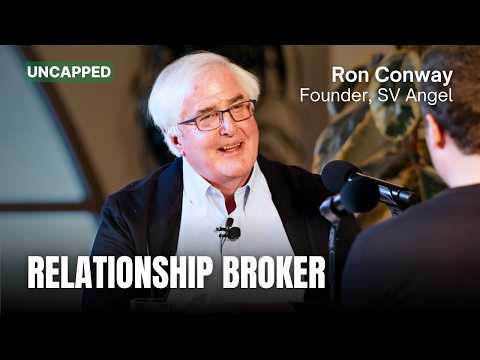
SV Angel’s Ron Conway: Silicon Valley’s Relationship Broker | Ep. 45
Ron Conway (guest), Jack Altman (host)
In this episode of Uncapped with Jack Altman, featuring Ron Conway and Jack Altman, SV Angel’s Ron Conway: Silicon Valley’s Relationship Broker | Ep. 45 explores ron Conway on angel investing, relationships, founder advocacy, and politics Conway traces his career across tech cycles—from semiconductors to today’s AI boom—which he argues is larger than all prior waves combined.
Ron Conway on angel investing, relationships, founder advocacy, and politics
Conway traces his career across tech cycles—from semiconductors to today’s AI boom—which he argues is larger than all prior waves combined.
He describes becoming an angel investor via mentorship from Sequoia’s Don Valentine and early learnings from both failures and wins like Ask Jeeves.
SV Angel’s model is explicitly non-passive: it prioritizes holistic founder support, especially at critical inflection points such as crises, fundraising dead-ends, or governance blowups.
Conway frames his core investing advantage as a decades-built “relationship network” that enables high-leverage introductions and rapid problem-solving across tech, media, healthcare, and government.
He argues tech must be civically engaged, citing SOPA/PIPA activism, the SVB deposit-guarantee push, and current opposition to a proposed California wealth tax ballot initiative.
Key Takeaways
Tech cycles reward those who adapt—and punish complacency.
Conway’s Altos story illustrates that even successful companies get displaced if they don’t disrupt themselves; he treats each new wave (now AI) as a major reset in opportunity and risk.
Get the full analysis with uListen AI
Angel investing is most powerful when it’s “all in,” not passive.
SV Angel positions itself as “Advocates for Founders,” helping with hiring, strategy, personal crises, and operational blockers—anything that keeps a founder functioning and the company alive.
Get the full analysis with uListen AI
Build a relationship network before you need it; transactional outreach won’t work.
Conway attributes his leverage to decades of compounding relationships (semis → Apple-era ties → software execs → internet platforms), which later become fast paths to distribution, talent, regulators, and crisis support.
Get the full analysis with uListen AI
Operate like a connector every day, not only when fundraising.
He describes constantly routing people to each other because “something good is gonna happen,” including helping founders even when SV Angel isn’t invested (e. ...
Get the full analysis with uListen AI
Go deepest at inflection points—this is where small effort can change outcomes.
Rather than hovering, SV Angel mobilizes when the company faces existential moments; Conway cites Airbnb’s COVID free-fall and quickly raising capital when the board believed it was impossible.
Get the full analysis with uListen AI
Founder advocacy sometimes requires confrontation and fearlessness.
Conway emphasizes conviction and competitiveness (“I do not like losing”) and points to high-stakes fights like the SVB response and the OpenAI governance crisis as moments to “take no prisoners.”
Get the full analysis with uListen AI
Thematic investing creates focus and improves deal filtering at seed.
SV Angel maintains a short list of active themes (historically search, B2B; now themes within AI) and prioritizes depth and pattern recognition inside them over looking at everything.
Get the full analysis with uListen AI
Notable Quotes
“The AI boom is bigger than all of those combined, I swear to God.”
— Ron Conway
“If you don't disrupt yourself, you will be disrupted.”
— Ron Conway
“With SV Angel, you're all in or don't bother.”
— Ron Conway
“Marc Andreessen calls me the human router.”
— Ron Conway
“You gotta recognize the problem, want to solve it, and have conviction, and want to win, and off you go.”
— Ron Conway
Questions Answered in This Episode
SV Angel says it’s “all in or don’t bother”—what are the specific activities you refuse to do because they’re low-leverage or distract founders?
Conway traces his career across tech cycles—from semiconductors to today’s AI boom—which he argues is larger than all prior waves combined.
Get the full analysis with uListen AI
You describe being constantly in “connector mode”; what system (notes, CRM, memory, routines) do you actually use to track and follow up on key intros?
He describes becoming an angel investor via mentorship from Sequoia’s Don Valentine and early learnings from both failures and wins like Ask Jeeves.
Get the full analysis with uListen AI
On Airbnb during COVID, what were the concrete steps and pitch that enabled raising capital in 10 days when others said it was impossible?
SV Angel’s model is explicitly non-passive: it prioritizes holistic founder support, especially at critical inflection points such as crises, fundraising dead-ends, or governance blowups.
Get the full analysis with uListen AI
In the SVB weekend, what was your communication strategy—who did you call first, and what arguments moved Congress/FDIC stakeholders?
Conway frames his core investing advantage as a decades-built “relationship network” that enables high-leverage introductions and rapid problem-solving across tech, media, healthcare, and government.
Get the full analysis with uListen AI
What decision framework do you use to determine when to fight publicly versus working quietly behind the scenes for a founder?
He argues tech must be civically engaged, citing SOPA/PIPA activism, the SVB deposit-guarantee push, and current opposition to a proposed California wealth tax ballot initiative.
Get the full analysis with uListen AI
Transcript Preview
You got to recognize the problem, want to solve it, and have conviction, and want to win, and off you go. I can call people up now and say, "You want to do it the hard way or the easy way?"
God, I would hate to get that call from you.
[laughs]
[upbeat music] Thanks. Cool. All right. Well, this is my, uh, this is my first go at a live podcast, so I don't know what's gonna happen. But we both have a sufficient number of microphones on that this will be, this will be good.
Yeah, yeah. And I, I feel rude not facing the audience, but because it's a podcast-
The audience is out there
... and my camera is there, if you're back there, don't think I'm rude.
That's right.
I'm doing what we do on podcasts. And I'm gonna leave the second we're done.
Second we're done.
Because I have Nancy and Paul Pelosi sitting with Gail and I on the floor of the Warrior game tonight, and if you know Nancy Pelosi, she is always prompt and has told me to be prompt.
We will not be late. And, uh, we're gonna get to that type of thing as one of the sort of your superpowers. So everybody, uh, knows who you are, but, um, as I was thinking about this conversation and this audience, we have a bunch of seed investors here in, you know, various forms of the job and various stages in their career. And you are sort of the person who is the kind of archetype of angel investing. You've been sort of, um, almost embarrassingly successful investing in, like, Stripe and LinkedIn and Facebook and Google and PayPal and Airbnb and Pinterest and almost more than, uh, it's, like, reasonable to name. And so what I kind of wanted to do was to try to open up how you've made that happen and have you kind of look back over the decades of your investing and try to glean what an investor in twenty twenty-six can learn from you and your success and try to, you know, take, take for themselves. I think the place I wanted to start was, like, if you could try to kind of give your own narrative of your own career, starting from when you first got into investing and, like, what played out over time, just to sort of ground us in, like, what your sort of professional life has been all about.
Well, I think it all starts with age and seniority. And speaking of age and seniority, uh, your mom is here, and I wanna recognize her.
My mom's young.
What?
My mom is young. There's no age and seniority.
Well, hey, I view myself as young too.
Yeah, that's good. Yeah.
But, uh, I wanna recognize that Mom is here. Uh, and we had a good time at Sam's fortieth. And this is why I bring up age. Because I've been through every technology cycle, starting with semiconductors, which is where I started my career. I did not like school. I couldn't wait to get the hell out of school. Uh, so I left San Jose State, and the next Monday, I started work at National Semiconductor in the Santa Clara Valley when there-- when most of Santa Clara Valley was fruit orchards and an occasional semiconductor factory. So I went, you know, I've been through the semiconductor phase, which kind of gave way to the computer phase, that gave way to the software phase, and then into the nineties with the internet boom, and then today, the AI boom. The AI boom is bigger than all of those combined, I swear to God. Uh, it's, it's hard to fathom. It's, it's hard to keep up with, but I think we all have that problem because there's so much change happening at once. Even in the internet boom, you, you could kind of keep track of things. You know, Netscape was mission central. Netscape's the one that allowed you access to all of this corpus of information on the web. And from that, you know, we, we, we got the internet boom. So I was fortunate to go work at National Semiconductor. A few people at National went off and started, started a company called Altos Computer. They asked me to join. This is when the microcomputers were disrupting DEC, Data General, Prime, Wang. Does anybody remember these names? But this little Altos computer was upending them. Uh, so it's, you know, technology is all about disrupting, so we were disrupting the mini computer companies. And I love it because I, I interviewed sitting on the floor. There are no desks, nothing. I, I was the head of sales, uh, on Walsh Road in, in, uh, Santa Clara, literally, like, five blocks from National Semiconductor. Um, and I, because I was the sales guy, and justifiably so, technology companies are engineer-driven. And our engineering, uh, CEO, Dave Jackson, who had more charisma, you know, this, this Brit just eked charisma-
Install uListen to search the full transcript and get AI-powered insights
Get Full TranscriptGet more from every podcast
AI summaries, searchable transcripts, and fact-checking. Free forever.
Add to Chrome