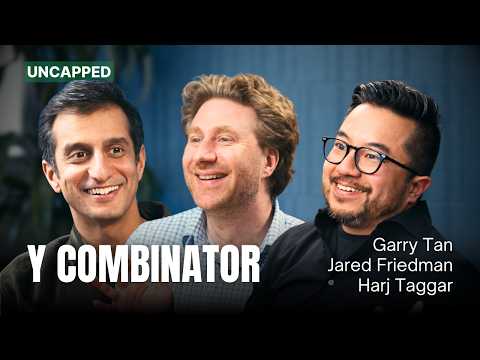
Y Combinator in the Age of AI | Ep. 43
Jack Altman (host), Garry Tan (guest), Jared Friedman (guest), Jared Friedman (guest)
In this episode of Uncapped with Jack Altman, featuring Jack Altman and Garry Tan, Y Combinator in the Age of AI | Ep. 43 explores yC refocuses on founder transformation as AI accelerates startups dramatically The group argues YC’s “product” has changed less than outsiders think: it’s still a high-trust, high-intensity environment that transforms builders through community, clarity, and pressure to make something people want.
YC refocuses on founder transformation as AI accelerates startups dramatically
The group argues YC’s “product” has changed less than outsiders think: it’s still a high-trust, high-intensity environment that transforms builders through community, clarity, and pressure to make something people want.
AI coding agents (e.g., Claude Code/Codex) are radically compressing build time, raising the expected product bar, enabling more pivots, and expanding the pool of founders who can ship sophisticated software without large teams.
YC is adapting selection and evaluation—experimenting with asking applicants to submit agent transcripts—to better assess real building ability, decision-making, and product judgment beyond resumes and pedigrees.
They discuss second-order effects: competitive pressure and faster iteration, shifting moats in SaaS (systems of record vs brittle integration-heavy tools), venture capital consolidation and bigger later rounds, and YC’s push to widen the founder funnel via campus outreach and programs like Fellows.
Key Takeaways
YC’s value proposition is intentionally stable: transformation through a proven process.
They describe YC as a “great product” created by PG that shouldn’t be over-edited—still centered on community, focus, and rapid iteration toward “make something people want.”
Get the full analysis with uListen AI
AI shifts the bottleneck from coding capacity to judgment: agency and taste.
As building gets cheaper/faster, YC emphasizes whether founders can choose the right problem, define a real “feature,” avoid over-engineering, and iterate toward what users want—skills revealed in how they use agents.
Get the full analysis with uListen AI
YC is experimenting with evaluating agent work directly, not just outputs or resumes.
For the first time, applicants can submit Claude/Codex transcripts; YC believes prompting style and workflow (plan mode, systems thinking, handling edge cases) can expose real builder competence and product rigor.
Get the full analysis with uListen AI
The MVP bar is rising because shipping is faster and users expect more polish.
Internal demos (“product showcase”) have become steadily stronger; with agents, founders can produce far more before interviews and within the batch, changing what “early” looks like.
Get the full analysis with uListen AI
Faster build cycles enable more pivots—but random pivoting is an anti-pattern.
They expect more experimentation during batches, but warn against founders launching unrelated ideas just to see what sticks; good pivots come from a founder’s genuine insight and motivation, not market noise.
Get the full analysis with uListen AI
Capital is less necessary to reach early revenue, but later rounds are getting larger.
They observe companies hitting $1–2M ARR with tiny teams, yet B rounds are “bigger than ever,” driven by mega-funds, competitive surface area, and the sense that teams are still execution-constrained post-PMF.
Get the full analysis with uListen AI
AI makes some classic SaaS moats brittle while strengthening others.
Integration-heavy advantages can evaporate if connectors can be generated quickly; systems of record, regulated “touching money,” and entrenched operational workflows may remain sticky. ...
Get the full analysis with uListen AI
Notable Quotes
“The most surprising thing to people from the outside… is actually how little has changed.”
— Jared Friedman
“[YC is] like Disneyland for transformation… we take people who are earnest and technical, and then… hopefully they become formidable.”
— Garry Tan
“AGI’s here, guys, for code… I could create in eighty hours something that I could not create with five million dollars and five engineers in two years.”
— Garry Tan
“You can tell a lot about whether someone can build just from like how they prompt the agents.”
— Garry Tan
“We spend the vast majority of our time talking about competition telling founders not to worry about competition… just out execute them.”
— Jack Altman
Questions Answered in This Episode
On the new application artifact: what specifically would impress you in a Claude/Codex transcript (planning, tests, debugging, architecture decisions), and what would be red flags?
The group argues YC’s “product” has changed less than outsiders think: it’s still a high-trust, high-intensity environment that transforms builders through community, clarity, and pressure to make something people want.
Get the full analysis with uListen AI
How do you separate “good prompting” from genuine engineering/product ability if applicants can copy prompting playbooks or outsource transcript creation?
AI coding agents (e. ...
Get the full analysis with uListen AI
You said AI expands the net rather than replaces the desire for “genius engineers.” What profiles are you now more likely to fund that previously wouldn’t pass the bar?
YC is adapting selection and evaluation—experimenting with asking applicants to submit agent transcripts—to better assess real building ability, decision-making, and product judgment beyond resumes and pedigrees.
Get the full analysis with uListen AI
If MVP quality expectations are higher, what’s the new minimum viable scope for a YC interview—working demo, paying users, or just evidence of iteration speed?
They discuss second-order effects: competitive pressure and faster iteration, shifting moats in SaaS (systems of record vs brittle integration-heavy tools), venture capital consolidation and bigger later rounds, and YC’s push to widen the founder funnel via campus outreach and programs like Fellows.
Get the full analysis with uListen AI
You predict more in-batch pivots. What cadence do you recommend for deciding to persevere vs pivot in an AI-accelerated environment (days, weeks, user count thresholds)?
Get the full analysis with uListen AI
Transcript Preview
I think like AI and like a big change like this, like, favors younger people and for all sorts of reasons. So I, I get it.
For what it's worth, I'm a late bloomer. I did YC when I was twenty-seven, and-
I was twenty-six.
Yeah. So, hey, late bloomers, high five. [laughing]
[laughing] The old guys. [on-hold music] All right, guys, I'm really excited to be here with you. Thanks for, thanks for all doing this with me. So I guess just to start, when did you all first go through YC as founders?
I think I did it first. I was summer two thousand and six, so the third batch ever.
I did winter two thousand and seven, so six months later.
And then summer '08.
Okay. So a long time.
Yeah.
It's, like, pretty close to the beginning.
Yeah.
So I guess where I wanna start is, like, you all have, in many incarnations, seen, you know, what YC has been like as founders, as partners. You know, you've sort of worked outside of YC, inside of it. What has changed? And so I guess maybe the lens I wanna ask this question through is what was the value proposition to founders in 2006 versus 2016, 2026? Like, what has changed? What has stayed the same?
Yeah, what was it like in '06?
The most surprising thing to people from, from the outside, I found, is actually how little has changed, and I think that's kinda by design, which is, like, the thing that Paul Graham created, that we all did in the early two thousands. Like, it was great. It was a great product, and as you know, when you have a great product, you're like, "Don't fuck with it."
[chuckles]
You know? There are some things had to change, but I would say in broad strokes, it's much more the same than it is, is different.
How would you capture the essence of that product? Like, to a founder, if you had to boil it down to, like, two or three things, like, what is that product about?
So we recently worked on a redesign of the Y Combinator website. Actually, Garry had it.
Garry Tan.
But we actually, like, tried to, like, write it down m- possibly for the first time. Do you wanna explain this? Since it's really your words on the website.
Oh, gosh. I mean, it was team effort, but, like, honestly, we tried to return to, you know, what is the founder's experience, and then we found all of these old photos of, you know... I-- actually, your brother is, like, the first-
Yeah
... one on there, and it's, like-
First batch
... him with the double pop collar.
Yeah.
And then-
We'll pop that up on the screen.
[laughing] That's right. And then you start flipping through, and it's, you know, Patrick and John Collison. It's Brian and Joe and Nate-
Yeah
... at Airbnb, and you see them so young. And then you see them, you know, ring the bell, and it's like, basically what we're trying to create is, like, Disneyland for transformation from, you know, startup founders who are just starting out to literally the people who sort of make these, the companies that really matter. It's actually a social process. Like, all reality is sort of, um, socially constructed. And then uniquely, like, I remember when I found, uh, YC and then came to my fir- my first startup school, it was kinda like being a fish out of water and then jumping into water.
Install uListen to search the full transcript and get AI-powered insights
Get Full TranscriptGet more from every podcast
AI summaries, searchable transcripts, and fact-checking. Free forever.
Add to Chrome