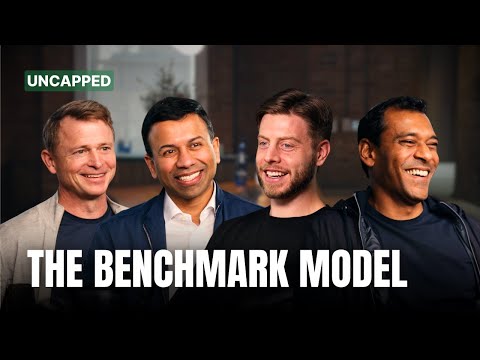
The Benchmark Partnership: Peter Fenton, Eric Vishria, Chetan Puttagunta, Ev Randle | Ep. 41
Peter Fenton (guest), Eric Vishria (guest), Jack Altman (host), Chetan Puttagunta (guest), Ev Randle (guest), Chetan Puttagunta (guest)
In this episode of Uncapped with Jack Altman, featuring Peter Fenton and Eric Vishria, The Benchmark Partnership: Peter Fenton, Eric Vishria, Chetan Puttagunta, Ev Randle | Ep. 41 explores benchmark’s small, founder-first partnership model and AI investing philosophy Benchmark argues that its small size is a deliberate choice to maximize founder proximity, relationship quality, and long-term engagement rather than assets under management or deal volume.
Benchmark’s small, founder-first partnership model and AI investing philosophy
Benchmark argues that its small size is a deliberate choice to maximize founder proximity, relationship quality, and long-term engagement rather than assets under management or deal volume.
The partners describe a culture built on equal economics, responsibility to “contribute more than you take,” and a commitment to truth-telling that’s easier when they aren’t structurally incentivized to win follow-on rounds.
They frame the best investor-founder relationship as a decade-long co-founder-like sparring partnership grounded in deep understanding, authenticity, and “unconditional positive regard,” not sycophancy or passivity.
On AI, they claim their apparent “thesis” was mostly founder-driven: they leaned into non-consensus early partnerships with exceptional entrepreneurs during the 2022–2024 correction and see founder adaptability as even more critical as AI’s technical substrate changes rapidly.
Key Takeaways
Benchmark optimizes for founder proximity, not firm scale.
They believe the core work—being deeply engaged with founders from idea/pre-launch through a decade-long arc—doesn’t scale with more capital, more deals, or more organizational layers.
Get the full analysis with uListen AI
Scaling a VC firm introduces activities that actively degrade outcomes.
They argue more capital pushes behaviors like “deploying” for its own sake, internal reporting dynamics, and portfolio/geo expansion friction—reducing relationship quality and even cash-on-cash multiples.
Get the full analysis with uListen AI
The model is “happiness maximizing,” not financially maximal.
Vishria explicitly says Benchmark could likely earn more by scaling, but chooses a structure that preserves day-to-day fulfillment and the kind of work they want to do.
Get the full analysis with uListen AI
Equal partnership works because prior generations gave away economics.
They call the real “leap” not founding Benchmark but the founders’ choice to hand off brand value with no residual economics—something most firms can’t replicate due to incentives and ego.
Get the full analysis with uListen AI
A cultural norm: leave before you’re taking more than you give.
Fenton describes feeling pressure to raise his hand and step back once he’s no longer contributing disproportionately—an implicit ethic that keeps the partnership healthy over generations.
Get the full analysis with uListen AI
Founder-friendliness means truth-seeking, not comfort or passivity.
They reject both sycophancy (“don’t hurt feelings”) and hands-off posturing (“call us if you need us”) in favor of direct feedback and transparent, face-to-face candor.
Get the full analysis with uListen AI
The best board member is a long-term sparring partner.
They emphasize asking clarifying questions that help founders surface their own judgment—more like coaching and co-founding than dispensing “advice”—especially over 10+ year board tenures.
Get the full analysis with uListen AI
Exceptional founders are often recognizable, but investors talk themselves out of them.
Vishria claims many good investors can see “special,” yet pass due to market narratives, competition, or outcome sizing; he cites missing Scale despite recognizing the founder’s quality.
Get the full analysis with uListen AI
Authenticity is a key founder screen; promotion is a red flag.
Fenton says they’re wary of “promoters” and inauthenticity—especially in hot cycles where the number of “founders” rises but true “entrepreneurs” remains constant.
Get the full analysis with uListen AI
Benchmark’s AI track record was more founder-driven than thesis-driven.
Randle notes the outside view looks thematic (inference cloud, vertical apps, data), but internally the common driver was backing unusually compelling founders early, often in non-consensus moments.
Get the full analysis with uListen AI
Down-cycles filter for ‘true believers’ and improve entry quality.
Puttagunta argues the 2022–2023 correction reduced tourist capital and surfaced founders willing to build through pain, which raised the caliber of seed/A opportunities Benchmark backed.
Get the full analysis with uListen AI
In AI, founder adaptability matters more because moats erode faster.
They argue AI’s underlying substrate is changing quarter-to-quarter, so a founder’s ability to continually re-find edge and rebuild moats is now central to underwriting.
Get the full analysis with uListen AI
Notable Quotes
“It’s not financially maximal… it’s happiness maximizing.”
— Eric Vishria
“More capital equals a whole bunch of activities that I think degrade.”
— Peter Fenton
“We wanna be the first call… when you hit a patch of bad news.”
— Chetan Puttagunta
“If we’ve really done our job… they feel like a co-founder, Benchmark.”
— Peter Fenton
“The conclusion was incorrect… we absolutely recognized that he was amazing.”
— Eric Vishria
Questions Answered in This Episode
Benchmark says scaling degrades cash-on-cash multiples—what specific mechanisms cause returns to worsen as AUM rises?
Benchmark argues that its small size is a deliberate choice to maximize founder proximity, relationship quality, and long-term engagement rather than assets under management or deal volume.
Get the full analysis with uListen AI
How does Benchmark operationalize “first call” behavior—what routines (weekly calls, response SLAs, recruiting help) are expected of every partner?
The partners describe a culture built on equal economics, responsibility to “contribute more than you take,” and a commitment to truth-telling that’s easier when they aren’t structurally incentivized to win follow-on rounds.
Get the full analysis with uListen AI
What are examples of “activities that degrade with scale” you’ve personally seen at other firms (committee dynamics, internal reporting, follow-on negotiations, platform teams)?
They frame the best investor-founder relationship as a decade-long co-founder-like sparring partnership grounded in deep understanding, authenticity, and “unconditional positive regard,” not sycophancy or passivity.
Get the full analysis with uListen AI
How do you maintain radical candor without crossing into demoralizing criticism—what’s the practical line between truth-telling and harshness?
On AI, they claim their apparent “thesis” was mostly founder-driven: they leaned into non-consensus early partnerships with exceptional entrepreneurs during the 2022–2024 correction and see founder adaptability as even more critical as AI’s technical substrate changes rapidly.
Get the full analysis with uListen AI
You argue “no follow-ons” reduces conflicts—are there cases where not doing pro-rata harms founders (signaling, pricing support), and how do you mitigate that?
Get the full analysis with uListen AI
Transcript Preview
I know that I'm a moment away from many of these people firing me, and I want them to.
[chuckles]
Um, but the minute I become predictable, it's over. [chuckles]
Many things, predictable is not one of them. [laughing]
Benchmark team, it is an honor to be here with you all. I'm not gonna make you all reply in unison to me, but I'm really excited to be doing this with you.
[laughing]
I want to start with an observation, which is that of the sort of top VC firms, whatever you call that, but like, you know, I'm thinking of Founders Funds, Sequoia, Thrive, Andreessen, most have scaled in a big way. For whatever set of reasons, that has been sort of like the dominant strategy. Benchmark has been a stalwart in some ways, to hold out with small firm, small team, smallish capital base, and I'm just curious, like, why? And I'm sure you all have sort of like different opinions on this. So just to pick somebody random, like Chetan, I'm curious, like, what is your take on this whole topic?
You know, we only do one thing, which is partner with founders early, and we really like to partner with them really early. Like, I think the favorite amongst all of us is partnering with a founder pre-launch or at idea phase, or when it's, like, two or three people in a room. You know, and just growing with that firm, I think just like in terms of measuring happiness for each of us, like, that's where we derive the most amount of like, professional satisfaction. And if you just think about what that does in terms of alignment of Benchmark with the founders and that company, it's pretty amazing if you're there from, like, step zero. I would argue that you can't do that as you scale. Like the interests... And we see it all in our board meetings, like, every round becomes its own thing and its own game and its own whatever.
And one of Benchmark's things that you-- and we've talked about this, that you're like, we don't do the future rounds, so there's no conflict in the middle of this.
That's right. And we're fully aligned on dilution. We're fully aligned on trying to make this as the biggest outcome we can do. And I think capital constrains you in that way, time constrains you in that way, and each time you go partner with a founder, you're doing it with extremely high conviction, and you're going all in. That, to me personally, is an extraordinary experience and, you know, different models, different ways of practicing the business. But for me, this is the way I love practicing the business. It's becoming rarer by the day, and then therefore, it becomes more differentiated.
Peter, you've been here the longest, and so you've obviously seen Benchmark in its context through a bunch of sort of changes around you. Have you felt tempted at any points? Have you felt strengthened in sort of your clarity on what it should be like?
Install uListen to search the full transcript and get AI-powered insights
Get Full TranscriptGet more from every podcast
AI summaries, searchable transcripts, and fact-checking. Free forever.
Add to Chrome