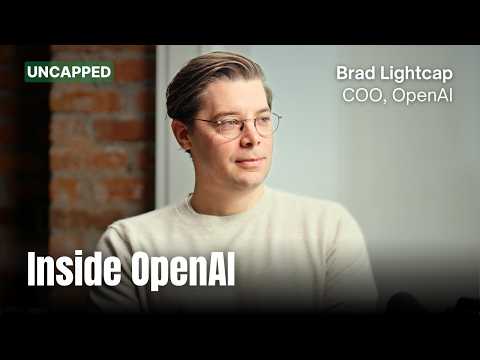
OpenAI COO Brad Lightcap on the Future of AI | Ep. 46
Brad Lightcap (guest), Jack Altman (host)
In this episode of Uncapped with Jack Altman, featuring Brad Lightcap and Jack Altman, OpenAI COO Brad Lightcap on the Future of AI | Ep. 46 explores brad Lightcap on OpenAI’s evolution from chatbots to agents Lightcap describes OpenAI’s pre-ChatGPT era as intensely research-driven, focused on accelerating progress via compute, infrastructure, and researcher enablement rather than product polish.
Brad Lightcap on OpenAI’s evolution from chatbots to agents
Lightcap describes OpenAI’s pre-ChatGPT era as intensely research-driven, focused on accelerating progress via compute, infrastructure, and researcher enablement rather than product polish.
He explains that ChatGPT’s breakout came from observing users’ natural desire to “talk to” models, though OpenAI still underestimated the scale and operational demands.
He frames AI’s recent history in phases—scaling (2018–2022), chatbots (2022–2024), and today’s agent era—where models can act asynchronously, use tools, and eventually gain long-horizon memory.
Lightcap argues public fear and skepticism about AI is partly the industry’s fault for failing to articulate a compelling “better future,” while he emphasizes individual empowerment and rapid time-to-value as the core upside.
On startups, incumbents, and investing, he advises building at the “outer ripple” of new capabilities—deep in specific user problems—while expecting rapid iteration, product ephemerality, and a major rebuild cycle across legacy software.
Key Takeaways
OpenAI’s core engine is still research, not product marketing.
Lightcap emphasizes that research “drives everything,” and the early years were about removing bottlenecks for researchers—from supercomputer investment down to mundane operational friction.
Get the full analysis with uListen AI
ChatGPT succeeded because users wanted dialogue, not “completions.”
Before ChatGPT, OpenAI noticed people hacking a completions interface into turn-based conversation, signaling that chat was the intuitive UI layer for language models.
Get the full analysis with uListen AI
The industry is moving from chatbots to agents, and we’re mid-transition.
Lightcap defines agents as systems that run asynchronously, use tools, take longer “thinking” horizons, and eventually incorporate primitives like memory for multi-session work.
Get the full analysis with uListen AI
Economic diffusion will lag technical progress by years or decades.
Even if model progress paused, Lightcap expects a long innovation/diffusion cycle to integrate capabilities into real workflows; the mismatch between fast innovation and slow adoption will shape the era.
Get the full analysis with uListen AI
Lower-cost software doesn’t remove engineers; it increases demand for software.
He applies a supply/demand lens: reducing marginal cost expands use-cases dramatically, shifting engineers from typing code to guiding, overseeing, and maintaining vastly more software.
Get the full analysis with uListen AI
Biggest near-term risk surface is fragile, archaic software in critical systems.
Rather than focusing only on job displacement, he points to hospitals, grids, and legacy enterprise systems as vulnerable; AI-enabled modernization and hardening could be a major net benefit.
Get the full analysis with uListen AI
Startups should avoid competing “under the rock” and build on the outer ripple.
He suggests founders target newly-enabled, underserved, specific problems where domain intimacy and customer understanding matter more than raw model capability.
Get the full analysis with uListen AI
Winning companies will iterate brutally fast and discard sunk costs readily.
As building becomes cheaper, founders (and even established software CEOs) will “restart” products, keeping only durable assets like teams, trust, and customer relationships.
Get the full analysis with uListen AI
Codex-style agent tools can empower even non-technical operators.
Lightcap says Codex has replaced ChatGPT for his daily work, citing a recruiting workflow where it wrote a program to gather and score candidates’ public writing—collapsing weeks of effort into minutes.
Get the full analysis with uListen AI
Forward-deployed engineering is a wedge for mass customization inside businesses.
He argues the off-the-shelf era is fading because AI makes bespoke internal tooling economical, shrinking solution design cycles from ~18 months to ~18 days.
Get the full analysis with uListen AI
Notable Quotes
““You could stop progress right now, and I still think there’s kind of a ten or twenty-year diffusion and innovation cycle.””
— Brad Lightcap
““In some sense, the better the technology gets… the more we actually end up… diminishing it almost to just being a tool.””
— Brad Lightcap
““Ninety-nine percent of people… get to use bad tools or don’t have any tools at all.””
— Brad Lightcap
““I think we as an industry have done a horrible job of being able to paint… a future that is way better than the world we live in today.””
— Brad Lightcap
““You don’t wanna be right under the rock dropping. You’re gonna drown.””
— Brad Lightcap
Questions Answered in This Episode
What specific internal signals (metrics or user behaviors) most convinced OpenAI that “talking to the model” would be the dominant interface, beyond anecdotal prompting behavior?
Lightcap describes OpenAI’s pre-ChatGPT era as intensely research-driven, focused on accelerating progress via compute, infrastructure, and researcher enablement rather than product polish.
Get the full analysis with uListen AI
When you say we’re “in the middle” of the agent era, what are the 2–3 missing primitives (memory, planning, tool reliability, evaluation) that most limit real-world agent deployment today?
He explains that ChatGPT’s breakout came from observing users’ natural desire to “talk to” models, though OpenAI still underestimated the scale and operational demands.
Get the full analysis with uListen AI
You mentioned a 10–20 year diffusion cycle even if progress stopped—what are the biggest organizational bottlenecks you see inside enterprises that will slow adoption?
He frames AI’s recent history in phases—scaling (2018–2022), chatbots (2022–2024), and today’s agent era—where models can act asynchronously, use tools, and eventually gain long-horizon memory.
Get the full analysis with uListen AI
How does OpenAI decide when to “shut down” experimental bets and recycle teams—what are the kill criteria in practice?
Lightcap argues public fear and skepticism about AI is partly the industry’s fault for failing to articulate a compelling “better future,” while he emphasizes individual empowerment and rapid time-to-value as the core upside.
Get the full analysis with uListen AI
On the startup ‘outer ripple’ strategy: can you give concrete examples of underserved niches that become viable only because agents/coding tools cut build costs dramatically?
On startups, incumbents, and investing, he advises building at the “outer ripple” of new capabilities—deep in specific user problems—while expecting rapid iteration, product ephemerality, and a major rebuild cycle across legacy software.
Get the full analysis with uListen AI
Transcript Preview
Ninety-nine percent of people, uh, get to use bad tools or don't have any tools at all. The quality of experience of the people that exist as their customers and users is not very good. Everyone has like lived the bad experience of going-
Yeah
... through modern life-
Yes
... uh, and dealing with the things that we have to deal with. I think if you're kind of sitting there lamenting the idea that, you know, there's no more good ideas and no more new ideas, like it's just kinda lazy. [upbeat music]
All right.
Do you like, do you film an intro?
Do I film an intro?
Or you just go-
No, I just kinda go-
... hard in?
I just start.
Okay.
Yeah, this probably is the intro.
All right.
So Brad, thanks for doing this with us. I'm excited.
Yeah, me too.
Do you have enough drinks? Would you like one more?
Well, yeah. I'll take whatever I can get.
We can load up. Well, I really appreciate you making time for this. I've been really looking forward to it. Um, what I wanted to start with actually was I was just like thinking about this last night, and you joined OpenAI in twenty eighteen, and then like four years, you know, as like research lab, you guys are like beating Dota. And then like four years in, like ChatGPT launches, and then it's like this whirlwind that's been, I guess like three years, but I'm sure it feels like a lot more.
Mm-hmm.
I was just curious if you could like share your narrative or recollection of like what the journey's been like and like what are like the chapters, like what's just your experience been like as you like look back on this so far?
Yeah, chap-chapters is the right word. Um, it's the kind of journey of OpenAI which I think tracks the journey of AI as a, as a field, as an industry is, uh, has kind of been broken up into these weird periods. Like, when I joined, it was no one had really heard of OpenAI. Our, our work was, uh, you know, relegated mostly to, uh, kind of small, uh, niches of San Francisco tech culture that followed such things as, you know, us beating the Dota, you know, best Dota players in the world-
Yeah
... and things like that. Really it was kind of, you know, I didn't really like have anyone to talk to about it. It was like e-everyone was kinda, "What are you, like what are you doing there?" Um, "What," and, "What do you do there?"
And you were like the CFO when you joined, right?
I was our CFO. Um, I spent-
What-
Yeah.
Uh, you, like what, what were you thinking when you joined? Like, what, what did you expect it was gonna be?
Well, I didn't know. Um, I was twenty-seven, and so I was just kind of like, you know... I, I, and I, I maybe back up a minute. I, I was at, uh, Y Combinator prior working with Sam, um, and I was starting to spend a lot more time with what I call our hard tech portfolio in YC, so all the companies that are building everything that wasn't pure kind of SaaS and internet, you know, consumer internet. So spending a lot of time with, you know, everything from nuclear fusion to satellites to biotech to, you know, anything that would kind of fit outside. And OpenAI was kind of in that camp. Like AI was kind of one of those things that was like, it was promised as this like future technology, but, you know, it wasn't really sure like who, who's like actually building this. Um, OpenAI started, as you know, as like a YC research project.
Install uListen to search the full transcript and get AI-powered insights
Get Full TranscriptGet more from every podcast
AI summaries, searchable transcripts, and fact-checking. Free forever.
Add to Chrome