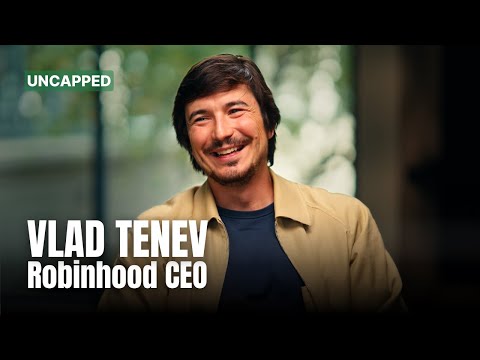
Robinhood’s Vlad Tenev on AI, Prediction Markets, and the Future of Trading | Ep. 33
Vlad Tenev (guest), Jack Altman (host)
In this episode of Uncapped with Jack Altman, featuring Vlad Tenev and Jack Altman, Robinhood’s Vlad Tenev on AI, Prediction Markets, and the Future of Trading | Ep. 33 explores vlad Tenev on democratizing finance with AI and prediction markets Tenev frames online brokerage as a decades-long democratization story driven by deregulation, new interfaces (phone → internet → mobile), and infrastructure that lowers costs to near-zero.
Vlad Tenev on democratizing finance with AI and prediction markets
Tenev frames online brokerage as a decades-long democratization story driven by deregulation, new interfaces (phone → internet → mobile), and infrastructure that lowers costs to near-zero.
He argues Robinhood has shifted from a “trading app” to a multi-product financial “super app,” aligning incentives around growing customer assets over time and expanding into banking, retirement, advice, and active trading tools.
Prediction markets, in his view, broke out due to U.S. regulatory changes around election contracts and now expand rapidly into sports and other event-based forecasting—functioning both as entertainment and as an information/forecasting layer.
On the horizon, he highlights tokenization as a path to broader access to private-market value creation and sees AI boosting customer support, engineering velocity, marketing output, and enabling “vibe trading”—natural-language-driven analysis and increasingly automated financial tasks.
Key Takeaways
Brokerage disruption historically comes from removing friction and cost.
Tenev traces a line from Mayday commission deregulation enabling Schwab’s low-cost phone model, to E-Trade bringing trading online, to Robinhood pushing commissions to zero via mobile-first design and institutional-grade infrastructure.
Get the full analysis with uListen AI
Robinhood’s strategy is shifting from trading to “financial home.”
He emphasizes building a financial super app (banking/direct deposit, credit card, Gold subscription, retirement, advice) so Robinhood becomes a primary account and assets stay on-platform.
Get the full analysis with uListen AI
“Passive vs active” isn’t a lifecycle—people keep multiple money buckets.
Rather than graduating from stock picking to ETFs, users typically allocate across buckets (retirement/passive plus a smaller active sleeve). ...
Get the full analysis with uListen AI
Prediction markets took off because U.S. election markets became viable at scale.
He credits a last-minute regulatory/legal opening before the presidential election as the “big bang,” letting federally regulated election contracts launch—then the same economic-value argument extends to sports and other event markets.
Get the full analysis with uListen AI
Prediction markets are positioned as both entertainment and an information product.
Tenev argues markets with “skin in the game” produce a price (not a poll), which can be highly accurate and useful for forecasting—while acknowledging the speculation/gambling critique has followed every tradable asset class.
Get the full analysis with uListen AI
Tokenization could broaden access to private-market value creation.
He calls it a major inequity that companies now stay private longer, capturing outsized gains before retail can participate. ...
Get the full analysis with uListen AI
AI impact is being operationalized with measurable productivity metrics.
Robinhood focuses on customer support (AI “deflection rate”) and engineering (AI-contributed code, commits per engineer), plus marketing throughput—pushing toward assistants/agents that explain moves, translate indicator logic into English, and automate account switching.
Get the full analysis with uListen AI
Notable Quotes
““Prediction markets… a way to think about them is they’re truth machines.””
— Vlad Tenev
““We don’t really think of ourselves as a trading app anymore… [we’re] a financial super app.””
— Vlad Tenev
““We want our customers to do well. We don’t want them to send their accounts to zero.””
— Vlad Tenev
““We call it… vibe trading.””
— Vlad Tenev
““At the fundamental level [tokenization is] basically the same idea as what stablecoins are… you mint and burn tokens against that.””
— Vlad Tenev
Questions Answered in This Episode
On prediction markets: what specific guardrails (limits, disclosures, suitability checks) does Robinhood think are necessary as sports contracts scale?
Tenev frames online brokerage as a decades-long democratization story driven by deregulation, new interfaces (phone → internet → mobile), and infrastructure that lowers costs to near-zero.
Get the full analysis with uListen AI
You describe prediction markets as a “truth machine”—how do you handle manipulation risks (thin liquidity, coordinated trading) and still claim informational reliability?
He argues Robinhood has shifted from a “trading app” to a multi-product financial “super app,” aligning incentives around growing customer assets over time and expanding into banking, retirement, advice, and active trading tools.
Get the full analysis with uListen AI
For the super-app vision, what’s the hardest product to get right: banking/direct deposit, advice (TradePMR), or active trading (Legend/Cortex)—and why?
Prediction markets, in his view, broke out due to U. ...
Get the full analysis with uListen AI
You said incentives align with assets under custody growing—how do you reconcile that with products that can encourage short-term speculation (0DTE options, sports contracts)?
On the horizon, he highlights tokenization as a path to broader access to private-market value creation and sees AI boosting customer support, engineering velocity, marketing output, and enabling “vibe trading”—natural-language-driven analysis and increasingly automated financial tasks.
Get the full analysis with uListen AI
Tokenization: in the end state, do users get voting rights and shareholder protections, or is “economic exposure” the only thing that matters? What tradeoffs are you willing to make?
Get the full analysis with uListen AI
Transcript Preview
We call it, uh, vibe trading. So you know how there's vibe coding? I think there will be vibe trading, which sounds a little flippant-
Well, but, you know-
I admit, but -
The thing you said, that we're not a trading platform, it's like, you know, it's like a financial home. It's like vibe finances. It's like, you know, because you have all these other products, I assume it's gonna, you know, like, vibe set up my, you know, kids' Five Twenty Nine account, which is, you know, not-
Totally. Here's the areas that I'm most interested in. [upbeat music]
All right, Vlad, I'm super excited to be here. Thanks for doing this with me today.
Well, glad to have you.
Okay, so I wanted to start by getting sort of your historical lay of the land of online brokerage, and maybe we don't have to go all the way back, but if you could sort of just go back to, you know, maybe, like, the early days of online stock trading into sort of like, you know, Vanguard and Schwab and Fidelity, and now you've got, like, online platforms for trading that are modern, like Robinhood. Just, like, what's sort of the history and sort of the narrative, uh, as you see it?
There's a great book about this, A Piece of the Action by Nocera. It covers basically the modern-- the rise of the modern financial industry, uh, which is super interesting. I mean, it's basically a story of a big wave of democratization associated with lower costs. So, um, Charles Schwab, uh, began in the '70s. I think there's a lot of similarities if you look back between what Charles Schwab was to begin with and kind of what Robinhood is sometimes accused of being, right? Before Schwab, Merrill Lynch was, was the big broker, and really, they had brokers that would sell you trades and call you and convince you to buy stuff, and they would charge hundreds of dollars per trade. And then after that, there was, uh... The, the event that led to the creation of Charles Schwab was called Mayday. I forget the exact date, but it was in 1972, and up until that point, uh, commissions were regulated.
Mm.
So you could not charge under, uh, a certain amount per trade for commission. And Mayday led to deregula-re-- deregulation of trading commissions, which allowed Schwab to enter the business. And Schwab said, "You know what? We're gonna cut costs. We're gonna make it as efficient as possible. So we're not gonna have branch offices. You're gonna call us on the phone. We're not gonna try to sell you anything. We'll just process your ticket over the phone, make your trade, and we'll do it for..." I don't know what it was. Call it seventy-five dollars per trade. And so they, they were in the news in the early days for creating this, like, extremely sophisticated phone dialing system that could handle lots of simultaneous... Like, they innovated-
Install uListen to search the full transcript and get AI-powered insights
Get Full TranscriptGet more from every podcast
AI summaries, searchable transcripts, and fact-checking. Free forever.
Add to Chrome