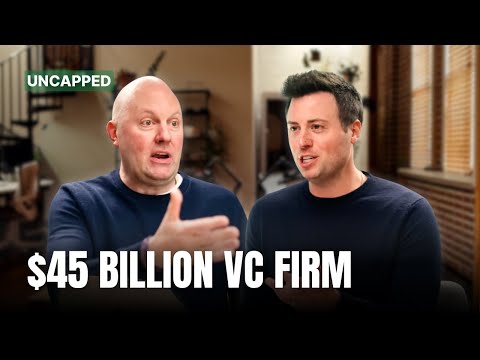
Marc Andreessen on The Future of Venture Capital | Ep. 12
Marc Andreessen (guest), Jack Altman (host)
In this episode of Uncapped with Jack Altman, featuring Marc Andreessen and Jack Altman, Marc Andreessen on The Future of Venture Capital | Ep. 12 explores andreessen explains venture’s barbell future, AI upheaval, and cultural power shifts Andreessen argues venture moved from funding “tool companies” to backing “full-stack” disruptors that enter and rebuild incumbent industries (Uber, Airbnb, Tesla, SpaceX), creating much larger winners and reshaping fund math.
Andreessen explains venture’s barbell future, AI upheaval, and cultural power shifts
Andreessen argues venture moved from funding “tool companies” to backing “full-stack” disruptors that enter and rebuild incumbent industries (Uber, Airbnb, Tesla, SpaceX), creating much larger winners and reshaping fund math.
He describes an industry “barbell” where scale firms and highly specialized seed/angel investors win, while mid-sized generalist venture funds face a “death of the middle,” with conflicts (competitive overlap) as a key limiter to firm size and strategy.
On AI, he frames current progress (reasoning models like OpenAI o1 and DeepSeek R1) as akin to the microprocessor—“a new kind of computer”—implying broad incumbent disruption and a renewed venture “hill-climbing” era.
The conversation extends into AI risk and governance (dual-use, autonomy in warfare), plus why Silicon Valley must engage politics and how social media, media distrust, and “preference falsification” have altered public discourse and institutional legitimacy.
Key Takeaways
Venture economics are dominated by omission risk, not failure risk.
Because you can only lose ~1x but can win 100–1000x, the costly mistake is missing the outlier winner. ...
Get the full analysis with uListen AI
Tech winners got bigger by going “full stack” into industries, not just selling tools.
Andreessen claims the post-2010 pattern (Uber/Airbnb/Tesla/SpaceX) is delivering the entire end-to-end experience rather than enabling incumbents with software. ...
Get the full analysis with uListen AI
Public markets are also power-law distributed—“S&P 492 and S&P 8.”
He argues a small set of companies drive most index returns because they’re “all in” on the future, while the majority harvest legacy positions. ...
Get the full analysis with uListen AI
The mature venture industry is becoming a barbell: scale platforms vs deep specialists.
Large firms can provide “power” (brand, recruiting, customers, policy access), while small seed/angels provide intense focus and early relationships. ...
Get the full analysis with uListen AI
Conflicts—not talent—are the biggest structural limiter to building mega-firms.
At Series A/B, founder trust makes investing in competitors emotionally and practically damaging, and future pivots can create surprise conflicts. ...
Get the full analysis with uListen AI
AI is ‘hill-climbing’ again; reasoning models made the breakout feel inevitable.
Andreessen says the shift from “search mode” to “hill-climbing mode” happened as models demonstrated robust reasoning and coding capability (citing o1 and DeepSeek R1). ...
Get the full analysis with uListen AI
The central AI governance risk is misapplied precaution, especially in a US–China race.
He warns the precautionary principle “killed” civilian nuclear power’s upside and could similarly suppress AI benefits if applied prematurely. ...
Get the full analysis with uListen AI
Notable Quotes
“Venture is actually a customer service business… There are two customers. There are the LPs, and there are the founders.”
— Marc Andreessen
“The S&P 500 is no longer the S&P 500. It’s like the S&P 492 and the S&P 8.”
— Marc Andreessen
“Fundamentally, we are buying long-dated, out-of-the-money call options.”
— Marc Andreessen
“Invest in strength, not in lack of weakness.”
— Marc Andreessen
“Write down two lists… What are the things that I believe that I can’t say? And what are the things that I don’t believe that I must say?”
— Marc Andreessen
Questions Answered in This Episode
On the “full-stack startup” shift: what are the best counterexamples where tool companies still create the biggest outcomes, and why?
Andreessen argues venture moved from funding “tool companies” to backing “full-stack” disruptors that enter and rebuild incumbent industries (Uber, Airbnb, Tesla, SpaceX), creating much larger winners and reshaping fund math.
Get the full analysis with uListen AI
If conflicts are the main limiter, what concrete conflict-policy innovations (if any) could let large firms do more seed without breaking trust?
He describes an industry “barbell” where scale firms and highly specialized seed/angel investors win, while mid-sized generalist venture funds face a “death of the middle,” with conflicts (competitive overlap) as a key limiter to firm size and strategy.
Get the full analysis with uListen AI
Andreessen says the ‘death of the middle’ is inevitable—what specific services or structures could a mid-sized fund offer to escape being squeezed?
On AI, he frames current progress (reasoning models like OpenAI o1 and DeepSeek R1) as akin to the microprocessor—“a new kind of computer”—implying broad incumbent disruption and a renewed venture “hill-climbing” era.
Get the full analysis with uListen AI
He argues omission is the key venture error: how should firms change diligence and portfolio construction to minimize omission without creating reckless over-deployment?
The conversation extends into AI risk and governance (dual-use, autonomy in warfare), plus why Silicon Valley must engage politics and how social media, media distrust, and “preference falsification” have altered public discourse and institutional legitimacy.
Get the full analysis with uListen AI
On AI as ‘a new kind of computer’: which layers of today’s software stack get replaced first (apps, data, dev tools, enterprise workflows), and what remains durable?
Get the full analysis with uListen AI
Transcript Preview
Here's what I encourage, I'm gonna break the fourth wall.
Yes. [chuckles]
[chuckles] Here's what I would encourage people to do. Here's the thought experiment to do: just write down two of these, in the middle of the night with nobody around, door's locked.
Write it down on a piece of paper, and let's pull it out in ten years?
Write down on a piece of paper two lists. What are the things that I believe that I can't say?
Mm-hmm.
And then what are the things that I don't believe that I must say?
Hmm. [upbeat music] All right, I am so excited to be here with Marc Andreessen. Marc, thank you so much for doing this with me today.
Jack, it, it's a pleasure.
So what I wanted to start with was the topic of small funds, big funds. We had Josh Kopelman on the podcast, and he made a point that resonated around fund size, the outcomes in venture, and sort of just, like, looking at the math of all of it. And I think as venture funds have grown, it sort of spoke to a lot of people about, like, kinda what the plan is a- and sort of how tech is gonna go. And so I guess to start, I'd be curious to hear your thoughts around that whole dynamic. Obviously, you know, s- you've got a big venture firm, and so I just want to hear kinda your perspective on this whole topic to start.
So, so start by saying, like, Jo- Josh is a longtime friend, and I, I think is a, he's a hero of the industry. Uh, and I say that because, you know, he started First Round Ventures back in the very dark days. Uh, I forget the exact year, but, you know, back, back during the dark days of, uh... after the 2000 crash. Um, and in fact, you know, there was a period of time back there when, you know, the total number of angel investors or seed investors operating in tech was, you know, maybe eight total. [chuckles] And, and, you know, f- uh, actually, Ben and I were two of them. But, you know, this was sort of the heyday of, you know, Ron Conway and, and, um, you know, kind of a, uh, you know, Reid Hoffman and a, a very small group of people who were kind of brave enough to invest in new companies at a point in time when, you know, basically everybody believed the internet was over, like the whole thing was, was, was done. And so he, like, I just think, like, that was an incredibly heroic, brave act. It obviously worked really well. It, you know, turns out buy low [chuckles] sell high actually is a good strategy.
It is very good.
Um, it's, it's very nerve-wracking when you're trying to do it, but it does work, and he, he, he had brilliant timing for when he started, and, you know, the companies that he's supported have gone on to become incredibly successful, and we've, we've worked with him a lot. Um, so, you know, we're a big fan, uh, of his. And then second is, I would say I didn't actually... I heard, I heard there was a discussion.
Install uListen to search the full transcript and get AI-powered insights
Get Full TranscriptGet more from every podcast
AI summaries, searchable transcripts, and fact-checking. Free forever.
Add to Chrome