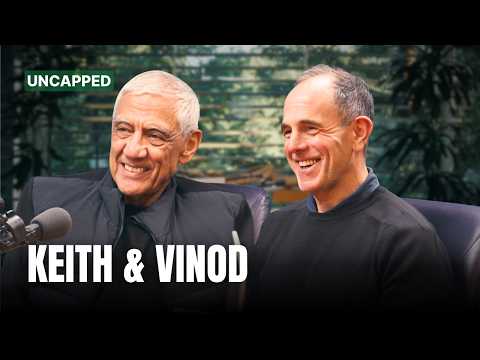
Vinod Khosla and Keith Rabois on Building and Investing in Enduring Companies | Ep. 40
Keith Rabois (guest), Jack Altman (host), Vinod Khosla (guest)
In this episode of Uncapped with Jack Altman, featuring Keith Rabois and Jack Altman, Vinod Khosla and Keith Rabois on Building and Investing in Enduring Companies | Ep. 40 explores khosla and Rabois on founder judgment, AI waves, and principles Khosla and Rabois describe a working relationship built on first-principles thinking, direct communication, and a shared view that their job is “venture assistance” for company-building—not passive capital allocation. They lay out what they look for in founders: exceptionality (top 1% in a dimension), “A+ and incomplete” profiles, high learning rate, recruiting ability, and non-negotiable ethics validated through references. On investing, they argue seed-stage consensus remains unreliable, citing outlier wins like Rocket Lab and OpenAI as examples where conviction came from people, architecture, and talent density rather than fashionable narratives. They then map AI opportunities (AI “workers,” real-world/embodied models, non-transformer approaches) and explain why AI companies require new org design, GTM, and compensation thinking due to unprecedented growth rates and fast-moving capabilities. The conversation ends with their reasons for engaging in politics on X, the importance of principles over convenience, and concerns about AI regulation and US–China techno-economic competition.
Khosla and Rabois on founder judgment, AI waves, and principles
Khosla and Rabois describe a working relationship built on first-principles thinking, direct communication, and a shared view that their job is “venture assistance” for company-building—not passive capital allocation. They lay out what they look for in founders: exceptionality (top 1% in a dimension), “A+ and incomplete” profiles, high learning rate, recruiting ability, and non-negotiable ethics validated through references. On investing, they argue seed-stage consensus remains unreliable, citing outlier wins like Rocket Lab and OpenAI as examples where conviction came from people, architecture, and talent density rather than fashionable narratives. They then map AI opportunities (AI “workers,” real-world/embodied models, non-transformer approaches) and explain why AI companies require new org design, GTM, and compensation thinking due to unprecedented growth rates and fast-moving capabilities. The conversation ends with their reasons for engaging in politics on X, the importance of principles over convenience, and concerns about AI regulation and US–China techno-economic competition.
Key Takeaways
First-principles alignment beats stylistic similarity.
They attribute smooth collaboration to breaking decisions into explicit variables (A, B, C) and debating assumptions rather than vibes—making disagreements crisp and resolvable.
Get the full analysis with uListen AI
Their identity is “company builders,” not investors.
Monday meetings start with portfolio support before new deals, reinforcing a long-horizon partnership model (“ten, twenty years”) where changing a company’s trajectory matters more than winning a term sheet.
Get the full analysis with uListen AI
Great founders are usually extreme, not well-rounded.
Rabois looks for top-1% strength in at least one dimension (or rare overlap of strengths), while Khosla embraces “A++ and incomplete,” expecting gaps that can be filled with the right support and hires.
Get the full analysis with uListen AI
Learning rate is a decisive (and hard) signal.
Khosla emphasizes openness to new ideas plus the ability to reject bad ones; he even “tests” founders with positions he doesn’t believe to see whether they think critically rather than comply.
Get the full analysis with uListen AI
Ethics is the only unacceptable deficiency.
Khosla calls ethics a hard requirement and says it’s primarily assessed via references; high-disagreeableness can coexist with strong moral clarity when principles are real.
Get the full analysis with uListen AI
Seed-stage “hotness” still doesn’t predict outcomes well.
They argue consensus at seed is often about pedigree rather than idea quality, and point to contrarian wins (Rocket Lab, Commonwealth Fusion, OpenAI) as evidence that outliers remain where returns are made.
Get the full analysis with uListen AI
AI shifts both what products are valuable and how companies must be built.
Khosla prefers AI that “does the work” (AI workers) over copilots, and stresses architecture for non-hallucination in regulated use cases. ...
Get the full analysis with uListen AI
Notable Quotes
““In forty years… I’ve not once called myself a venture capitalist… Always say I’m a venture assistant to entrepreneurs trying to build companies.””
— Vinod Khosla
““I prefer hypocritical brutal honesty to hypocritical politeness.””
— Vinod Khosla
“Had I not rejoined KV, “I would either have missed the whole wave and been completely irrelevant or been reckless.””
— Keith Rabois
““If a person listens to me all the time, I’ll almost never invest with them.””
— Vinod Khosla
““PMs does not make sense in a rapidly emerging technology field… You can’t have a twelve-month roadmap.””
— Keith Rabois
Questions Answered in This Episode
On ‘venture assistant’ vs ‘capital and get out of the way’: where is the line between helpful coaching and harmful interference, and how do you operationalize that on boards?
Khosla and Rabois describe a working relationship built on first-principles thinking, direct communication, and a shared view that their job is “venture assistance” for company-building—not passive capital allocation. ...
Get the full analysis with uListen AI
Khosla: you said you sometimes take positions you don’t believe to test founder thinking—what are examples of prompts that reliably reveal learning rate vs performative agreeableness?
Get the full analysis with uListen AI
Rabois: your founder filter is ‘best I’ve ever met on some dimension’—how do you avoid over-indexing on charismatic signals (e.g., “smart in three minutes”) versus durable traits?
Get the full analysis with uListen AI
You argue seed consensus is weak; what specific data (if any) would change your mind that consensus has improved in today’s denser ecosystem?
Get the full analysis with uListen AI
Khosla: you decided ‘no copilots, humans get in the way—just do the work.’ What categories are exceptions where copilots still win, and why?
Get the full analysis with uListen AI
Transcript Preview
I've invested a lot in AI, so I-
Yeah.
Yeah, I love your quote about AI and how you'd have done it differently-
Okay.
-if you hadn't joined-
Oh, my God
... Khosla Ventures.
Yeah.
I wanna hear it. I don't know.
So before I joined KV, I joined KV literally two years ago, basically this week.
Yeah.
I had invested in zero-
Rejoined.
Zero-- rejoined, yeah.
Rejoined.
Rejoined.
Yeah, I joined. That's what I did.
And literally had invested in zero AI companies before.
Interesting.
Since then, in the last two years, I'd say it's about seventy percent of my investments are AI.
Mm-hmm.
And had I not rejoined KV, I think I would either have missed the whole wave and been completely irrelevant or been reckless.
[upbeat music] Keith and Vinod, I'm incredibly excited. I got to do this with each of you individually last year. First thing I wanted to do coming into the new year was ask the two of you to come on together, so thanks for doing it.
Pleasure to be with you.
Yeah.
Obviously, I follow both of you a lot, you know, sort of on- online and watching a lot of podcasts you've done and just knowing you over time, and I've never seen you together, um, in this kind of format, and so I was really excited to set this up. One of the first things I want to get into is, like, how the two of you work together, because I think, like, it's rare that you have two people who are both super individually accomplished at a venture firm, working side by side. You've done it for many years now, and you're obviously very different people, but there's, like, a lot in common. Like, I see you as this, like, Venn diagram with a lot, you know, in the middle, but you also have your own styles. So I guess just to start, like, what's the, like, texture of your day-to-day working relationship like? Like, how do you guys operate together? How do you communicate with each other? Like, what does it look like, just, like, all the time?
You want to start?
Sure. Well, we first started working together when, uh, Vinod joined the board of Square. So... and, you know, I learned a lot of things from him.
Actually, Slide.
Well, we worked together at Slide, but that was more-
Yeah
... intermediated through Max, and I would, I would hear about these meetings with Vinod and all these ideas and these grand theories about how we should reorient the business, but it wasn't, like, hands-on. I actually worked with another one of our partners, David, at Slide, uh, very directly. He told me my first revenue model was terrible, and [chuckles] so David's a little bit of an acquired taste.
Sounds like David.
[laughs] Yeah. He's like, "This revenue plan is very mediocre," was the exact quote.
That's great.
Which turned out to be right. Um, but in any event, while he was on the board of Square, he taught me a lot of things, including the most important precept of the team he builds, the company build. So when I was considering being a VC, it was a very natural fit because a lot of the contributions that Vinod had at Square resonated with me, and I could see the style of KV and how that translated through my brain and that I felt like it would be a really good pairing.
Install uListen to search the full transcript and get AI-powered insights
Get Full TranscriptGet more from every podcast
AI summaries, searchable transcripts, and fact-checking. Free forever.
Add to Chrome