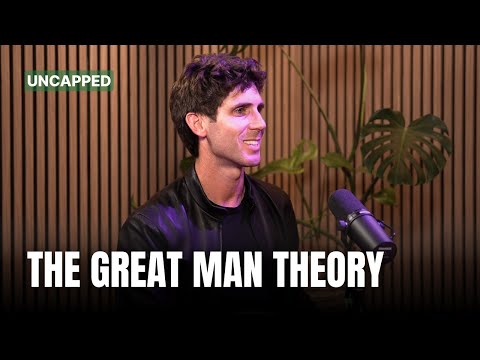
Investing in Outliers | Shaun Maguire, Partner at Sequoia | Ep. 1
Jack Altman (host), Shaun Maguire (guest), Shaun Maguire (guest)
In this episode of Uncapped with Jack Altman, featuring Jack Altman and Shaun Maguire, Investing in Outliers | Shaun Maguire, Partner at Sequoia | Ep. 1 explores sequoia’s Shaun Maguire on truth, geopolitics, and outlier investing Maguire describes becoming more publicly vocal after Oct. 7, arguing that modern conflicts are fought through information warfare with distinct “attention phases,” and that you must be prepared immediately or lose credibility.
Sequoia’s Shaun Maguire on truth, geopolitics, and outlier investing
Maguire describes becoming more publicly vocal after Oct. 7, arguing that modern conflicts are fought through information warfare with distinct “attention phases,” and that you must be prepared immediately or lose credibility.
He outlines why trust in media has eroded: incentive shifts toward sensationalism, “prisoner’s dilemma” defection among outlets, social-media click dynamics, and increasingly sophisticated nation-state propaganda operations.
On U.S. strategy, he argues America’s relative “chip stack” has declined, requiring more selective global engagement while still bluffing and acting unpredictably in strategic spots.
In venture, he predicts a multi-decade hardware resurgence (AI infrastructure, robotics, defense, photonics, onshoring) and explains why hardware investing is harder but can compound more strongly once a first product succeeds; he closes with a framework for identifying outlier founders using an Elo-like calibration model and precise language.
Key Takeaways
The first two weeks of a major event dominate narrative formation.
Maguire claims attention decays in phase transitions (first two weeks, next six weeks, then the long tail). ...
Get the full analysis with uListen AI
Prepared minds win; mistakes early can permanently destroy credibility.
He argues you must know your core points before an event happens, especially if you’re on the “weaker” side of an asymmetric debate. ...
Get the full analysis with uListen AI
Propaganda often works via “95/5” credibility laundering.
Outlets tied to state interests can report accurately on most topics to build trust, then exploit that trust on the small set of issues they care about. ...
Get the full analysis with uListen AI
Truth is at a low point due to compounding incentive and actor shifts.
He attributes the decline to (1) partisan/ratings-driven editorialization, (2) social platforms rewarding speed and outrage, and (3) better-hidden intelligence operations from many countries. ...
Get the full analysis with uListen AI
America must adapt strategy to a smaller chip stack—without becoming predictable.
Using poker, he argues the U. ...
Get the full analysis with uListen AI
The next big investing era may be hardware-led, not software-led.
He contends software waves typically follow hardware breakthroughs (iPhone→Uber, GPUs→deep learning, cheap compute→cloud). ...
Get the full analysis with uListen AI
Hardware is harder to start but can compound faster after product-market fit.
Maguire claims software companies rarely create multiple organic breakout products, while successful hardware companies often build dozens due to supply-chain leverage, component re-use, capital advantage, and manufacturing know-how. ...
Get the full analysis with uListen AI
To spot outliers, calibrate the evaluator—not just the founder.
His Elo analogy: a “1000-rated” observer can’t reliably distinguish 2200 vs 2600 play, while a 2600 can. ...
Get the full analysis with uListen AI
Notable Quotes
“I think we're at basically a low point in the truth in our lifetimes.”
— Shaun Maguire
“The most sophisticated actors… are the most accurate source of news… on ninety-five percent of topics… then they leverage that credibility on the five percent that they actually care about.”
— Shaun Maguire
“Freedom of speech… is kind of a root vulnerability for America.”
— Shaun Maguire
“You have to adapt your strategy based on your chip size.”
— Shaun Maguire
“Almost by definition, every software revolution is preceded by a hardware revolution.”
— Shaun Maguire
Questions Answered in This Episode
You describe three attention “phase transitions” (2 weeks, 6 weeks, then long tail). What concrete actions do you take in each phase, and how do you measure whether you’re “winning” the narrative?
Maguire describes becoming more publicly vocal after Oct. ...
Get the full analysis with uListen AI
On the “95/5 credibility laundering” model: what are your practical heuristics for detecting when a typically reliable outlet has entered its critical 5%?
He outlines why trust in media has eroded: incentive shifts toward sensationalism, “prisoner’s dilemma” defection among outlets, social-media click dynamics, and increasingly sophisticated nation-state propaganda operations.
Get the full analysis with uListen AI
You mention being manipulated in 2016–2020 due to trust in the intelligence community. What signals would you look for now to avoid that same “root vulnerability,” especially when claims come with official credibility?
On U. ...
Get the full analysis with uListen AI
Your U.S. strategy analogy recommends both pulling back and occasionally bluffing. What are examples of “surprising” moves that are high-deterrence but low-cost, and what moves are bluffing traps?
In venture, he predicts a multi-decade hardware resurgence (AI infrastructure, robotics, defense, photonics, onshoring) and explains why hardware investing is harder but can compound more strongly once a first product succeeds; he closes with a framework for identifying outlier founders using an Elo-like calibration model and precise language.
Get the full analysis with uListen AI
You predict a hardware renaissance (photonics, robotics, defense, onshoring). Which specific layers are most under-invested: materials, manufacturing processes, sensors, supply-chain software, or something else?
Get the full analysis with uListen AI
Transcript Preview
[upbeat music] All right, Shaun, thanks for doing this. I'm really excited to talk to you today.
Thrilled to be here, Jack. What's going on, man?
All right, so I wanna go right into it. So the first thing I wanna talk about is sort of like the current state of the media and social media. I'm not sure if I have-
I have no opinions on the subject.
You got nothing. We can move on. [chuckles]
I'm just kidding.
I don't know if I have the timing exactly right, but the way I experienced sort of you on Twitter was October 7th happened, and you got super vocal, and you started sharing a lot of opinions on X that were, that were kind of controversial, that were strongly rooted. They were ones that I agreed with, but, you know, ones that many people were sort of afraid to say in those ways. I wanted to start there, of just, like, what happened in that moment, and did I read that right, that there was some change in you or the way you thought about how you were gonna show up around that moment?
For sure. Um, you nailed it. There's a pretty long backstory [chuckles] on this, so I'll try to keep it brief, but I... Child of the internet, born in 1985. First time using the internet was fourth grade at my friend Nick Palchakoff's house, AOL. We went in AOL chat rooms. We realized that we could impersonate being a professional baseball player, uh, Mike Piazza. If you're listening, Mike, I've never met you, but I, I did a great job pretending I was you in fourth grade. You know this, too, but there was just really something about the internet in those points, where it was very new and the social elements of it were brand new. And this is a, a weird tangent, but, like, in physics, when you study some system, you start with very simple toy systems that you can actually understand. You study a single ball on a spring or a single ball on a string, you know, or y- you study with some simple system, and then you try to build up from there. When you understand a simple system deeply, it makes it much easier to understand the complex systems. I feel like I got lucky with when I was born, where I was on the internet in the very beginning of the social element, and so I think I was able to understand, as a participant, like, how manipulation works, how, how misinformation works, how it spreads. Y- I, and I'll give you an example on Mike Piazza, and I've talked about this maybe twice before, but, you know, my friend and I, we would A/B test. Like, can we convince people as fourth graders that we're a professional baseball player? And we basically learned a tactic accidentally that worked almost every time, call it eighty percent of the time. You know, if you just come out in a forum and say, "I'm Mike Piazza," no one's gonna believe you. But if you join some chat room, and you're talking to people, and you seem normal, and oftentimes AOL at the time would then go into a sidebar, you'd be talking to someone one-on-one. You know, after talking to someone for a little bit about random stuff, you know, the weather, whatever their hobbies are, you know, they'd ask: "What do you do?" And if you're not the one that starts, you know, with that, and they ask you, "What do you do?" And you'd be like: "Oh, I play baseball. " And they'd be like: "What do you mean you play baseball?" You're like: "You know, like, I get paid to play baseball." And they're like: "So you're a professional baseball player?" S- It's like: "I guess so." It's like: "Who do you play for?" "I play for the Dodgers." They're like: "You're lying."
Install uListen to search the full transcript and get AI-powered insights
Get Full TranscriptGet more from every podcast
AI summaries, searchable transcripts, and fact-checking. Free forever.
Add to Chrome