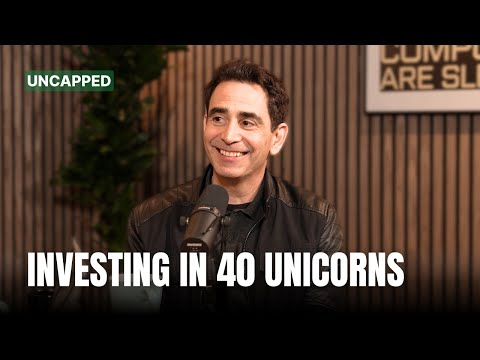
How To Navigate Your Career | Elad Gil | Ep. 6
Elad Gil (guest), Jack Altman (host)
In this episode of Uncapped with Jack Altman, featuring Elad Gil and Jack Altman, How To Navigate Your Career | Elad Gil | Ep. 6 explores elad Gil on careers, optionality, networks, and investing longevity principles Gil argues that the most durable careers are built by “doing” rather than over-indexing on “learning,” combined with a willingness to look foolish, ask basic questions, and take bounded risks.
Elad Gil on careers, optionality, networks, and investing longevity principles
Gil argues that the most durable careers are built by “doing” rather than over-indexing on “learning,” combined with a willingness to look foolish, ask basic questions, and take bounded risks.
He describes career progression as partly unplanned and reactive—where optimizing for market need and maintaining optionality often beats rigid long-term planning.
For early career decisions, he emphasizes selecting the right geographic cluster, market, and a fast-growing company with a strong talent network—while ignoring distracting signals like titles and marginal compensation differences.
On investing, he stresses that there’s no single “right” style; getting the theme right matters enormously, but outcomes still concentrate in a few winners, making both selection and exposure critical.
Key Takeaways
Learn fastest by doing, not pre-learning.
Gil rejects “lifelong learning” as a prerequisite and argues that action is the real teacher—most skills (outside a few deep technical domains) can be picked up along the way by jumping in.
Get the full analysis with uListen
Shamelessness is a career superpower.
Being willing to sound dumb, ask obvious questions, and risk mild social embarrassment often uncovers the core truth faster than performing competence.
Get the full analysis with uListen
Unplanned careers can outperform planned ones if you track market pull.
Gil’s investing career emerged from helping founders; he frames reactivity as a way to “optimize for market need,” capturing opportunities that rigid plans miss.
Get the full analysis with uListen
Cultivate optionality by designing for flexibility early.
He intentionally set up his work so he can shift between investing, advising, and building projects—because the “organic path” tends to produce both better outcomes and higher enjoyment.
Get the full analysis with uListen
Early career: pick the cluster, then the market, then the fast-grower.
He prioritizes being in the right geographic hub (e. ...
Get the full analysis with uListen
Networks compound more than comp, titles, or marginal equity.
Great industries move in “cliques,” and early cohorts often reassemble across the best future companies; taking a slightly worse offer can cost a lifelong set of opportunities.
Get the full analysis with uListen
Investing excellence is style-dependent, but theme selection is decisive.
He contrasts different successful heuristics (e. ...
Get the full analysis with uListen
Notable Quotes
“I actually don't believe in lifelong learning. I believe in lifelong doing... Of course, just go fucking do it.”
— Elad Gil
“You learn a foreign language more easily if you're willing to sound like an idiot.”
— Elad Gil
“If you're sort of reactive to the market in the moment, then that's when you can actually do really interesting things relative to it.”
— Elad Gil
“If a company goes from 50 to 500 people, that's way better than joining a company that goes from 50 to 60.”
— Elad Gil
“My big lesson from technology trends... people always say these things are over or overhyped, or, and it's still early.”
— Elad Gil
Questions Answered in This Episode
You distinguish “lifelong doing” from “lifelong learning”—what are the few cases where you would explicitly recommend learning first (and how do you tell)?
Gil argues that the most durable careers are built by “doing” rather than over-indexing on “learning,” combined with a willingness to look foolish, ask basic questions, and take bounded risks.
Get the full analysis with uListen AI
When evaluating a ‘cluster,’ what signals best predict that a hub will stay dominant for the next 5–10 years (e.g., AI in Bay Area)?
He describes career progression as partly unplanned and reactive—where optimizing for market need and maintaining optionality often beats rigid long-term planning.
Get the full analysis with uListen AI
You say ‘winning’ is the biggest determinant of culture—what specific interview/selection signals help a candidate detect likely ‘winners’ early?
For early career decisions, he emphasizes selecting the right geographic cluster, market, and a fast-growing company with a strong talent network—while ignoring distracting signals like titles and marginal compensation differences.
Get the full analysis with uListen AI
How would you advise someone who is in a great company but a weakening market—when is it time to bail versus stay for the network?
On investing, he stresses that there’s no single “right” style; getting the theme right matters enormously, but outcomes still concentrate in a few winners, making both selection and exposure critical.
Get the full analysis with uListen AI
On the mercenary→missionary→artist progression: what are concrete behaviors that indicate someone should shift stages?
Get the full analysis with uListen AI
Transcript Preview
I actually don't believe in lifelong learning. I believe in lifelong doing, right? Everybody talks about lifelong learning, and I'm gonna go learn this thing before I go do it. Of course, just go fucking do it.
Yeah.
That's how you learn things the best, [chuckles] I think.
Yeah.
But again, that's, that's how I view the world. And it's back to your point on assuming there aren't obstacles in the way or there aren't that many limits, part of that is just that assumption that I can just go do stuff. [upbeat music]
All right. Well, I'm very excited to do this with you, Elad. Thanks for making the time. And before we get started, I'm gonna try a joke because I just shared it with you, and you looked at me deadpan-
[chuckles]
... but I thought it was funny, which is that we're at Sarah Guo's office, and I said, "This episode was brought to you by Sarah Guoga."
Yeah, I think it's fantastic.
I thought it was funnier than you thought it was, so-
Thank you, Sarah
... Hopefully, the viewers will laugh a little bit.
We love your water.
Today, we're gonna talk about a bunch of stuff. The main thing is kind of around the idea of careers and how you think people can navigate their own. Obviously, to some extent, you're gonna be the case study, uh, as we talk about some of this stuff, but that's kinda where I wanna go. And where I wanna start is kind of around the mindset that at least I perceive in you, which is that you seem to navigate the world in somewhat of like an anything is possible, there aren't boundaries type of way, where any person can be, you know, met, where any company can be built, where any deal can get done. I don't know if we've ever, like, talked about this explicitly, but I've just observed over the years that that seems to be kind of how you operate, and I'm curious if that mindset was always there. Did you cultivate it over time? Because it seems very valuable.
I think it's, uh... It all started when I saw the movie Limitless. [chuckles] And as-
All right. [chuckles]
[chuckles] Sorry. It's off to a bad start.
No, it's good.
Um, yeah, you know, it's kind of interesting. I feel like, uh, I don't know if it was instilled by one of my parents or something, um, but in general, I had a family that, you know, uh, on both sides are multiple generations of immigrants, et cetera, and you got to just show up in a country and figure things out. And so a lot of that perspective, I think, kind of transferred over in terms of you should just go and try things, and what's the worst case that could happen, or what's the worst thing that could happen? And I think a lot of barriers that people kind of set up for themselves mentally or that they perceive to be existing societally actually don't really exist. And so there's a very strong attitude in my family of life is kind of what you make of it, but also, you can just pick up the phone and try calling someone, and what's the, what's the worst thing that could happen? They just don't answer the phone.
Install uListen to search the full transcript and get AI-powered insights
Get Full TranscriptGet more from every podcast
AI summaries, searchable transcripts, and fact-checking. Free forever.
Add to Chrome