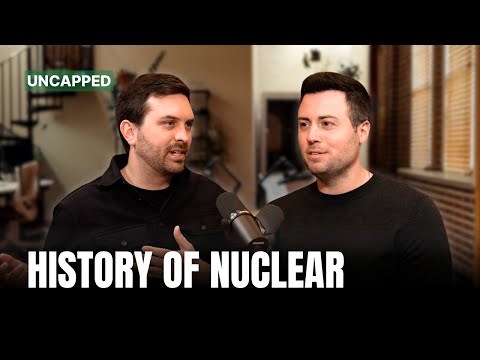
Why the US Needs Nuclear Energy | Jordan Bramble, CEO of Antares | Ep. 11
Jordan Bramble (guest), Jack Altman (host)
In this episode of Uncapped with Jack Altman, featuring Jordan Bramble and Jack Altman, Why the US Needs Nuclear Energy | Jordan Bramble, CEO of Antares | Ep. 11 explores nuclear’s slowdown, resurgence, and microreactors for defense and space The conversation traces U.S. nuclear history from early wartime reactors and the nuclear navy to commercial grid buildout—then highlights the sharp post-1970s slowdown (roughly 100 reactors built early, only a few since).
Nuclear’s slowdown, resurgence, and microreactors for defense and space
The conversation traces U.S. nuclear history from early wartime reactors and the nuclear navy to commercial grid buildout—then highlights the sharp post-1970s slowdown (roughly 100 reactors built early, only a few since).
Bramble argues nuclear’s stagnation was “overdetermined”: safety incidents and regulatory restructuring mattered, but so did 1970s-era macro/financial shifts and the drop in large government R&D programs that previously catalyzed demand and workforce capacity.
He outlines today’s renewed drivers: decarbonization (net-zero needs fission), rising electricity needs (AI/data centers and broader growth), national security energy resilience, and accelerating space militarization requiring high power in orbit.
Antares focuses on kilowatt-scale “microreactors” using heat-pipe cooling—factory-manufacturable, premium-power products optimized for mission-critical defense and space use cases rather than commodity electricity markets.
Key Takeaways
U.S. nuclear growth collapsed after an early buildout.
Bramble notes the U. ...
Get the full analysis with uListen AI
Nuclear’s stagnation wasn’t just politics or fear—finance and demand mattered.
He argues many narratives overemphasize regulation/public sentiment, while underweighting 1970s budget austerity, rising interest rates, and reduced federal R&D intensity (from ~12–15% of budget historically to ~3% today), which eroded the pipeline and workforce needed for repeatable builds.
Get the full analysis with uListen AI
Regulatory separation changed the development environment.
The Atomic Energy Commission once both built and regulated; Congress later created DOE and an independent NRC, changing incentives, timelines, and approval pathways alongside other headwinds.
Get the full analysis with uListen AI
Fission alone can materially address decarbonization at scale.
Bramble positions fission as available, carbon-free power now, contrasting it with fusion’s promised advantages (less waste/radiation challenges) but emphasizing fusion’s unresolved materials and timeline risks.
Get the full analysis with uListen AI
AI/data centers revive the ‘how do we power it?’ question—and nuclear is back on the table.
He argues renewables’ low energy density and transmission buildout limits make firm, high-density generation attractive; Big Tech interest (Meta/Amazon/Google) is real, though he claims they’re not yet spending meaningfully compared to DoD.
Get the full analysis with uListen AI
Defense energy resilience is an immediate buyer driver.
Mission assurance for critical assets (ICBM command/compute, missile defense sites, Arctic radar) motivates local, reliable generation that can operate through grid outages, cyberattacks, or disasters—and DoD is funding tech maturation now.
Get the full analysis with uListen AI
Space weaponization increases demand for compact high power in orbit.
For non-kinetic effects (lasers, microwaves, particle beams), power enables range and capability; Bramble argues nuclear beats solar beyond ~175–200 kW due to mass-scaling advantages (ISS-scale solar is ~100 kW but football-field sized).
Get the full analysis with uListen AI
Microreactors target ‘premium power’ markets, not commodity electricity.
He says microreactors may not soon reach ~10¢/kWh because fuel becomes a large share of cost (estimated 40–50%), but they can compete where diesel is expensive (e. ...
Get the full analysis with uListen AI
Heat-pipe cooling is a strong fit for very small reactors.
Antares uses heat pipes (phase-change, no pumping) invented for space nuclear; they enable simpler, iterative prototyping, but scaling to larger cores becomes inefficient because added metal absorbs neutrons.
Get the full analysis with uListen AI
Defense sales require ‘connecting the dots,’ not just a great product.
He highlights the lack of a single customer persona: end users, buyers, Pentagon planners, and Congress all shape procurement. ...
Get the full analysis with uListen AI
Notable Quotes
“We built something like a hundred reactors… between roughly 1950 and the early 1970s. I think we’ve built and turned on three since in the US on the grid.”
— Jordan Bramble
“I’ve seen a lot of people have talked about regulation… public sentiment… But I’ve seen very few people really comment on the… financial changes… in the seventies.”
— Jordan Bramble
“We can certainly do it with just fission… fission is carbon-free power.”
— Jordan Bramble
“The problem with fusion is that it’s… perpetually thirty years away.”
— Jordan Bramble
“You could fit it on a truck bed… an eighteen-wheeler truck bed.”
— Jordan Bramble
Questions Answered in This Episode
You frame nuclear’s decline as partly financial: which specific mechanisms (interest rates, cost of capital, utility regulation, federal R&D cuts) mattered most, and how would you quantify their impact versus safety incidents?
The conversation traces U. ...
Get the full analysis with uListen AI
When you say only ~3 reactors have been turned on since the early 1970s, which projects are you counting—and what lessons do they offer for new entrants?
Bramble argues nuclear’s stagnation was “overdetermined”: safety incidents and regulatory restructuring mattered, but so did 1970s-era macro/financial shifts and the drop in large government R&D programs that previously catalyzed demand and workforce capacity.
Get the full analysis with uListen AI
For AI data centers, what power characteristics (ramp rate, islanding, siting constraints, licensing timeline) make microreactors attractive versus pairing gas + carbon capture or expanding transmission?
He outlines today’s renewed drivers: decarbonization (net-zero needs fission), rising electricity needs (AI/data centers and broader growth), national security energy resilience, and accelerating space militarization requiring high power in orbit.
Get the full analysis with uListen AI
You suggest Big Tech interest is ahead of real spending: what concrete commitments (prepurchase agreements, development capital, siting partnerships) would change your view?
Antares focuses on kilowatt-scale “microreactors” using heat-pipe cooling—factory-manufacturable, premium-power products optimized for mission-critical defense and space use cases rather than commodity electricity markets.
Get the full analysis with uListen AI
Heat pipes scale poorly due to neutron absorption—at what power level would you personally switch to a different coolant architecture, and what would that likely be?
Get the full analysis with uListen AI
Transcript Preview
It was really around the 1970s that things slowed down. We, we built something like a hundred, uh, reactors, uh, between, you know, roughly 1950 and the early 1970s. I think we've built and turned on three since in the US on the grid.
Wow! [upbeat music] All right. Really excited to have this conversation with Jordan Bramble, CEO of Antares. Jordan, thanks a ton for doing this conversation with me today.
Thank you for having me.
Yeah. We're gonna talk all about nuclear today. Maybe before we get into it, could you give me, like, a little overview of, like, the nuclear market, the history in the US, you know, what's happened over previous decades, and kind of catch us up to speed on where we are today?
Let's start from the beginning. So, um, the first, you know, artificial human-made nuclear reactor ever was, um, the Chicago Pile. So 1942, I think it was. Um, they actually built it at the University of Chicago, underneath of the football field, so, you know, right in the city, in the middle of Chicago. And the idea was you stacked, um, something like forty-five thousand graphite blocks in order to moderate neutrons. Um, I wanna say it was, like, fifty tons of natural uranium in order to sustain a critical reaction, and they actually only produced, like, a half watt of power. But that was the first, um, you know, first kind of academic research reactor ever built. Um, and the motivation behind it was, was really, um, uh, the Manhattan Project was going on, right? So we were exploring nuclear fission for the development of weapons, but then later, actually for the production of plutonium, because plutonium production is a by-product of nuclear fission, uh, uranium fission. So built, built a couple of reactors after that, um, and, you know, by 1945, um, '45, '47, so we're still in the '40s, um, we had pu- plutonium-producing reactors, both, um, at Savannah River and at the Hanford site in Washington, all to support the weapons program. And then in parallel, uh, an, a naval officer by the name of Hyman Rickover, started the Naval Nuclear Propulsion Program in, I, I also want to say 1945. So, you know, all, all these things are happening really fast at this point.
Mm-hmm.
He eventually became Admiral Rickover, and is kind of the father of the nuclear navy. You know, 1952, we had the first nuclear submarine, so the Nautilus, which was a water-cooled reactor, and then in parallel to that, they built the, um, the Seawolf, which was a sodium-cooled reactor.
That was the first non-weapon application of nuclear, was submarines?
Cer- certainly first, first naval application. We'll actually get into it. The first, uh, kind of, you know, power-producing, civilian power-producing reactor was actually a, a spin-off from a naval reactor core that they didn't end up using. It was the Shippingport reactor in Pennsylvania. Uh, they built it in, like, eighteen months. So it's kind of a spin-off from, uh, the, the nuclear navy programs. It's actually only a sixty-megawatt reactor. Not long after that, we got the, uh, Yankee Rowe in Massachusetts, which, which I wanna say was, like, hundred megawatts, hundred and twenty megawatts, something like that. So significantly smaller than what we, um, what we build today. I imagine at some point, talk about small modular reactors. You know, one thing I would highlight is actually the, the kind of small concept is actually how we originally built reactors-
Install uListen to search the full transcript and get AI-powered insights
Get Full TranscriptGet more from every podcast
AI summaries, searchable transcripts, and fact-checking. Free forever.
Add to Chrome