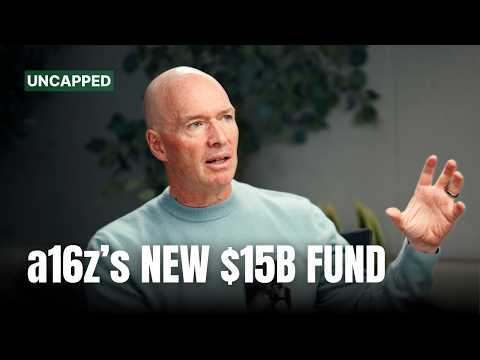
Ben Horowitz on How a16z Built a Venture Machine | Ep. 38
Ben Horowitz (guest), Jack Altman (host)
In this episode of Uncapped with Jack Altman, featuring Ben Horowitz and Jack Altman, Ben Horowitz on How a16z Built a Venture Machine | Ep. 38 explores ben Horowitz explains how a16z scaled venture, platform, and brand Horowitz frames a16z’s founding premise as fixing venture capital’s “product” for entrepreneurs by pairing capital with real capabilities: networks, recruiting help, policy support, and experienced operating advice.
Ben Horowitz explains how a16z scaled venture, platform, and brand
Horowitz frames a16z’s founding premise as fixing venture capital’s “product” for entrepreneurs by pairing capital with real capabilities: networks, recruiting help, policy support, and experienced operating advice.
He explains why scaling a venture firm can work if investing remains organized into small, coherent teams (like “little VCs”) while a centralized platform handles repeatable support functions and reduces partner overload.
A major operational theme is organizational design: managing intense GP conflict, avoiding shared-control governance that blocks reorgs, and using clear principles for risk-taking and decision-making.
He also argues that in venture, “winning” deals often matters more than superior picking—because access and the ability to close attracts top investors and compounds firm advantage—while media has shifted from press-driven branding to direct, personality-driven distribution.
Key Takeaways
a16z started by treating VC as an entrepreneur-facing product problem.
Horowitz argues traditional VC often offered money plus generic advice; a16z aimed to provide confidence and execution leverage via network, expertise, and capabilities founders actually need to build enduring companies.
Get the full analysis with uListen AI
Scale works when investing stays small-team, but support scales centrally.
a16z keeps investing units to ~5 GPs to preserve high-quality “truth-seeking” conversations, while the platform handles BD, recruiting support, and policy/regulatory help—letting partners focus on investing and CEO-level counsel.
Get the full analysis with uListen AI
Managing GPs is harder than managing executives because conflict is existential.
GPs are highly disagreeable idea generators and can “wreck each other’s businesses” through conflicts (e. ...
Get the full analysis with uListen AI
Firm-wide guidance focuses on taking risk by weighting strengths over weaknesses.
Horowitz warns that analytical investors can disqualify any deal by finding flaws; a16z tries to avoid passing on world-class founders because of fixable gaps (monetization, go-to-market, accounting) and avoids funding “weak” founders merely because they lack obvious problems.
Get the full analysis with uListen AI
Venture scaling is driven by both market expansion and founder requirements.
The “Software is Eating the World” bet implied far more than ~15 breakout companies per year; additionally, modern founders need help with hiring, credibility, enterprise access, international expansion, and government/policy—capabilities small firms struggle to offer.
Get the full analysis with uListen AI
Platform services must be domain-specialized, not generic.
Broad, cross-domain research/content and generalized talent efforts were less useful; the highest leverage came from specialized work (e. ...
Get the full analysis with uListen AI
Boards are primarily about governance protection, with occasional massive upside.
Horowitz calls “no board” dangerous once others own equity, because board process is key legal/fiduciary protection; value-add varies, but in pivotal moments (financing inflection points, acquisition decisions) the right board member can change outcomes dramatically (e. ...
Get the full analysis with uListen AI
Notable Quotes
““Venture capital was disappointing as a product for an entrepreneur.””
— Ben Horowitz
““The key to running a venture capital firm is to keep the principals from killing each other.””
— Ben Horowitz (quoting Mike Moritz)
““It’s always a mistake to rule out somebody who’s truly world-class on a weakness.””
— Ben Horowitz
““The idea that you’re not gonna have a board… is the most dangerous fucking idea in the world.””
— Ben Horowitz
““Winning it… is a much bigger percentage of that equation than people… like to give credit for.””
— Ben Horowitz
Questions Answered in This Episode
You distinguish “heat seekers” from “truffle hunters.” What specific behaviors or decision patterns reliably separate them when you’re hiring or evaluating a GP?
Horowitz frames a16z’s founding premise as fixing venture capital’s “product” for entrepreneurs by pairing capital with real capabilities: networks, recruiting help, policy support, and experienced operating advice.
Get the full analysis with uListen AI
You said cross-fund conflicts can “wreck each other’s businesses.” What structural rules (ownership, sector boundaries, approval processes) does a16z use to prevent accidental conflicts?
He explains why scaling a venture firm can work if investing remains organized into small, coherent teams (like “little VCs”) while a centralized platform handles repeatable support functions and reduces partner overload.
Get the full analysis with uListen AI
On the principle of betting on strengths: how do you operationalize that in IC so it doesn’t become an excuse to ignore real, fatal risks (e.g., regulatory, ethics, security)?
A major operational theme is organizational design: managing intense GP conflict, avoiding shared-control governance that blocks reorgs, and using clear principles for risk-taking and decision-making.
Get the full analysis with uListen AI
Which platform functions have the clearest measurable ROI (time-to-hire, revenue introductions, policy wins), and which are still more qualitative bets?
He also argues that in venture, “winning” deals often matters more than superior picking—because access and the ability to close attracts top investors and compounds firm advantage—while media has shifted from press-driven branding to direct, personality-driven distribution.
Get the full analysis with uListen AI
You argue board governance protects founders legally. What are the most common founder mistakes you’ve seen that a well-run board process would have prevented?
Get the full analysis with uListen AI
Transcript Preview
You know, when we started the firm, like, a big idea that we had was that venture capital was disappointing as a product for an entrepreneur. We always thought, "Wow, a much better product would be, give me, like, the network to be confident and the advice I need to run this fucking thing."
[upbeat music] Ben, I'm really happy to be back here doing this. I got to be in the same room with Marc earlier in the year, and I'm, I'm really happy that you're doing this with me.
I know. I'm glad to be here. This should be some fun.
Can we start with your relationship with Marc? 'Cause I think it's, like, a super unique thing-
Yeah
... where you guys obviously work together, you know, running companies. You've built this firm together. You have a really unique relationship.
Yeah.
I can't think of that many examples where I feel like I've seen it in that sort of equal way for so long. Can you talk about it a little bit?
We've been working together thirty years. Uh, and, uh, I, I, I would say we're, we're both different and complement... and, and the same, and so not too complementary, so that helps. Um, he's kind of like, uh, we're a little more like relatives than, than anything else at this point, you know, working together thirty years and so forth, so-
Yeah
... uh, yeah.
Like, are you friends outside of the work context? Or, like, what's like on a, on, like, a non-work situation, like, what is the interaction like?
Yeah, we're, we're friends, but not like drinking buddies or something like that, right? Like, uh, we both work so much, we mostly talk about work anyway, and then, like, 'cause we're working together-
Yeah
... we're talking about work. But it's kind of like the, the way I would describe it, um... And I, I want to say this without sounding-- I'm not making the, like, level comparison, like, I'm, uh, so I'm just saying the relationship comparison that I think-
Mm-hmm
... is most similar that I've know about is kind of the Michael Jackson, Quincy Jones relationship, if you think about that. Um, and that, yeah, Marc's more Michael Jackson, like, he's a, a star of talents that nobody else has.
Yeah.
Like, nobody else has maybe, like, ever had, right? Like, you've talked to Marc. Um, to the point where, like, as a firm, we can just put him out there, and it's like-
Yeah
... a magic trick. Like, he's like, bang, you know? And, you know, for me to, you know, my kind of relationship with him is, you know, like a Quincy Jones. It's not like I'm, uh, you know... I, I'm certainly not Michael Jackson, but I know enough. You know, Quincy Jones knew so much about music-
Mm-hmm
... and so much about how you get the most out of somebody that talented. You know, that makes it work together, so I can surround Marc with the kinds of people, with the kinds of ideas, and so forth, that maximize him. And then, you know, like, he's makes me much, much better 'cause he's Michael Jackson, and, like, you're never, [chuckles] you're never gonna make Thriller if you don't have Michael Jackson.
Install uListen to search the full transcript and get AI-powered insights
Get Full TranscriptGet more from every podcast
AI summaries, searchable transcripts, and fact-checking. Free forever.
Add to Chrome