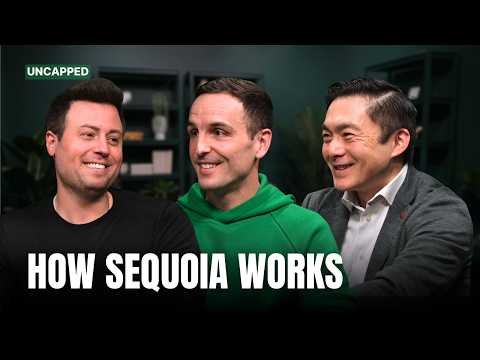
Pat Grady & Alfred Lin on the Tactics of Great Venture Investing | Ep. 36
Pat Grady (guest), Alfred Lin (guest)
In this episode of Uncapped with Jack Altman, featuring Pat Grady and Alfred Lin, Pat Grady & Alfred Lin on the Tactics of Great Venture Investing | Ep. 36 explores sequoia’s new stewards on conviction, craft, and outlier investing tactics Grady and Lin frame Sequoia’s leadership transition as “stewardship,” emphasizing enabling a team of “outliers” rather than running a hierarchical, CEO-style organization.
Sequoia’s new stewards on conviction, craft, and outlier investing tactics
Grady and Lin frame Sequoia’s leadership transition as “stewardship,” emphasizing enabling a team of “outliers” rather than running a hierarchical, CEO-style organization.
They argue venture is an “outlier business,” so consistency is less important than creating room for volatility, strong individual judgment, and high-conviction bets with sufficient ownership.
The discussion breaks down the venture value chain—sourcing, picking, winning, building, harvesting—and how Sequoia measures inputs (values, capabilities, coverage quality, decision hygiene) given that outputs can be a decade delayed and markups can be mirages.
They share tactical methods: coverage targets without incentivized gaming, debrief rituals, CRM/data advantages (including a long-running talent “PageRank” map), and coaching investors toward courage by normalizing failure and managing psychological biases.
Key Takeaways
Venture leadership is about enabling outliers, not directing them.
They contrast operating-company CEOs (optimize consistency) with venture (optimize outliers). ...
Get the full analysis with uListen AI
Consensus doesn’t predict returns; conviction does.
Sequoia’s internal voting data shows consensus vs non-consensus is not a factor. ...
Get the full analysis with uListen AI
Measure investors on inputs because outputs arrive too late (and can be misleading).
Markups can be mirages and outcomes take ~10 years, so they focus on behaviors and capability development (quality of memos, diligence, networks, time allocation) and later inspect the chain if results lag.
Get the full analysis with uListen AI
Avoid individual activity metrics to prevent gaming; focus on time-investment judgment.
Grady describes how granular funnel quotas can create padding behavior (calling founders you’ll never invest in). ...
Get the full analysis with uListen AI
Sourcing quality beats raw ‘seeing everything’ coverage—watch for “false coverage.”
Demo days and broad meetings can create superficial exposure. ...
Get the full analysis with uListen AI
Mid-funnel decisions drive the biggest misses; improve ‘decision hygiene.’
They claim Monday partner-meeting decisions are usually solid; the bigger error is what never reaches Monday. ...
Get the full analysis with uListen AI
Coaching for asymmetry is largely coaching for courage and bias control.
Many investors are high-achieving “A students” optimized to avoid mistakes; Sequoia normalizes ~50% write-off rates even in great funds. ...
Get the full analysis with uListen AI
Notable Quotes
“Our internal data shows that consensus versus non-consensus does not matter at all. Presence of conviction is what matters.”
— Pat Grady
“If everybody’s a six, probably shouldn’t make the investment… If three people are nines and three people are one, we should probably make the investment.”
— Pat Grady
“We’re in the outlier business.”
— Pat Grady
“The two fears—fear of missing out and fear of looking stupid—are the two fears that prevent people from making the right decisions.”
— Alfred Lin
“The stability at the partnership level is what allows for volatility at the partner level.”
— Pat Grady
Questions Answered in This Episode
On your 0–10 voting system, what specific evidence tends to turn a ‘6’ into a ‘9’ for you in practice?
Grady and Lin frame Sequoia’s leadership transition as “stewardship,” emphasizing enabling a team of “outliers” rather than running a hierarchical, CEO-style organization.
Get the full analysis with uListen AI
How do you distinguish healthy non-consensus conviction from a partner simply being overconfident or contrarian?
They argue venture is an “outlier business,” so consistency is less important than creating room for volatility, strong individual judgment, and high-conviction bets with sufficient ownership.
Get the full analysis with uListen AI
Can you share 5–10 examples from your ‘catalog of 40 psychological traps’ besides “separation of church and state,” and how you operationalize them before decisions?
The discussion breaks down the venture value chain—sourcing, picking, winning, building, harvesting—and how Sequoia measures inputs (values, capabilities, coverage quality, decision hygiene) given that outputs can be a decade delayed and markups can be mirages.
Get the full analysis with uListen AI
How exactly do you define and measure “false coverage” in the CRM—what are the observable signals that someone only superficially covered a company?
They share tactical methods: coverage targets without incentivized gaming, debrief rituals, CRM/data advantages (including a long-running talent “PageRank” map), and coaching investors toward courage by normalizing failure and managing psychological biases.
Get the full analysis with uListen AI
You mentioned growth coverage targets (e.g., ~70% relative to a competitor set). How do you choose that competitor set, and how often do you update it as markets shift?
Get the full analysis with uListen AI
Transcript Preview
We've been recording the number that everybody votes on every investment for more than a decade now. Um, our internal data shows that consensus versus non-consensus does not matter at all.
It's just not a factor.
Presence of conviction is what matters.
Huh.
And so if everybody is a six, we vote zero to 10, no fives, so six and above is positive, four and below is negative. If everybody's a six, probably shouldn't make the investment. It's consensus, but nobody has conviction. If-
Strong yes, strong no is much better.
If three peoples are, are nines and three people are one, we should probably make the investment. [upbeat music]
All right, guys, thank you very much for doing this. This is my first attempt at a three-person podcast. So-
And this, this is our-
This is our first- [chuckles]
... showing together, so.
Yeah. So I apologize if this is a disaster. [chuckles] Um, so-
It's not gonna be a disaster. Um, we're gonna ask you questions, too. [chuckles]
That's what I want, and then we can edit everything out. This could be a five-minute pod with whatever's good. [chuckles]
Love it.
And that'll be fine. Um-
Five minutes might be generous.
No, that's all right. We'll take what we can get.
[chuckles]
I guess to start, like, how are you guys... How are you feeling, and, like, where's your mindset? Are you like- do you feel the way you expected to when you first knew this was happening? Like, you're a couple weeks settled in, like, what's, what's going on psychologically?
I mean, we just came out of a, a meeting where we both said we're more excited than ever before. Um, and so we're, we're excited. And, uh, it's- part of it is because we're- we get to help lead, co-lead S- Sequoia into the next generation with a great team, and the team that we have is probably one of the best that we've ever had in the history of Sequoia.
Does it feel, like, heavy or light? Like, does it feel more like you just got to pick up the most fun video game, or are you like: "Whoa, I have the weight of something very serious on my shoulders?"
I think it's a little bit of both. Y- you know, I think for both Alfred and I, the idea of being steward someday was sort of a dream, but not an objective. I mean, it wasn't something that we-
[chuckles]
... sought necessarily, but it's, it's an honor to get to continue the-
Yeah, of course
... legacy that Roelof and Doug and Jim, and everybody else, sort of started for us. Um, so I think it's heavy in the sense that we feel a responsibility to make Sequoia great. I think it's also light in a sense that one of the kinda main things that we wanna try to do for Sequoia is to kinda get it back to what it's been for most of our 53-year-old history, where Alfred and I are doing minimal amounts of administrative work, and mostly in the field making investments alongside a team of people like Andrew Reid and Luciana Alexandru and, you know, David Khan and Constantin Buhler, who are amazing at what they do, and our job is really just to enable them, as opposed to, to really manage people.
Install uListen to search the full transcript and get AI-powered insights
Get Full TranscriptGet more from every podcast
AI summaries, searchable transcripts, and fact-checking. Free forever.
Add to Chrome