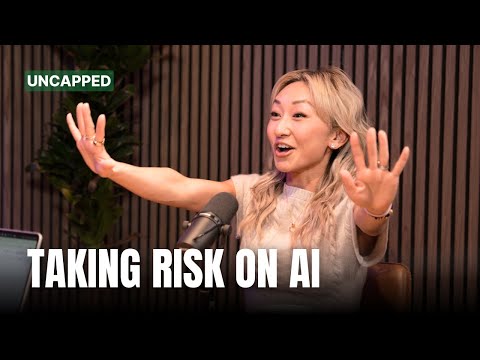
Investing with Conviction | Sarah Guo, Founder of Conviction | Ep. 5
Jack Altman (host), Sarah Guo (guest)
In this episode of Uncapped with Jack Altman, featuring Jack Altman and Sarah Guo, Investing with Conviction | Sarah Guo, Founder of Conviction | Ep. 5 explores sarah Guo on building venture firms, brand, and AI investing Guo frames a VC firm as a “bundle” of money (commodity), people/beliefs, and actual advantage—arguing the squishy parts (brand, individuals, ethos) are what can compound into durability over decades.
Sarah Guo on building venture firms, brand, and AI investing
Guo frames a VC firm as a “bundle” of money (commodity), people/beliefs, and actual advantage—arguing the squishy parts (brand, individuals, ethos) are what can compound into durability over decades.
She describes Conviction’s early go-to-market as solving founder information asymmetry: demonstrating network and expertise through opinionated content, partnerships, and visible community adjacency—essentially treating the firm like a funnel-driven business.
On market structure, she’s skeptical about venture’s incentive to grow AUM (fees can dominate outcomes) and notes large multi-stage platforms can subsidize early-stage activity, but believes small, opinionated firms can still win by serving non-homogeneous founder preferences.
On AI, Guo emphasizes staying grounded in real adoption signals (revenue, capital efficiency), expects more truly large companies than the prior SaaS era, and anticipates long-run pricing pressure on “agent” products unless they achieve Figma-like uniqueness and defensibility.
Key Takeaways
VC differentiation is mostly non-monetary and inherently fragile.
Guo argues “money is the purest commodity” in venture; what matters is the associated people/beliefs and any real advantage a firm provides, which can be difficult to make durable.
Get the full analysis with uListen AI
Durable venture firms compound ethos, tribal knowledge, brand, and network.
She attributes longevity at firms like Sequoia/Greylock to a transmissible culture plus accumulated pattern recognition and founder perception—assets that are slow to replicate.
Get the full analysis with uListen AI
Founders don’t pick VCs uniformly; repeat founders often pick individuals over logos.
Guo contrasts first-time founders (who may value brand halo and trust) with experienced founders like Brett Taylor, who “just [calls] people he wants to work with.”
Get the full analysis with uListen AI
Early brand-building is about fixing information asymmetry, not vanity PR.
Conviction tried to make its network legible without “man-to-man combat” by showing up with high-distribution partners and publishing opinions—akin to partner marketing and funnel thinking.
Get the full analysis with uListen AI
Having an opinion is a product feature for a VC firm—especially in AI volatility.
Publishing LP letters and predictions is intentionally risky; Guo believes explicit worldviews can be “grounding” for founders deciding whether the firm’s framework matches theirs.
Get the full analysis with uListen AI
Venture AUM growth is often rational for managers but can be bad for LP returns.
She notes it’s easier to raise capital than to generate top-tier venture multiples, and fee economics can reward scale even when returns don’t justify it—mirroring PE’s mature dynamics.
Get the full analysis with uListen AI
Small early-stage firms can still win by being selective and distinct.
Even if platforms subsidize seed as a pipeline, Guo believes founders seek different experiences; a small team with strong taste can compete without “winning everyone.”
Get the full analysis with uListen AI
In AI, the grounding metrics are still adoption and unit economics.
She aligns with traditional signals—revenue, capital efficiency, even “EBITDA”—and contrasts her venture constraint ($200M) with hyperscaler capex debates like Satya’s 7–10% growth lens.
Get the full analysis with uListen AI
AI may create more $10B+ companies than SaaS did, via new willingness-to-pay.
She argues AI expands spend beyond software budgets into services/capability budgets (law, support, creative work, education), though she expects the market is still “wrong about something.”
Get the full analysis with uListen AI
Agent pricing will face heavy pressure unless products become uniquely indispensable.
Near-term pricing can peg to labor replacement, but she expects competition to push many offerings toward “compute/energy/intelligence plus,” with only a few retaining value-based pricing like Figma.
Get the full analysis with uListen AI
The founder edge isn’t IQ alone; it’s force of will and correct conviction.
Guo prioritizes the ability to take a point of view, navigate uncertainty, and be right—qualities she doesn’t think “pure intelligence” (human or model) substitutes for soon.
Get the full analysis with uListen AI
Notable Quotes
“Venture is a bundle of, like, money… everybody’s money is approximately green.”
— Sarah Guo
“Money is the purest commodity. The rest of it is pretty squishy.”
— Sarah Guo
“Nobody cares… and so, like, you have to make them care.”
— Sarah Guo
“Be willing to take risk on having an opinion is an important one for us.”
— Sarah Guo
“Some of those beliefs and predictions are gonna be wrong and look very stupid.”
— Sarah Guo
Questions Answered in This Episode
When you say venture is a bundle of “money, people/beliefs, and advantage,” what are concrete examples of “advantage” that actually change outcomes for a Series A company?
Guo frames a VC firm as a “bundle” of money (commodity), people/beliefs, and actual advantage—arguing the squishy parts (brand, individuals, ethos) are what can compound into durability over decades.
Get the full analysis with uListen AI
You describe brand as solving information asymmetry for founders—what metrics or signals told you Conviction’s “partner marketing” approach was working (deal flow quality, close rate, inbound mix)?
She describes Conviction’s early go-to-market as solving founder information asymmetry: demonstrating network and expertise through opinionated content, partnerships, and visible community adjacency—essentially treating the firm like a funnel-driven business.
Get the full analysis with uListen AI
If large multi-stage firms subsidize seed as a sourcing funnel, what specific strategies can small funds use to avoid getting priced out of the “obvious” winners while staying disciplined on ownership?
On market structure, she’s skeptical about venture’s incentive to grow AUM (fees can dominate outcomes) and notes large multi-stage platforms can subsidize early-stage activity, but believes small, opinionated firms can still win by serving non-homogeneous founder preferences.
Get the full analysis with uListen AI
You said founders shouldn’t optimize for a VC’s returns; what founder-facing proxy metrics best predict “taste” and useful tribal knowledge?
On AI, Guo emphasizes staying grounded in real adoption signals (revenue, capital efficiency), expects more truly large companies than the prior SaaS era, and anticipates long-run pricing pressure on “agent” products unless they achieve Figma-like uniqueness and defensibility.
Get the full analysis with uListen AI
Which predictions from your published LP letters do you think are most likely to look “very stupid” in hindsight, and how do you hedge that risk as an early-stage specialist?
Get the full analysis with uListen AI
Transcript Preview
[upbeat music] All right, Sarah, thank you for doing this. I realize that you, uh, you've been spending more time being the interviewer than being interviewed, but I appreciate you doing this, and it's nice to be doing it in your office.
Yeah, well, any excuse to hang out with you.
The first thing I wanna ask you about is what a VC firm sort of is, and th- the thing I've been thinking about a bunch is when I was doing Lattice, I kind of knew what a company was. Like, you know, you build a product, you sell the product. Like, there's like a sort of a very tractable thing. And then over the last year doing venture full-time for the first time, it struck me that it's a much more sort of flimsy concept. And, you know, there's obviously like a, a fund that owns shares, but then there's like a brand, and there's people, and there's these other parts. And as I've been thinking about building a VC firm, I've realized that thinking about what it actually is, is sort of like a wispy idea. And so I would love just to hear from you as you've thought about... You know, you've been at one, like a, a very substantial, long-standing one. Now you've built your own. Um, how do you think about what a VC firm is?
We've taken, like, two steps toward building our own.
You've built something, though.
But it's, it's an interesting question. Like, the way we think of it internally is, um, and it's not, like, the most flattering view, but venture is a bundle of, like, money. Um, I'm thinking about the value prop to the customer, right? The customer is the founder. Venture is a bundle of money, where, like, everybody's money is approximately green, right? You can have, like, lower and higher quality LPs, but, uh, generally, that's not how founders make their decision. Then you have, um, people and beliefs that you are associated with as a founder, and then you have advantage, right? Like, what can, like, can... And I, I wouldn't do the job if I didn't figure, like, that the last piece could matter at all, but, um, help you can give companies and to, to try to make things happen faster or make ideas, like, more possible to, to actually make real. It is a, it is a weird way to think about venture as a business, because for all tech investors love to talk about, like, you know, like, moats and differentiation and sustainable advantage, I think venture, like, when you think about those components, money is the purest commodity. The rest of it is pretty squishy. It's a lot of, like, brand and individuals that feel quite fragile or, like, point in time. Um, but, uh, you know, some of the great venture brands have been around for, um, a long time, and I think it's still possible to build an enduring institution, so.
Install uListen to search the full transcript and get AI-powered insights
Get Full TranscriptGet more from every podcast
AI summaries, searchable transcripts, and fact-checking. Free forever.
Add to Chrome