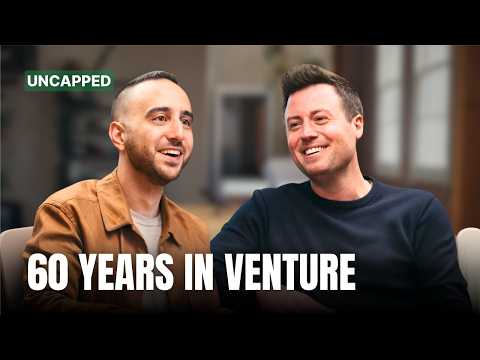
Greylock’s Saam Motamedi on How Venture Firms Endure | Ep. 37
Saam Motamedi (guest), Jack Altman (host)
In this episode of Uncapped with Jack Altman, featuring Saam Motamedi and Jack Altman, Greylock’s Saam Motamedi on How Venture Firms Endure | Ep. 37 explores how Greylock stays durable: ethos, apprenticeship, depth, and reinvention. Greylock’s Saam Motamedi and host Jack Altman unpack how a venture firm can remain elite across generations, using Greylock’s 60-year history as the case study.
How Greylock stays durable: ethos, apprenticeship, depth, and reinvention.
Greylock’s Saam Motamedi and host Jack Altman unpack how a venture firm can remain elite across generations, using Greylock’s 60-year history as the case study.
Saam argues durability comes from a persistent service-first ethos toward founders, paired with continual reinvention in sectors, team composition, and operating cadence.
They discuss Greylock’s apprenticeship talent model, incentive design (avoiding “sourcing credit” politics), and inputs-based performance management as tools for long-term excellence.
The conversation also covers why incubations/“initiations” are hard, where alpha exists in venture today (early market-making and late market-making), how to interpret today’s extreme AI revenue ramps, and why horizontal software may re-open as a category in the AI era.
Key Takeaways
A venture firm’s core ethos is the most durable competitive advantage.
Saam highlights a founding Greylock principle: partners should aim to be “the best supporting actor” to entrepreneurs. ...
Get the full analysis with uListen AI
Reinvention is required; brand alone decays over time.
Even strong venture brands have inertia, but Saam believes the default trajectory is decay unless firms continually update how they work (team mix, geography, speed, sector focus) to match each era.
Get the full analysis with uListen AI
Incentives drive founder experience—carry businesses behave differently than fee businesses.
Saam argues scaled, fee-driven “asset manager” models naturally lead to larger portfolios and less hands-on support. ...
Get the full analysis with uListen AI
Partner turnover is a hidden risk founders should underwrite in financings.
He suggests founders increasingly must ask: will the partner joining the board still be at their firm in five years? ...
Get the full analysis with uListen AI
Apprenticeship and ‘causal impact’ beat ‘sourcing credit’ for developing investors.
Greylock emphasizes whether someone was “causally impactful” to a successful investment (prepared mind, winning, board work), not just who sourced it. ...
Get the full analysis with uListen AI
You can pursue depth and still avoid blind spots through systematic market coverage.
Greylock keeps a concentrated portfolio but tracks competitor financings weekly by sector, asking whether they were in position to win ~70–75% of relevant seed/A opportunities. ...
Get the full analysis with uListen AI
The best initiations target low market risk and high execution risk.
Saam frames “initiation” success as choosing areas where demand is clear (low market risk) but building and scaling is hard (high execution risk), so great teams can build moats. ...
Get the full analysis with uListen AI
Inputs-based performance management can substitute for slow feedback loops.
Because venture outcomes take years and include luck, Greylock defined ~18 measurable inputs across sourcing/coverage, decision quality, company-building, and internal citizenship (including responsiveness SLAs and sector prediction reviews). ...
Get the full analysis with uListen AI
Portfolio ‘services’ often fail because they’re treated as marketing, not value creation.
Saam says many firms build services to impress founders/LPs rather than to deliver outcomes. ...
Get the full analysis with uListen AI
Alpha is increasingly at the barbell ends: earliest market-making and latest market-making.
He distinguishes market makers (creating proprietary access/round construction) from market takers (auction participants). ...
Get the full analysis with uListen AI
Extreme AI revenue ramps require decomposition, not awe.
Saam warns against confusing growth rate with growth durability, echoing 2021’s mistake. ...
Get the full analysis with uListen AI
AI may reopen the door to new horizontal systems by changing pricing, work units, and data models.
Drawing on Aneel Bhusri’s view, Saam argues AI introduces new pricing models (outcome-based), new atomic units of work (end-to-end task completion), and less reliance on rigid ontologies/schemas—potentially enabling new challengers to CRM, service management, observability, etc.
Get the full analysis with uListen AI
Notable Quotes
“That the ambition of every Greylock partner should be to win the Oscar for the best supporting actor to the entrepreneur.”
— Saam Motamedi
“You have to have clarity on what’s your core economic engine. Are you in the carry business, or are you in the fee business?”
— Saam Motamedi
“The number one thing we need to optimize for is: is the person who’s joining the board likely to still be at their firm in five years?”
— Saam Motamedi
“We don’t use the language: ‘Who sourced it?’ We use the language: ‘Were you causally impactful to a successful investment?’”
— Saam Motamedi
“There’s this river… If you’re in the river, the current’s behind you… every six months, you have the ability to raise capital at like three times your last price.”
— Saam Motamedi
Questions Answered in This Episode
Greylock claims a “service mindset” is core—what specific behaviors (beyond responsiveness) are most predictive that a firm truly has it when things go wrong?
Greylock’s Saam Motamedi and host Jack Altman unpack how a venture firm can remain elite across generations, using Greylock’s 60-year history as the case study.
Get the full analysis with uListen AI
On the 70–75% competitor-financing coverage metric: how do you define ‘in position to win’ in a way that doesn’t devolve into self-justifying narratives?
Saam argues durability comes from a persistent service-first ethos toward founders, paired with continual reinvention in sectors, team composition, and operating cadence.
Get the full analysis with uListen AI
Your ‘causally impactful’ attribution model sounds healthier than sourcing credit—how do you operationalize compensation and promotion without reintroducing politics implicitly?
They discuss Greylock’s apprenticeship talent model, incentive design (avoiding “sourcing credit” politics), and inputs-based performance management as tools for long-term excellence.
Get the full analysis with uListen AI
What are the 18 inputs in Greylock’s performance framework, and which 3 have proven most predictive (and which were red herrings)?
The conversation also covers why incubations/“initiations” are hard, where alpha exists in venture today (early market-making and late market-making), how to interpret today’s extreme AI revenue ramps, and why horizontal software may re-open as a category in the AI era.
Get the full analysis with uListen AI
Initiations: can you share a concrete example where Greylock passed because market risk wasn’t truly zero—and how that decision aged?
Get the full analysis with uListen AI
Transcript Preview
Palo Alto and Workday both started at Greylock at the same year in the same office, two thousand and five San Mateo office. And Aneel obviously, and Dave Duffield started Workday, Nir Zuk started, uh, Palo Alto. Ashim, you know, wrote the first check, has been on- was on the board for eighteen years.
Yeah.
I think he just rolled off recently.
And these are fifty to hundred billion dollar companies?
I think Palo Alto is like a hundred forty billion dollar company-
Hundred and forty.
Workday's, I, I don't know, between fifty and a hundred.
Yeah, big.
Right? These are big businesses.
Crazy.
Right? And by the way, we've started-
Now there's Abnormal.
Been part of starting Abnormal, Sumo Logic, which went public.
Yeah.
Uh, several companies-
Okay, so Greylock's good. But before we get to Greylock being good, like, why is this [laughing] ? [upbeat music] All right, Saam, I'm happy to be here with you. This will be hard to stay serious, but we'll find our way. You and I talk a lot. We text many times a day.
I think we're in, like, what? Twelve different text groups.
There was a joke, um, my wife and I had when we were sitting at dinner one time, and I was like... I, I was realizing, I feel like I have so many friends. It turned out that it was the same configuration of, like, three people, nine times, and they're all you.
But isn't that- doesn't that make you happy?
Yeah. Before we start, by the way, do you have any products you want to plug or things you need to get off your chest?
I just got this new standing desk- [chuckles]
Okay. [chuckles]
-from Design Within Reach. First of all, it's a standing desk that actually looks good. I don't know if the videos can see these, but these are-
These aren't what we want.
These aren't what we want.
By the way, mine already... Mine just arrived.
Yeah, mine arrived Friday. [laughing]
Okay. It is really good, though.
But the middle is leather, and so I think the mouse just glides beautifully.
We do have a memetic product thing going with our friends, where everything that one person buys, everybody ends up with.
But I think, as a result, we all end up with amazing products.
It's a, it, it's actually a big-
Like this rice cooker you got me?
The rice cooker's crazy.
It's unbelievable.
Okay.
And it keeps it warm.
I'm gonna start with a serious topic. I didn't realize this before, but when I did research prepping for, for you, Greylock started in nineteen sixty-five. Sixty years. I can understand, like, a firm being successful since twenty fifteen and evolving. I kinda get, like, even coming from the nineties, although that seems still, like, a lot to navigate. But in nineteen sixty-five, there wasn't the internet. Like, there wasn't like a TI-83. There wasn't, like, anything. So, like, what was happening in nineteen sixty-five?
Install uListen to search the full transcript and get AI-powered insights
Get Full TranscriptGet more from every podcast
AI summaries, searchable transcripts, and fact-checking. Free forever.
Add to Chrome