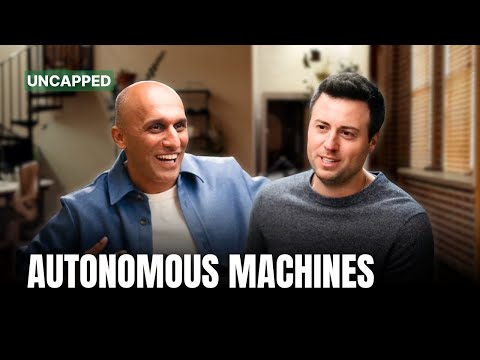
Building a Multi-Billion Dollar Hard Tech Company | Qasar Younis, CEO of Applied Intuition | Ep. 9
Qasar Younis (guest), Jack Altman (host)
In this episode of Uncapped with Jack Altman, featuring Qasar Younis and Jack Altman, Building a Multi-Billion Dollar Hard Tech Company | Qasar Younis, CEO of Applied Intuition | Ep. 9 explores applied Intuition CEO on hard tech, culture, and defense markets Qasar Younis describes the mid-career decision to leave Google and then Y Combinator, weighing starting a fund versus founding Applied Intuition, and ultimately choosing the work he’d enjoy most with the right co-founder and domain fit.
Applied Intuition CEO on hard tech, culture, and defense markets
Qasar Younis describes the mid-career decision to leave Google and then Y Combinator, weighing starting a fund versus founding Applied Intuition, and ultimately choosing the work he’d enjoy most with the right co-founder and domain fit.
He outlines Applied Intuition’s platform strategy—tools, an operating system layer, and autonomy—framing it as a “Microsoft for moving machines” across cars, trucks, construction equipment, and defense systems.
The conversation emphasizes domain expertise as a competitive moat in industrial markets, plus the operational realities: safety-critical constraints, long product lifecycles, and deeply embedded customer relationships.
Younis also shares culture and management beliefs—radical pragmatism, debate-driven truth-seeking, in-office intensity, decisiveness with imperfect information, and maintaining an uncompromising quality bar—alongside reflections on family and personal values.
Key Takeaways
Mid-career is a decisive window for committing to a path.
Younis frames life as a limited number of “five-year Post-its,” arguing your mid-30s combine enough credibility to choose among paths with enough runway left to build something enduring.
Get the full analysis with uListen AI
Founders and investors require different psychologies.
He characterizes great investors as more independent and academic, while great founders are highly opinionated, often disagreeable, and compelled to correct what they see as wrong—traits that are hard to sustain as a non-boss.
Get the full analysis with uListen AI
“Radical pragmatism” means integrating feedback without losing agency.
He credits a willingness to take feedback (e. ...
Get the full analysis with uListen AI
Applied’s platform strategy is broader than autonomy.
He positions autonomy as one component of machine intelligence, alongside core software/compute architecture (centralized compute, “defragging” systems) and interaction layers (e. ...
Get the full analysis with uListen AI
Industrial domain expertise compounds into a flywheel moat.
Younis argues few Silicon Valley teams truly understand automotive/industrial ecosystems; deep familiarity with OEMs, suppliers, lifecycles, and buying processes accelerates product decisions and credibility with customers.
Get the full analysis with uListen AI
Dual-use works when the same core product serves multiple verticals.
Rather than building “defense-only” software, he describes using largely shared products across automotive, trucking, construction, and defense—letting commercial scale subsidize expensive technology and reduce costs for all customers.
Get the full analysis with uListen AI
In defense, procurement and operations are a separate universe.
He warns founders not to enter defense casually: the buying process, compliance (facility clearance, cleared staff), and political/economic context differ fundamentally from standard enterprise SaaS.
Get the full analysis with uListen AI
In-person culture was decided through first-principles logistics, not vibes.
Applied debated remote vs hybrid vs office across employee segments and concluded customer visits, interviewing constraints, and global coordination made consistent in-office work the pragmatic choice.
Get the full analysis with uListen AI
Contrarianism is useful when it forces truth through debate.
He emphasizes a “debate, debate, debate” culture to surface assumptions and reach truth, distinguishing it from conflict-for-conflict’s-sake and from “get-along” cultures that avoid hard conversations.
Get the full analysis with uListen AI
Tech hype can be self-fulfilling, but business models still matter.
Using humanoid robots and past autonomy hype as examples, he argues funding can create momentum (talent, customers, belief), yet durable outcomes depend on discovering real business models—often later than the initial hype cycle.
Get the full analysis with uListen AI
A CEO’s job includes protecting the bar against organizational drift.
He describes maintaining high standards as a core leadership duty; if the leader lowers the bar, mediocrity spreads—even if short-term harmony improves.
Get the full analysis with uListen AI
Good advice to founders includes the hard call to stop.
With an ‘Into Thin Air’ analogy, he notes many founders are “going up the wrong side of the mountain,” and that while it’s hard to tell (given false negatives), it’s even harder for founders to stop once committed.
Get the full analysis with uListen AI
Notable Quotes
““All of our values can be reduced to radical pragmatism.””
— Qasar Younis
““No problem can withstand the constant onslaught of thought.””
— Qasar Younis
““Decisiveness, decisiveness, decisiveness. You’ve got to make decisions as a leader without all the information. And then, by the way, they’ve got to be right.””
— Qasar Younis
““I feel more myself today than I’ve ever felt.””
— Qasar Younis
““No matter how successful you become… if your kids don’t like you, you’re a failure.””
— Qasar Younis
Questions Answered in This Episode
Applied is “tools, OS, autonomy”—what are concrete examples of each product category today, and how do customers typically adopt them (sequence, land-and-expand paths)?
Qasar Younis describes the mid-career decision to leave Google and then Y Combinator, weighing starting a fund versus founding Applied Intuition, and ultimately choosing the work he’d enjoy most with the right co-founder and domain fit.
Get the full analysis with uListen AI
You compare your strategy to Microsoft’s 1975–2000 era: what is the analog of “Windows” for moving machines, and what’s the risk of platform fragmentation across OEMs?
He outlines Applied Intuition’s platform strategy—tools, an operating system layer, and autonomy—framing it as a “Microsoft for moving machines” across cars, trucks, construction equipment, and defense systems.
Get the full analysis with uListen AI
You say cars are still “pretty dumb.” What technical or regulatory bottlenecks most limit intelligence deployment: compute architecture, validation/testing, liability, supply chain, or org structure at OEMs?
The conversation emphasizes domain expertise as a competitive moat in industrial markets, plus the operational realities: safety-critical constraints, long product lifecycles, and deeply embedded customer relationships.
Get the full analysis with uListen AI
What are the most common ways Silicon Valley teams misunderstand the automotive ecosystem (procurement, safety criticality, timelines, supplier politics), and how did you operationalize that insight early?
Younis also shares culture and management beliefs—radical pragmatism, debate-driven truth-seeking, in-office intensity, decisiveness with imperfect information, and maintaining an uncompromising quality bar—alongside reflections on family and personal values.
Get the full analysis with uListen AI
For dual-use, where do you draw the line on product reuse vs defense-specific augmentation—what must remain separate (security, classification, deployment), and what can be standardized?
Get the full analysis with uListen AI
Transcript Preview
So number one, I lo- I love the car business in, in the, in a way that I've never loved, you know, any other [chuckles] like bus- beyond a business.
Why do you love it so much?
I mean, I came to the US in GM money, um, so there's an emotional, you know, component there. Like, my uncle was a General Motors engineer. He bought us the tickets that we came to America on and then supported us.
[music] All right. Thanks a bunch for doing this. You're, um, you're one of the CEOs that I look up to the most, but there's no content about you online.
Wow! I'm deeply flattered.
When I started this, I was like-
And the same
... I've gotta get you.
[laughing]
Oh, yeah, he'll... Every single one, right to him.
[laughing]
Um, so I wanna start with when you began working on this company, you were at a place where you had already started a company-
Yeah
... that was, like, probably really hard. You know, you went to Google, and then you were, like, the COO at YC, and you had this comfortable, good job.
Yeah.
You already knew that starting a company is pretty brutal, kind of sucks, and you started one anyway, which is very different than, like, a 22-year-old starting a company who's just, like, bright-eyed and doesn't know how hard it is. But you decided to. So can you talk about what was the psychology for you-
Yeah
... when you began working on the company, knowing that you could've, you could've gone and ran a VC firm?
Yeah.
You could have gone and been a COO at a public company probably. Like, you had a bunch of options. Why'd you do it?
Yeah, yeah. I, uh, first thing is, I didn't quite know, because the first company I had was three years, but it was like this... I did it full-time for a while, then did it part-time, et cetera, and it was, like, and it failed. It was in Chicago. It kind of failed quietly, and literally didn't know anybody. I mean, my co-founders from that company know us, but, like, we didn't raise a dollar. It was just, you know, you're-
Mm.
... It's like a tree falls in the forest. [chuckles] If a company dies without raising money-
Yeah
... and no one even knew it existed-
Yeah
... was it really a company?
Yeah. Okay.
Then the second one was 10 months when it was acquired by Google, and it was a good outcome for us financially. We were, like, three poor, you know, kids, uh, and so, um, it wasn't, we didn't have the grind. 10 months is nothing.
It's nothing.
You blink, and your 10 months is done. So, uh, pa- partly, I didn't know, but I knew just from the YC experience that there were a lot of smart founders that went out and did all the right things-
Install uListen to search the full transcript and get AI-powered insights
Get Full TranscriptGet more from every podcast
AI summaries, searchable transcripts, and fact-checking. Free forever.
Add to Chrome