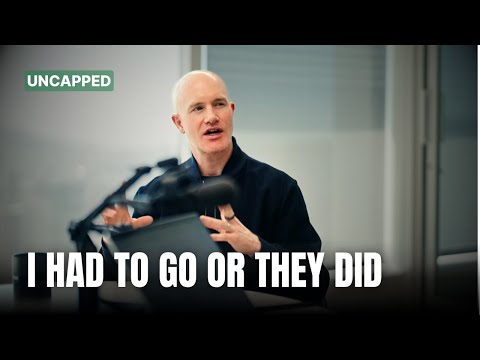
The Future of Crypto | Brian Armstrong, CEO of Coinbase | Ep. 21
Brian Armstrong (guest), Jack Altman (host)
In this episode of Uncapped with Jack Altman, featuring Brian Armstrong and Jack Altman, The Future of Crypto | Brian Armstrong, CEO of Coinbase | Ep. 21 explores coinbase’s everything exchange vision, regulation battles, and frontier bets ahead Armstrong argues that most asset classes will migrate on-chain because blockchain rails are faster, cheaper, globally accessible, and enable new market structures (24/7 trading, fractionalization, novel governance).
Coinbase’s everything exchange vision, regulation battles, and frontier bets ahead
Armstrong argues that most asset classes will migrate on-chain because blockchain rails are faster, cheaper, globally accessible, and enable new market structures (24/7 trading, fractionalization, novel governance).
He describes recent U.S. legislative momentum—especially the GENIUS Act for stablecoins—and explains how regulatory clarity plus industry political organization changed Washington’s posture toward crypto.
Armstrong shares operating lessons from repeated boom/bust cycles: avoid chasing hype, invest during downturns, and manage headcount/culture when markets are overheated.
The conversation broadens into Armstrong’s framework for prioritizing “meta problems” (AI, longevity, fusion, BCIs), his thesis on epigenetic reprogramming via New Limit, and the personal psychology of contrarian leadership and sustainable CEO performance.
Key Takeaways
On-chain finance wins on speed, cost, and global reach.
Armstrong frames tokenization as inevitable because blockchains can reduce friction and expand access—especially for people outside the U. ...
Get the full analysis with uListen AI
Tokenization enables products traditional markets struggle to offer.
He highlights 24/7 trading, fractional shares, perpetual-futures style order books for securities, and programmable governance (e. ...
Get the full analysis with uListen AI
Regulatory clarity is a prerequisite for the next wave of on-chain capital formation.
Armstrong argues both tech readiness and an improved U. ...
Get the full analysis with uListen AI
The GENIUS Act is as much a political signal as a rulebook.
Beyond defining reserve requirements (cash/short-term treasuries) and audits, he says the law reduces the chance that future officials can “weaponize” ambiguity to suppress stablecoins.
Get the full analysis with uListen AI
Big startups can’t ignore policy—lack of clarity forces engagement.
Armstrong describes moving from a “just follow the law” mindset to actively shaping rules once a company operates on an undefined frontier where legislation lags innovation by years.
Get the full analysis with uListen AI
Political organization, not just lobbying, drove U.S. movement on crypto.
He credits building voter salience (StandWithCrypto scorecards, mobilizing millions) and funding influence channels (PAC support, policy research) with convincing DC that “crypto voters” exist.
Get the full analysis with uListen AI
Enduring cycles requires resisting FOMO and treating downturns as build time.
Armstrong says the best companies start “when it isn’t cool,” avoid switching to every hot trend, and use bear markets to innovate with fewer competitors—while admitting Coinbase also overhired during peaks.
Get the full analysis with uListen AI
Notable Quotes
““It’s faster, cheaper, and more global.””
— Brian Armstrong
““Even if you’re not interested in government, government’s interested in you.””
— Brian Armstrong
““Bitcoin is a check and balance on deficit spending… a digital gold standard.””
— Brian Armstrong
““It’s never as good as it seems, never as bad as it seems.””
— Brian Armstrong
““During those times, I felt quite scared… my voice was cracking, and my leg was shaking.””
— Brian Armstrong
Questions Answered in This Episode
On the “everything exchange” vision, which asset class is realistically next after crypto—tokenized equities, private company shares, commodities, or prediction markets—and what’s the biggest blocker for each?
Armstrong argues that most asset classes will migrate on-chain because blockchain rails are faster, cheaper, globally accessible, and enable new market structures (24/7 trading, fractionalization, novel governance).
Get the full analysis with uListen AI
You said companies should opt-in rather than having derivatives created without permission. What would an ethical/regulated “permissioned tokenization” standard look like in practice?
He describes recent U. ...
Get the full analysis with uListen AI
GENIUS requires 100% reserves in cash/short-term treasuries plus audits. How should the industry handle operational risks like bank concentration, treasury duration risk, or redemption stress events?
Armstrong shares operating lessons from repeated boom/bust cycles: avoid chasing hype, invest during downturns, and manage headcount/culture when markets are overheated.
Get the full analysis with uListen AI
You described building political power via StandWithCrypto scorecards and Fairshake. Where’s the line between legitimate representation of users and regulatory capture—and how do you keep credibility?
The conversation broadens into Armstrong’s framework for prioritizing “meta problems” (AI, longevity, fusion, BCIs), his thesis on epigenetic reprogramming via New Limit, and the personal psychology of contrarian leadership and sustainable CEO performance.
Get the full analysis with uListen AI
If Bitcoin is a “check” on deficit spending, what specific fiscal/monetary signals would make you expect meaningful migration from fiat to Bitcoin?
Get the full analysis with uListen AI
Transcript Preview
people shouldn't, like, seek out a specific moment to do something super contrarian. But if you're in a position of leadership, it will care-- occasionally become necessary for you to do something really difficult, which will piss off some large group of people, but it's the right thing to do-
Yeah
... for the company. And so these moments present themselves to you, and, and when I, when I did it, I had no idea I would be talking about it five years later. [upbeat music]
Brian, thank you so much for doing this with me. I am extremely excited for this.
Yeah, thanks for having me.
So last week, you posted on X that Coinbase is becoming the everything exchange, and you basically said all assets are basically inevitably going to be on chain. I want to start by asking, why is that inevitable?
Well, the short answer is that it's faster, cheaper, and more global, right? And so if you just zoom out, I mean, crypto, we think of as a technology to update the financial system broadly. It's happening with payments, it's happening with trading, it's happening with borrowing and lending, uh, even some non-financial use cases, which we can talk about later if you want. But we do think trading is all going to come on chain, all these different asset classes. And, you know, I'll give you a couple examples. Like, today, people have been trading crypto for a long time. Um, what if we could trade stocks that were tokenized and brought on chain? Well, that would allow you to-- anybody in any country of the world to have access to these US assets and securities, which there's high demand for, but only usually, like, rich people in some of these countries, like in Argentina, to get a US brokerage account or something, you have to be kind of wealthy. So it sort of democratizes access to, from international point of view. Um, it also allows twenty-four-seven trading, which, you know, the traditional financial system has been slowly getting there, but they haven't gotten all the way there. Uh, fractions of shares. Um, you can launch new types of order books, like there's these perpetual futures order books, which are very popular in crypto, but you could bring that to traditional securities. And I think eventually you'll see even more novel stuff that we haven't really explored yet. But the way that voting happens and governance, um, can all happen on chain, you know, you could even create novel types of structures where, like, let's say, you only want long-term holders of your stock to be voters, so you don't have someone buy, buy a few shares and turn into an activist or something. You could say, "All right, you need to have held these shares for more than a year to actually vote in the next governance vote," or something like that, to incentivise long-term holders. So yeah, it's... Crypto can make all these things more efficient, so I think eventually we'll get every asset class coming on chain. Not just stocks, but also, you know, prediction markets, commodities, like the way startups raise money. All capital formation could be a lot more efficient on chain.
Install uListen to search the full transcript and get AI-powered insights
Get Full TranscriptGet more from every podcast
AI summaries, searchable transcripts, and fact-checking. Free forever.
Add to Chrome