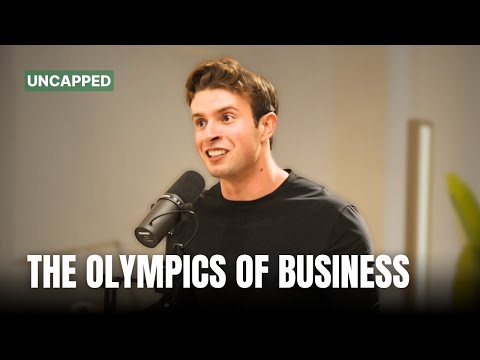
High School Dropout Turned Unicorn Founder | Adam Guild, CEO of Owner | Ep. 4
Jack Altman (host), Adam Guild (guest)
In this episode of Uncapped with Jack Altman, featuring Jack Altman and Adam Guild, High School Dropout Turned Unicorn Founder | Adam Guild, CEO of Owner | Ep. 4 explores high-school dropout Adam Guild on building Owner through grit, inbound, talent Adam Guild describes early disadvantages as a 17-year-old high school dropout founder—no credentials, no network, and low initial customer trust—and how those constraints pushed Owner toward an inbound, content-driven go-to-market motion.
High-school dropout Adam Guild on building Owner through grit, inbound, talent
Adam Guild describes early disadvantages as a 17-year-old high school dropout founder—no credentials, no network, and low initial customer trust—and how those constraints pushed Owner toward an inbound, content-driven go-to-market motion.
He explains key “contrarian” bets, including buying the Owner.com domain to manufacture trust and brand authority with small business customers, and shares his framework for high-conviction decision-making under uncertainty.
A major theme is talent: recruiting persistence over years, spending ~30% of his time hiring, and “gene pool engineering” by poaching operators who solved similar risks at companies like Shopify and HubSpot.
Guild also details the cultural expectations at Owner (energy, intensity for leadership roles, ownership mindset) and the personal discipline he treats as necessary to compete in the “Olympics of business.”
Key Takeaways
Constraints can force a superior go-to-market strategy.
Because outbound selling failed when prospects didn’t take a baby-faced teen seriously, Owner leaned into inbound content. ...
Get the full analysis with uListen AI
In SMB markets, trust is often the real bottleneck.
Guild argues products and tools are abundant; trust is scarce. ...
Get the full analysis with uListen AI
Make controversial bets only after “earning” conviction.
His approach is to define the problem in writing, list possible solutions without judging them, then rapidly gather perspectives (people/books) until conviction is high enough to decide—even without perfect data.
Get the full analysis with uListen AI
Speed matters, but so does a disciplined rapid-decision process.
Guild pushes back on the idea that CEOs can stay undecided: he clears 6–8 hours to research and decide quickly on high-stakes issues, noting indecision has real momentum costs in startups.
Get the full analysis with uListen AI
Recruiting is the CEO’s highest-leverage job—treat it like one.
He targets ~30% of his time on hiring, including sourcing and long-term courting. ...
Get the full analysis with uListen AI
“Gene pool engineering” de-risks the company by importing proven operators.
Identify the business’s biggest risks, find “centers of excellence” that solved them (e. ...
Get the full analysis with uListen AI
Culture enforcement starts at the first minute of the interview.
Guild ends interviews immediately when a non-negotiable value mismatch appears (e. ...
Get the full analysis with uListen AI
Notable Quotes
“Initially, being a young founder is a huge disadvantage… the worst disadvantage of all was that I have a baby face.”
— Adam Guild
“Anybody could be an expert on the internet as long as they created content that was good enough.”
— Adam Guild
“Trust is scarce. It is not products that are scarce.”
— Adam Guild
“Hiring big company executives that have only done big company work is always an unmitigated disaster.”
— Adam Guild
“Startups are the Olympics of business… I will not be outworked.”
— Adam Guild
Questions Answered in This Episode
Can you break down the specific content playbook that turned your restaurant marketing blog into consistent inbound leads (topics, SEO tactics, publishing cadence, conversion funnel)?
Adam Guild describes early disadvantages as a 17-year-old high school dropout founder—no credentials, no network, and low initial customer trust—and how those constraints pushed Owner toward an inbound, content-driven go-to-market motion.
Get the full analysis with uListen AI
What exactly changed on the website and sales motion after acquiring Owner.com that drove the reported 50%+ conversion lift—messaging, branding, pricing, or perceived credibility alone?
He explains key “contrarian” bets, including buying the Owner. ...
Get the full analysis with uListen AI
In your 6–8 hour “rapid conviction” decision block, what sources and conversations consistently produce the best signal—and what do you avoid because it creates noise?
A major theme is talent: recruiting persistence over years, spending ~30% of his time hiring, and “gene pool engineering” by poaching operators who solved similar risks at companies like Shopify and HubSpot.
Get the full analysis with uListen AI
How do you distinguish which roles at Owner require “partner-level” intensity versus roles where balance is encouraged, without creating a two-tier culture?
Guild also details the cultural expectations at Owner (energy, intensity for leadership roles, ownership mindset) and the personal discipline he treats as necessary to compete in the “Olympics of business.”
Get the full analysis with uListen AI
On the viral ‘counting down to the weekend’ incident: what would you do differently in the moment to be fair to the candidate while still protecting culture standards?
Get the full analysis with uListen AI
Transcript Preview
[upbeat music] All right, I'm super excited to be here with Adam, the CEO of Owner. Thanks for doing this, Adam. I'm really excited to have this conversation today.
Thanks, Jack. I'm stoked.
All right, so what I wanna start with is you as a young founder. You dropped out of, not college, but high school when you were not even eighteen. You started at Owner. You're twenty-five now, and that's, like, still pretty young, all things consider-- You know, like, I started Lattice when I was twenty-six, and I felt like I was, I was, like, a pretty young founder, and, you know, you're younger than I was when I started, and you've already got hundreds of employees and, you know, seven years of experience and tens of millions revenue and all this other stuff, so that's, like, amazing. I also know you've, like, you know, chewed a lot of glass and done a lot of hard stuff to get where you are and to make that happen, and there's, like, a ton of backstory to what you've been through. So I guess I wanted to open with just, you know, Silicon Valley talks a ton about young founders, and it's like this sort of both glamorized and sort of complicated topic, but I'm sitting with one. I'm sitting with a really good one, and I just wanna be inside your brain a little bit. Like, tell me about the experience of it.
Initially, being a young founder is a huge disadvantage, particularly the type of young founder that I was. Because I was a tenth grade high school dropout that had no credentials to my name, no professional network to draw on, no fancy college with a great computer science program to recruit classmates in order to build stuff, and the worst disadvantage of all was that I have a baby face. So when I was seventeen, starting Owner, I looked like I was twelve, and after grinding for weeks to get single demos, appointments scheduled, I would walk into the restaurant to demo their software after emailing and texting and calling incessantly to try and initially grab their attention, and then they would look at me as I was telling them about SEO, and I looked like I was twelve, and they wouldn't take anything that I said seriously. They'd ask me things like: "Where'd you go to college?" And then I'd have to explain, "I didn't go to college." "Uh, why not?" "Uh, 'cause I dropped out of high school halfway through tenth grade to build a Minecraft server." It led to all this friction where restaurant owners weren't willing to really even listen to what I had to say. Then this was, like, for context, four years before I got any credentials to my name. Four years later, I ended up getting the Thiel Fellowship, but for four years of building Owner, young founder, no network, high school dropout, and just grinding to, to make things work. So what's interesting is that these disadvantages ended up flipping into being massive advantages, both in the way that they changed our strategy and the way that they pushed me as a founder and CEO to grow myself. I got sick and tired of having to grind so hard for trying to distribute our product outbound and started asking myself: How do I get them to come to me after having benefited from something that I've put out there in a way that actually makes them excited to chat with me? And this is what led to, from the very earliest days, focusing entirely on inbound. I realized that anybody could be an expert on the internet as long as they created content that was good enough. So one of the things that I did in that first year was I started writing a blog on restaurant marketing that had these very comprehensive articles because I had looked up to this marketer, Neil Patel, who I had learned a lot of marketing stuff from, and so I told myself: If I could be the Neil Patel of the restaurant space, maybe people will benefit from the content and then want to use our product. Which, for the first few months, didn't work, 'cause content takes a while, but eventually, I ended up writing some of the most popular restaurant marketing articles of twenty eighteen and twenty nineteen, at which point restaurant owners started reaching out and saying, "I saw that article you posted. That was so helpful. I ended up doing the first strategy you mentioned in my restaurant and, and grew my sales. I'd love to chat with you about how your product might be able to help grow our sales even more." And then I would show up either for the Zoom call or for the in-person meeting, and they would see that I was eighteen years old at that point, or nineteen years old, and be blown away. And that's what ended up leading to us defying this trend in our space of selling via outbound, because we had to build via inbound on that necessity alone. I was the first sales rep in the company and the person that needed to do all the demos, and nobody was taking me seriously when I was going to them, but when they started coming to me, it flipped the dynamic entirely, and that ended up being a superpower as a young founder, both in driving our strategy as a company as well as in feeling extra energized by the fact that I had to work even harder.
Install uListen to search the full transcript and get AI-powered insights
Get Full TranscriptGet more from every podcast
AI summaries, searchable transcripts, and fact-checking. Free forever.
Add to Chrome