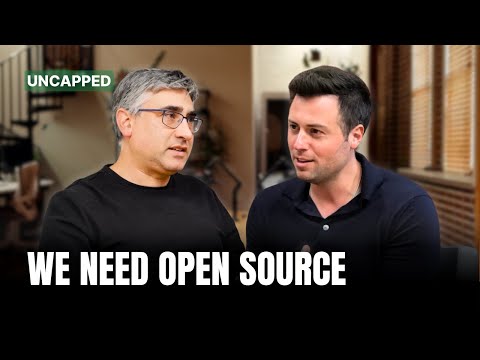
Inside a16z’s $1.25B Infra Bet | Martin Casado, General Partner at a16z | Ep. 23
Martin Casado (guest), Jack Altman (host)
In this episode of Uncapped with Jack Altman, featuring Martin Casado and Jack Altman, Inside a16z’s $1.25B Infra Bet | Martin Casado, General Partner at a16z | Ep. 23 explores martin Casado on scaling VC, AI infra value, open source debates Casado argues that VC historically didn’t require public media presence, but today direct-to-audience platforms help portfolios navigate a more hostile traditional press and a more episodic attention economy.
Martin Casado on scaling VC, AI infra value, open source debates
Casado argues that VC historically didn’t require public media presence, but today direct-to-audience platforms help portfolios navigate a more hostile traditional press and a more episodic attention economy.
He describes a16z’s shift from a small group of generalist GPs to a scaled, specialized structure as a response to market expansion, increasing AUM, and the need for better coverage and decision-making.
On AI, he emphasizes that infrastructure is where software differentiation and durability often concentrate, while the fiercest competition in AI right now is for scarce experienced talent (e.g., teams that have trained large models).
He outlines which AI markets are clearly working (content “diffusion,” code) versus those with murkier economics (enterprise/agentic automation), and defends open source as a key mechanism for healthy ecosystems and anti-monopoly pressure.
Key Takeaways
Media isn’t correlated with investing skill—but platforms now matter operationally.
Casado notes many top historical VCs were not public. ...
Get the full analysis with uListen AI
Specialization is driven more by market expansion than by firm ambition alone.
As software markets became huge, investors can spend whole careers in narrow layers (e. ...
Get the full analysis with uListen AI
Infrastructure tends to be more durable and value-accretive than apps.
His “inflammatory” view: real software differentiation is technical and often rooted in infrastructure, leading to stronger multiples and durability. ...
Get the full analysis with uListen AI
Incumbents cast a shadow, but rarely kill viable infra startups outright.
Drawing on VMware and long exposure to AWS dynamics, he argues big companies struggle to execute like focused startups. ...
Get the full analysis with uListen AI
In AI, talent competition can be fiercer than market competition.
Because AI markets are expanding quickly, apparent competitors can end up in different whitespace. ...
Get the full analysis with uListen AI
The hardest VC mistake is picking the wrong company within a category.
Casado frames “the only sin” as choosing a loser in a space and getting conflicted out of the eventual winner. ...
Get the full analysis with uListen AI
In fast-moving AI waves, obsessing over TAM/valuation is less useful than selecting the best team.
He argues TAM and pricing are unusually uncertain when categories are forming and growing rapidly. ...
Get the full analysis with uListen AI
Notable Quotes
“If you wanna help a portfolio, you do wanna build a bit of a platform. You do have to go straight.”
— Martin Casado
“Infrastructure’s where the value is… they just have better multiples and they’re more durable.”
— Martin Casado
“I still today can’t really think of a company that AWS has put out of business, even though they entered the market.”
— Martin Casado
“The only sin is picking the wrong company in a certain space… ’cause you’re conflicted out of the winner.”
— Martin Casado
“A board is to keep everybody out of jail and to… do the right thing for the shareholders.”
— Martin Casado
Questions Answered in This Episode
You argue traditional media “turned on tech.” What specific changes (editorial incentives, politics, scandals) made it feel structurally hostile, and how should founders adapt without becoming media-first?
Casado argues that VC historically didn’t require public media presence, but today direct-to-audience platforms help portfolios navigate a more hostile traditional press and a more episodic attention economy.
Get the full analysis with uListen AI
What are concrete examples of the “episodic” attention economy you described (besides major model launches), and what repeatable playbooks actually work for infra companies launching today?
He describes a16z’s shift from a small group of generalist GPs to a scaled, specialized structure as a response to market expansion, increasing AUM, and the need for better coverage and decision-making.
Get the full analysis with uListen AI
You claim infra captures more durable value than apps—where do you see counterexamples (app layers that became the durable monopolies), and what made them different?
On AI, he emphasizes that infrastructure is where software differentiation and durability often concentrate, while the fiercest competition in AI right now is for scarce experienced talent (e. ...
Get the full analysis with uListen AI
On incumbents: are there specific categories where the ‘AWS won’t kill you’ heuristic breaks (e.g., commoditized primitives), and what early signals tell you you’re in the danger zone?
He outlines which AI markets are clearly working (content “diffusion,” code) versus those with murkier economics (enterprise/agentic automation), and defends open source as a key mechanism for healthy ecosystems and anti-monopoly pressure.
Get the full analysis with uListen AI
In AI conflicts, how do you handle the scenario where an existing portfolio company insists it will pivot into a space where you believe it can’t win—do you ever actively discourage the pivot?
Get the full analysis with uListen AI
Transcript Preview
The market is so big, and it's growing so fast, even companies that seem like they're competing end up in totally different places, just 'cause so much white space is being created. But they're all competing, like, totally different companies and spaces are competing for the same talent.
Talent, yeah.
So the first time-
Yeah
... I can remember where the actual talent competition is, like, way more fierce. [upbeat music]
Martin, I'm really excited to be doing this here with you today.
Same.
Thanks for making time for it.
Yep, yep.
And, um, one of the things that I was just, uh, chatting with you and laughing about, on my way in, there were, like, many other podcasts going. There's, like, one, like, before and after us.
Yeah.
And I talked about this with Mark-
Yeah
... about how, like, podcasts are, like, this future thing-
Yeah
... of, of media. And basically, my question for you is sort of like, as somebody who's been on the inside of a firm that's dominated this, you do a lot of it yourself-
Yeah
... like, what's your experience about, like, the importance of media for venture capital?
So I think it's probably important to recognize that it's never been a thing, really. Like, if you look at a lot of historically good investors, they weren't very public. Like, think about, like, the, the greats, like Moritz, Ping Li, Doug Leone, Benton, Mike Volpi. Like, they're just not very public, and so historically there's been no correlation to being between public or not.
Yeah.
I think a couple of things have changed in that time. Um, one of them is the traditional media just turned on tech, and it hates tech, right?
Yeah.
And so in the past, you know, when I was a founder, to get a po- uh, like, a, a lukewarm to positive article was pretty straightforward, and the VCs would help with that. Like, you know, they would know a few reporters. It was very easy. But now it's actually very dangerous because, like, you go talk to them, and, like, who knows what they're gonna say? And so in a way, like, if you wanna help a portfolio, you do wanna build a bit of a platform. You do have to go straight. So I, I, I think that's one thing that's changed. The second thing is... [exhales] So if you're traditionally an enterprise, take from the enterprise standpoint, like, marketing has been something that you build brick by brick, right? And it's like you put content out there, and people read it, and, like, it's durable over time, and so you get this kind of compendium, and you build a brand over time. And it feels we're in an era now where it's just become so episodic that if you don't understand, like, the current zeitgeist, you just can't even get a voice at all. And by episodic, I mean, like, today, GPT-5 launched, right? It was, it was, it was massive. Like, if you didn't know that that was gonna happen, you would've been drowned out, and if you did know, you could draft on it. And so, and then, and then it just feels like for some launches, they go, they're a big deal, and then they just disappear forever. So I just... So much of the nature of how we consume and think about content has changed, and so I do think that venture capitalists, one, they need to, like... If they have a message they wanna get out, they kind of have to go direct because, I mean, if it's your own platform, it doesn't hate you. That's one.
Install uListen to search the full transcript and get AI-powered insights
Get Full TranscriptGet more from every podcast
AI summaries, searchable transcripts, and fact-checking. Free forever.
Add to Chrome