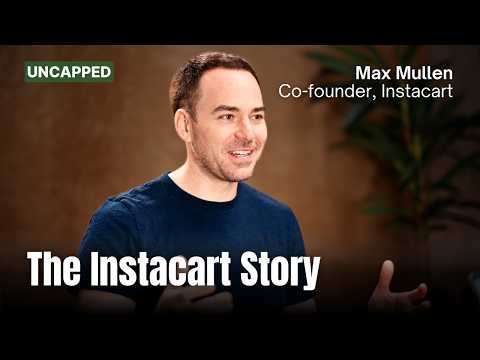
Instacart Co-founder Max Mullen on Building a $10B Consumer Marketplace | Ep. 47
Max Mullen (guest), Jack Altman (host)
In this episode of Uncapped with Jack Altman, featuring Max Mullen and Jack Altman, Instacart Co-founder Max Mullen on Building a $10B Consumer Marketplace | Ep. 47 explores max Mullen on Instacart’s hard-mode growth, resilience, and investing lens Instacart began as a contrarian bet that grocery delivery could work post-Webvan due to smartphones, higher e-commerce adoption, and using existing stores as warehouses.
Max Mullen on Instacart’s hard-mode growth, resilience, and investing lens
Instacart began as a contrarian bet that grocery delivery could work post-Webvan due to smartphones, higher e-commerce adoption, and using existing stores as warehouses.
Early execution was intensely manual—founders ran customer support, iterated weekly on operational metrics, and even built retailer catalogs by buying and photographing one of every item.
True product-market fit emerged as Instacart added beloved retailers (e.g., Trader Joe’s) and expanded city-by-city with balanced supply (shoppers/ops) and demand (marketing/referrals).
Major external shocks—Amazon buying Whole Foods and COVID demand surges—were reframed into accelerants through “wartime” urgency, retailer partnerships, and organizational adaptability.
Mullen argues great consumer companies require contrarian timing, thick skin, and speed, and he outlines what founders should seek from investors plus a “science, art, religion” framework for taking advice.
Key Takeaways
Operational breakthroughs can beat capital-intensive models.
Instacart avoided warehouses and trucks by turning existing stores into “warehouses,” enabled by shopper smartphones (GPS, in-store workflows) and marketplace routing.
Get the full analysis with uListen
Product-market fit is gradual and can shift as the customer changes.
Mullen describes PMF as a spectrum: early pull came from “fast groceries from anywhere,” but deeper fit came later with families once preferred retailers and full catalogs were added.
Get the full analysis with uListen
Do unscalable things early to create the first scalable loop.
Buying one of every Trader Joe’s item (~$20k) to build a catalog created a retailer-specific experience that triggered word-of-mouth and stronger retention—similar to Airbnb’s early photo playbook.
Get the full analysis with uListen
Retailer selection is not a detail; it’s core value.
Customers have strong store loyalty; hiding the source store limited appeal, while adding retailer toggles (Safeway vs. ...
Get the full analysis with uListen
Marketplace growth is often a balanced choreography, not a single hack.
City launches required defining service areas, hiring shoppers/ops, and layering demand-gen (events, PR, referrals) so supply and demand ramped together.
Get the full analysis with uListen
Crises can be strategic accelerants if you declare ‘wartime.’
Amazon acquiring Whole Foods looked existential, but it pushed other retailers to urgently form e-commerce strategies—helping Instacart sign major holdouts faster than would’ve happened otherwise.
Get the full analysis with uListen
Profitability can be driven by distributed ownership of unit economics.
After quantifying losses per order, teams owned “five cents to one dollar” improvements across the P&L (batching, pricing, deposits, taxes), compounding to gross-margin profitability and cultural resourcefulness.
Get the full analysis with uListen
Notable Quotes
“My belief is that product market fit is like a spectrum. It doesn't just happen in one moment.”
— Max Mullen
“What if we bought one of everything in the whole store? … Twenty thousand dollars.”
— Max Mullen
“Amazon buys Whole Foods. Instacart's toast.”
— Max Mullen
“We had an all hands, and we declared wartime.”
— Max Mullen
“You got three kinds of decisions in your company: science, art, and religion.”
— Max Mullen
Questions Answered in This Episode
In the Trader Joe’s experiment, what metric changes convinced you the retailer-specific catalog was the inflection point (conversion, retention, order frequency, AOV)?
Instacart began as a contrarian bet that grocery delivery could work post-Webvan due to smartphones, higher e-commerce adoption, and using existing stores as warehouses.
Get the full analysis with uListen AI
What were the most important operational metrics in the first year (lateness, found rate, batch efficiency), and what weekly changes reliably moved them?
Early execution was intensely manual—founders ran customer support, iterated weekly on operational metrics, and even built retailer catalogs by buying and photographing one of every item.
Get the full analysis with uListen AI
How did Instacart decide when to pursue a retailer partnership versus shopping without one, and what changed the retailer negotiating power over time?
True product-market fit emerged as Instacart added beloved retailers (e. ...
Get the full analysis with uListen AI
What did “wartime” concretely mean after the Amazon–Whole Foods news—what was reprioritized, and what initiatives were cut immediately?
Major external shocks—Amazon buying Whole Foods and COVID demand surges—were reframed into accelerants through “wartime” urgency, retailer partnerships, and organizational adaptability.
Get the full analysis with uListen AI
During COVID hypergrowth, what broke first operationally (support, shopper supply, routing, inventory substitutions), and how did you stabilize it fastest?
Mullen argues great consumer companies require contrarian timing, thick skin, and speed, and he outlines what founders should seek from investors plus a “science, art, religion” framework for taking advice.
Get the full analysis with uListen AI
Transcript Preview
And I look at their sneakers. If you're looking at a founder and, and they got dirty white sneakers on, people that are busy building, they're locked in on their companies, they're sleeping at the office, right? They don't have time to buy nice sneakers, right?
Yeah.
They just put on the same pair of sneakers, and they get dirty, and, like, the real builders, you know, they sort of just, they look the part.
[upbeat music] All right, Max, I'm very excited for this one. I love doing this with close friends. As you know, we've had some other ones on the show, and one of the things I was just sharing to you is we've hung out a million times, and we barely talk about work. I barely know what you do. So I'm excited to learn about your work-
[laughs]
... along with the rest of the audience.
Well, thank you so much for having me, Jack.
Let's start with Instacart because you obviously just completed, you know, sort of the, the end-to-end dream of any entrepreneur, and then I wanna go into sort of your investing and some of your other work. But starting with Instacart, and I don't even know all these stories, which I, I really should given how much we've hung out. Can you talk about Instacart getting started, like the early days, the idea coming together? I know this was YC, like back in twenty twelve, right?
Mm-hmm.
So tell me about the beginning.
I'm, I'm so fortunate to be, um, to be able to be a founder of a consumer company because it's like a household name and everybody knows about it. And today-
I mean, I use it like seven times a week.
You really do order a lot.
You probably know what I u- too.
I do not look at customer accounts, but-
Could you if you wanted to?
I, I can't, no.
Okay. You probably could.
But [laughs] but, um, um, what's great about being a consumer founder is, is that, you know, everybody knows kind of what you do. You don't need to repeat yourself anymore, uh, when you're pitching the company, and that wasn't the case in the early days, right? In twenty twelve, grocery delivery was basically something that didn't exist in the US. It was quite a contrarian idea back then to have an app.
Well, actually, it's even more contrarian because didn't people try it in like Web one point O and it was like a big high-funded failure?
Yeah. There were some spectacular failures, uh, in twenty, in, uh, like the dot com era.
Like hundreds of millions went in, and it didn't work or anything.
Yeah, like Sequoia invested over a billion dollars in a company called Webvan.
Yeah.
And it failed.
Yeah.
And that was ten years earlier before we started.
So did you have that when you were talking to... Was that like the big thing when you were talking to investors was like, "This has been tried. It doesn't work"?
Install uListen to search the full transcript and get AI-powered insights
Get Full TranscriptGet more from every podcast
AI summaries, searchable transcripts, and fact-checking. Free forever.
Add to Chrome