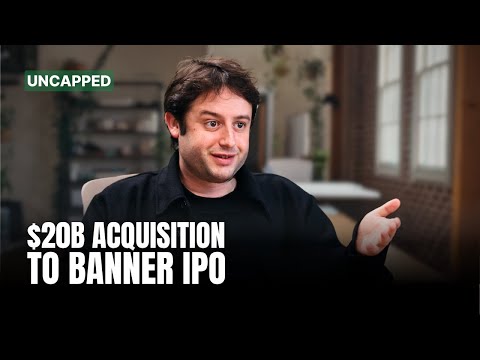
Figma's Dylan Field on the Future of Design | Ep. 31
Dylan Field (guest), Jack Altman (host)
In this episode of Uncapped with Jack Altman, featuring Dylan Field and Jack Altman, Figma's Dylan Field on the Future of Design | Ep. 31 explores dylan Field on AI, design craft, and building Figma’s future Field contrasts Figma’s multi-year “hard product” build with today’s AI-era speed, arguing that while faster tooling helps, defensibility and thoughtful execution still matter.
Dylan Field on AI, design craft, and building Figma’s future
Field contrasts Figma’s multi-year “hard product” build with today’s AI-era speed, arguing that while faster tooling helps, defensibility and thoughtful execution still matter.
He believes AI will raise the baseline so “good enough” becomes mediocre—making differentiation via craft, taste, brand, and storytelling more important, not less.
Rather than replacing designers, AI shifts work away from drudgery toward broader exploration and higher-leverage decisions across systems, constraints, and culture.
Field also shares leadership lessons from the failed Adobe acquisition, emphasizing equanimity, direct communication, and a structured reset that helped Figma accelerate product momentum.
Key Takeaways
Shipping earlier would have revealed product pull sooner.
Field says Figma’s first five years were “definitely too long,” and that strong user passion (detailed feedback even when the product was rough) should have prompted faster hiring and earlier scaling.
Get the full analysis with uListen AI
Separate “blockers” from “differentiators” to prioritize effectively.
Figma focused one stream on removing adoption blockers and another on big differentiators (e. ...
Get the full analysis with uListen AI
AI accelerates building, but also amplifies hype cycles and fragility.
Field expects some AI companies to “go straight up, go straight down,” especially when speed creates tech debt and scaling problems—similar to what he observed in past competitors.
Get the full analysis with uListen AI
AI raises the baseline—so craft and point of view become the moat.
As AI closes gaps and makes “good enough” easy, competitive advantage shifts upward to taste, brand, storytelling, and cohesive product decisions—“the stuff at the top of the stack.”
Get the full analysis with uListen AI
Roles won’t disappear; boundaries blur as impact expands cross-functionally.
Designers, PMs, and engineers keep specializations, but AI and better tooling let each contribute outside their lane (designers committing code; PMs prototyping rather than only writing PRDs).
Get the full analysis with uListen AI
Engineering rigor remains essential in an agentic world.
Field argues engineers are “more needed than ever” to architect systems safely; letting agents run unchecked leads to security issues, data leaks, and brittle systems.
Get the full analysis with uListen AI
Figma handled the Adobe breakup by optimizing for clarity and momentum.
Field focused on equanimity, kept shipping regardless of outcome, then offered a paid exit (“Detach”) so only committed people stayed—after which velocity increased and major launches followed.
Get the full analysis with uListen AI
Notable Quotes
“We’re gonna get to a world… where good enough is not enough. Good enough is gonna be mediocre.”
— Dylan Field
“If your pure strategy is like, ‘It’s a gold rush, I’m gonna get there fastest,’ then you have to be charging incredibly hard… and you have to know if you got that in you.”
— Dylan Field
“Design is… kind of everything going forward.”
— Dylan Field
“If you just let these agents run right now… you’re gonna have a mess.”
— Dylan Field
“The word of the year for me then was… equanimity.”
— Dylan Field
Questions Answered in This Episode
On the early Figma years: what specific milestones or signals would you use today to decide “ship now” versus “keep building” for a hard product?
Field contrasts Figma’s multi-year “hard product” build with today’s AI-era speed, arguing that while faster tooling helps, defensibility and thoughtful execution still matter.
Get the full analysis with uListen AI
You described “blockers” vs “differentiators”—what are the current top 3 blockers you see teams facing in AI-assisted design-to-dev workflows?
He believes AI will raise the baseline so “good enough” becomes mediocre—making differentiation via craft, taste, brand, and storytelling more important, not less.
Get the full analysis with uListen AI
Figma Make aims for a “round trip” between design and generation—what are the hardest technical or UX problems to make that loop reliable and non-destructive?
Rather than replacing designers, AI shifts work away from drudgery toward broader exploration and higher-leverage decisions across systems, constraints, and culture.
Get the full analysis with uListen AI
Dev Mode MCP: what file structure or design-system hygiene is required for AI to generate trustworthy front-end code from Figma context?
Field also shares leadership lessons from the failed Adobe acquisition, emphasizing equanimity, direct communication, and a structured reset that helped Figma accelerate product momentum.
Get the full analysis with uListen AI
You said the key strategic test is “as models get better, do we get better?”—what are concrete examples where Figma’s advantage increases as frontier models improve?
Get the full analysis with uListen AI
Transcript Preview
We're gonna get to a world, we're already kind of there, where good enough is not enough. Good enough is gonna be mediocre.
Mm.
And you're gonna need to differentiate through design, through craft, through point of view, through brand, through storytelling, and marketing. And I think, uh, the people that internalize that now, they're gonna be winners.
Yep.
That's my point of view, is that this is what's gonna matter, the stuff at the top of the stack. And if you don't internalize it now, like, you got an issue. [upbeat music]
Dylan, it's a pleasure to have you here. Thanks for doing this.
Jack, thank you.
Okay, I wanna start by teeing up a contrast between Figma in the early days, which was, like, a multi-year-long build before you kind of got things going, and then the state of the world today, where, like, AI startups are racing out of the gates, and there's tons of competition, and-
Yeah
... everything's frenetic.
13 years in, uh-
13 years for you.
And, uh, it's, it's a little different now, isn't it?
Yeah. So you started in 2012?
Mm-hmm. August 2012 was our official start.
And then you got really kind of off to the races when? Like, four or five years later?
Closed beta was launched December 2015. Uh, GA, October 2016. Didn't start charging until summer 2017.
Geez.
Same day as our CFO, now CFO, started. Fun fact.
CFO started the day you started charging?
Yeah, he was, like, a biz ops guy then-
Yeah
... but now he's CFO.
Okay, so you had this five-year period.
Mm-hmm.
And I guess when you look back on it, you could, you could either sort of, I imagine, feel like that was a little too long. We should have launched-
Definitely too long
... We should have launched earlier.
If you're watching, don't do that.
But on the other hand, you built some hard stuff. Like, you put, like, you know, an- a design product in the browser when people had never done it.
Mm-hmm.
You'd made, like, collaboration, which, you know, I've read is very- was a very difficult task, and that had advantages, too. So how do you sort of make sense looking back now in sort of the fullness of time on that five-year period?
Yeah, I think definitely there were ways we could have speed run it. Uh, hiring faster, noticing that we had product market pull, and that folks were, like, literally begging us to go do things. You know, when we got very long docs from people saying, "I was so inspired by our last night together," when we went through this very long user test where the... Everything was not performant, and it was-
Mm
... you know, uh, the tool was in terrible shape. Then they followed up the next morning with, like, you know, a 13, 14-page doc, and it was like, "Here's all the stuff that I want you to build." I probably should have known that maybe people, like, cared and wanted this thing. Um, but, you know, I was also nervous. I kind of took the roadmap feedback, and I was like, "Oh, man, it's gonna take forever to do all this stuff." In reality, I should have hired faster. Uh, I think we had the resources to do it. I was just a little trepidatious. But beyond that, I think, um, yeah, there was a lot of stuff to build, and there were certain things we could have not done that we, like, later pulled out.
Install uListen to search the full transcript and get AI-powered insights
Get Full TranscriptGet more from every podcast
AI summaries, searchable transcripts, and fact-checking. Free forever.
Add to Chrome