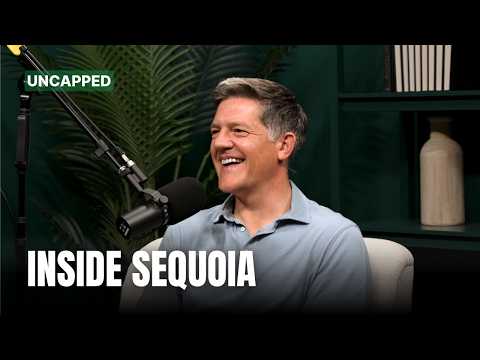
Sequoia’s Roelof Botha on Decision Making, AI, and the Next Trillion Dollar Market | Ep. 28
Roelof Botha (guest), Jack Altman (host)
In this episode of Uncapped with Jack Altman, featuring Roelof Botha and Jack Altman, Sequoia’s Roelof Botha on Decision Making, AI, and the Next Trillion Dollar Market | Ep. 28 explores roelof Botha on stewardship, rigorous decisions, AI economics, future markets Botha frames leading Sequoia as “stewardship”: maintaining continuity across generations while resisting complacency through institutionalized paranoia and constant self-auditing of missed deals.
Roelof Botha on stewardship, rigorous decisions, AI economics, future markets
Botha frames leading Sequoia as “stewardship”: maintaining continuity across generations while resisting complacency through institutionalized paranoia and constant self-auditing of missed deals.
He argues venture capital doesn’t “scale” like a true asset class—too much capital is chasing a limited number of outsized outcomes—so returns compress unless you consistently access and win the rare winners.
He details Sequoia’s consensus-oriented investment process: full-contact debate, trust-building rituals, anonymous voting to reduce deference to seniority, and bias-checking tools to improve judgment over time.
On AI, he emphasizes cost curves and gross-margin dynamics: token/compute costs should fall, enabling today’s lower-margin AI apps to become durable businesses; he also highlights robotics, healthcare (genetics + physician productivity), and stablecoins as major societal and market shifts.
Key Takeaways
Stewardship is continuity plus responsibility, not personal control.
Botha describes Sequoia leadership as a generational handoff with mentorship and ongoing counsel from prior leaders—designed to minimize discontinuities while keeping a duty to “leave it better” for the next generation.
Get the full analysis with uListen
Paranoia is operationalized, not just motivational.
Sequoia embeds “We are only as good as our next investment” as a daily reminder, and systematically reviews competitor investments to diagnose misses, emerging categories, and internal blind spots.
Get the full analysis with uListen
Venture doesn’t scale; too much capital mathematically forces lower returns.
Botha’s simple arithmetic: ~$250B/year going into U. ...
Get the full analysis with uListen
Consensus decisions work only with high-trust, high-candor culture.
Sequoia aims for “triumph of ideas, not seniority” using full-contact debate (“front stabbing”), offsite check-ins to build interpersonal trust, and processes that make people comfortable disagreeing hard and then resetting immediately afterward.
Get the full analysis with uListen
Anonymous mechanisms reduce hierarchy bias in high-stakes decisions.
They anonymize pre-mortems/pre-parades and do anonymous initial vote distributions to surface real dissent, especially from newer team members who may have better domain insight than senior partners.
Get the full analysis with uListen
Cost—not low price—is the durable competitive advantage.
Botha calls cost reduction a hidden driver of Silicon Valley’s success because it creates “degrees of freedom”: you can price at parity for margins, underprice to gain share, or reinvest profits to expand—whereas “low price” alone is easily copied.
Get the full analysis with uListen
AI app margins can look bad now, but experience curves are your friend.
He points to cloud precedents (e. ...
Get the full analysis with uListen
Notable Quotes
“We are only as good as our next investment.”
— Roelof Botha
“Venture is a return-free risk, not a risk-free return.”
— Roelof Botha
“Cost is the secret of Silicon Valley.”
— Roelof Botha
“We want the triumph of ideas, not the triumph of seniority.”
— Roelof Botha
“We wanna recruit people to Sequoia who wanna be pirates, not people who wanna join the Navy.”
— Roelof Botha
Questions Answered in This Episode
On the “venture isn’t an asset class” claim: what specific data would change your mind (e.g., more $10B+ outcomes, faster liquidity, secondary markets)?
Botha frames leading Sequoia as “stewardship”: maintaining continuity across generations while resisting complacency through institutionalized paranoia and constant self-auditing of missed deals.
Get the full analysis with uListen AI
How do you decide when a dissenting partner should “ride with conviction” versus block a deal—are there explicit thresholds or recurring red-flag patterns?
He argues venture capital doesn’t “scale” like a true asset class—too much capital is chasing a limited number of outsized outcomes—so returns compress unless you consistently access and win the rare winners.
Get the full analysis with uListen AI
What does Sequoia’s anonymous vote distribution typically look like for the best-performing investments (uniformly above the line vs. a polarized mix)?
He details Sequoia’s consensus-oriented investment process: full-contact debate, trust-building rituals, anonymous voting to reduce deference to seniority, and bias-checking tools to improve judgment over time.
Get the full analysis with uListen AI
In AI apps, what margin floor do you underwrite today, and what evidence convinces you the cost curve will improve fast enough for durable profitability?
On AI, he emphasizes cost curves and gross-margin dynamics: token/compute costs should fall, enabling today’s lower-margin AI apps to become durable businesses; he also highlights robotics, healthcare (genetics + physician productivity), and stablecoins as major societal and market shifts.
Get the full analysis with uListen AI
Robotics seems inevitable, but what’s the real bottleneck: hardware cost, deployment/maintenance, safety/regulation, or customer workflow integration?
Get the full analysis with uListen AI
Transcript Preview
when you're in my shoes as sort of part of the third generation to run the partnership, there's this enormous burden that Sequoia has been at the top of its game for a long time.
Yeah.
And we have these legendary companies that we've participated in. You know, something like thirty percent of the total value of the Nasdaq is comprised of companies we were investors in when they were private businesses.
I still don't understand how that happened, but that's crazy, yeah.
And so there's this expectation of, can you keep going? [upbeat music]
I am super excited to be here with you today, and I was, um, just commenting to a friend that I was gonna mess up your name before we started. So I haven't done this before, but could you introduce yourself?
My name is Roelof Botha.
I'm not even gonna try, but, you know, I've been really looking forward to this. This was also probably the best pre-chat conversation I've had, where it turns out we both had a detached retina and this miserable surgery. So I, uh, I feel lucky to have gotten to, to bond with you over that.
[chuckles]
It was brutal. I hated it.
Misery loves company, and we, we can certainly bond over that experience.
Just like spikes in your eye. [chuckles] Okay, here's where I wanted to start. I was thinking about trying to put myself in your shoes, and you're running what I think is widely considered the best, strongest, most storied venture capital firm, and you've been running it for three years now. And the first place I wanted to start was, tell me about your mentality on day one when you became, you know, the, the head, the, the steward of Sequoia, and how has it evolved over three years, and what has updated for you in your mentality as, as the leader of the firm?
Interesting. So Sequoia has a long history of generational transfer, and so we have a very interesting culture where we, um... hence the title stewardship. W- we are momentarily, uh, we have the privilege of working in Sequoia, and we have a duty to leave it for the next generation. And so even when I joined in two thousand and three, I had the sense that there were people ahead of me who were willing to invest in me and nurture me and train me in a mentorship fashion, and maybe down the road I'd be in a leadership position at Sequoia. So I think it says a lot about the culture that we have, and so we don't have a lot of discontinuities in our leadership. So when I joined and Michael Moritz and Doug Leone were running the partnership-
Yeah.
Don was still around. Don interviewed me.
Mm.
As the founder, he wasn't overbearing, but he was present, and he provided counsel without having to be in the room, and if there was a disagreement, he respected that. I became the steward, actually, of the US business in twenty seventeen. Uh, Jim Goetz and I had been running the US venture business since twenty ten, and in twenty seventeen, I took over all of, uh, the US business when Doug was our senior steward globally. And then, as you said, in twenty twenty-two, I became-
Install uListen to search the full transcript and get AI-powered insights
Get Full TranscriptGet more from every podcast
AI summaries, searchable transcripts, and fact-checking. Free forever.
Add to Chrome