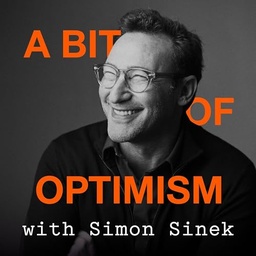
 Simon Sinek
We All Get Cancelled One Day with "Somebody Feed Phil’s" Phil Rosenthal | A Bit of Optimism Podcast
Simon Sinek and Phil Rosenthal on food-fueled conversation on creativity, gratitude, specificity, and AI’s disruption ahead.
In this episode of Simon Sinek, featuring Simon Sinek and Phil Rosenthal, We All Get Cancelled One Day with "Somebody Feed Phil’s" Phil Rosenthal | A Bit of Optimism Podcast explores food-fueled conversation on creativity, gratitude, specificity, and AI’s disruption ahead Phil Rosenthal explains how "Somebody Feed Phil" took a decade to sell, moving from PBS to Netflix by leaning into a clear character premise and persistence despite industry trend cycles.
At a glance
WHAT IT’S REALLY ABOUT
Food-fueled conversation on creativity, gratitude, specificity, and AI’s disruption ahead
- Phil Rosenthal explains how "Somebody Feed Phil" took a decade to sell, moving from PBS to Netflix by leaning into a clear character premise and persistence despite industry trend cycles.
- They unpack why "execution beats concept," contrasting high-concept shows that burn out quickly with low-concept premises that can run for years when written with specificity and craft.
- The conversation broadens into life philosophy: do the work you want because everything ends anyway, and start each day from a baseline of gratitude rather than entitlement or reputation.
- Food becomes a central metaphor for connection and community, from Japanese cultural practices of care to the way shared meals and good service create belonging and trust.
- Sinek and Rosenthal debate AI’s impact on art and labor, arguing that business models will shift but human meaning—growth through struggle, storytelling, and service—remains a key differentiator.
IDEAS WORTH REMEMBERING
7 ideasDo the project you actually want—cancellation is inevitable.
Rosenthal shares Ed Weinberger’s advice: “Do the show you want to do, because in the end they’re gonna cancel you anyway,” reframing risk as unavoidable and making fulfillment the rational choice.
Low-concept premises can last longer than clever premises.
High-concept shows must serve the same gimmick repeatedly, while everyday-life setups (like Raymond living near family) create near-infinite story fuel—if the writing is strong.
Execution is what audiences experience; pitches are just packaging.
They argue that decision-makers buy concepts because they’re easy to sell in a meeting, but what wins is craft—like the “fried egg with gooey yolk” detail that makes one burrito unforgettable.
The more specific you get, the more universal it becomes.
Rosenthal’s Fruit-of-the-Month story worked because it was hyper-specific; viewers don’t laugh at “Ray’s parents,” they recognize their own family dynamics through the emotion behind the details.
Trends and gatekeepers often optimize for their own resumes, not the audience.
Rosenthal’s Raymond spinoff was rejected despite proven talent and cast because executives wanted “young, hip, edgy,” illustrating how career incentives distort creative decision-making.
Food is a connector; laughter is the cement.
Shared meals elevate mood, create openness, and turn strangers into friends—an operating principle for Rosenthal’s show and a practical recipe for building relationships offline.
Service and human warmth are durable moats against automation.
They suggest even if AI can replicate outputs (recipes, scripts), people still crave eye contact, stories, and a “hug” feeling—great staff and hospitality can beat purely efficient systems.
WORDS WORTH SAVING
5 quotesDo the show you want to do, because in the end they’re gonna cancel you anyway.
— Phil Rosenthal
We all get canceled one day.
— Phil Rosenthal
Any idea is valid. It’s the execution.
— Phil Rosenthal
The more specific you get… the more universal it becomes.
— Phil Rosenthal
Food is the great connector… and then laughs are the cement.
— Phil Rosenthal
QUESTIONS ANSWERED IN THIS EPISODE
5 questionsRosenthal says it took 10 years to get the show—what were the specific inflection points (one meeting, one champion, one cut) that finally changed the outcome?
Phil Rosenthal explains how "Somebody Feed Phil" took a decade to sell, moving from PBS to Netflix by leaning into a clear character premise and persistence despite industry trend cycles.
How would Phil define the “character” of Somebody Feed Phil in one sentence, and how does he keep that character consistent across cultures and episodes?
They unpack why "execution beats concept," contrasting high-concept shows that burn out quickly with low-concept premises that can run for years when written with specificity and craft.
In practical terms, what are the repeatable elements of “execution” in a writer’s room that reliably turn mundane life into great comedy?
The conversation broadens into life philosophy: do the work you want because everything ends anyway, and start each day from a baseline of gratitude rather than entitlement or reputation.
Phil argues executives choose shows to protect their resumes—what structural incentives (metrics, tenure, compensation) would need to change to reward long-term quality instead?
Food becomes a central metaphor for connection and community, from Japanese cultural practices of care to the way shared meals and good service create belonging and trust.
They claim specificity creates universality—how can a creator test whether a detail is “specific and relatable” versus “specific but alienating”?
Sinek and Rosenthal debate AI’s impact on art and labor, arguing that business models will shift but human meaning—growth through struggle, storytelling, and service—remains a key differentiator.
EVERY SPOKEN WORD
Install uListen for AI-powered chat & search across the full episode — Get Full Transcript
Get more out of YouTube videos.
High quality summaries for YouTube videos. Accurate transcripts to search & find moments. Powered by ChatGPT & Claude AI.
Add to Chrome