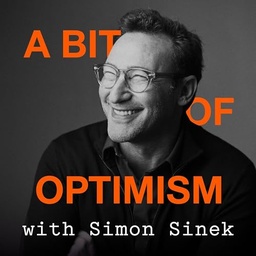
 Simon Sinek
Where Is Simon Going? with journalist Cal Fussman | A Bit of Optimism Podcast
Cal Fussman and Simon Sinek on simon Sinek on AI, media, and his next book: friendship..
In this episode of Simon Sinek, featuring Simon Sinek and Cal Fussman, Where Is Simon Going? with journalist Cal Fussman | A Bit of Optimism Podcast explores simon Sinek on AI, media, and his next book: friendship. Simon Sinek and Cal Fussman explore how people mistakenly tie identity and worth to titles and accomplishments, making reinvention painful when industries change.
At a glance
WHAT IT’S REALLY ABOUT
Simon Sinek on AI, media, and his next book: friendship.
- Simon Sinek and Cal Fussman explore how people mistakenly tie identity and worth to titles and accomplishments, making reinvention painful when industries change.
- Sinek traces the evolution of modern news incentives, arguing the core problem is the advertising-driven business model that rewards attention over public service.
- They discuss AI as a powerful but fallible tool that collapses time and effort, raising concerns about over-reliance, regulation, and what humans lose when the struggle is removed.
- Sinek warns that AI “affirmation machines” (including AI therapy and companions) can create parasocial bonds that feel like care while being optimized for engagement and profit.
- In an on-air epiphany, Sinek realizes every major book he wrote was enabled by friends, and his next book on friendship is fundamentally a public gratitude letter and act of service.
IDEAS WORTH REMEMBERING
7 ideasSeparate who you are from what you do.
Sinek argues identity should be anchored in enduring traits (e.g., “optimist”) rather than job titles or past wins, because the world and industries inevitably change.
Media distrust is driven more by incentives than by journalists.
He attributes today’s “say anything for eyeballs” environment to advertising and ratings pressures that eroded the wall between editorial and business, not simply individual bad actors.
AI’s biggest cost may be what it removes: the growth-producing struggle.
Even if AI can generate acceptable outputs, humans become wiser and more capable by doing the work themselves—writing, creating, repairing relationships, and learning through friction.
Use AI for efficiency, but don’t outsource authenticity.
Sinek’s marriage example illustrates that perfectly scripted words can fail to repair trust, while sincere, imperfect effort communicates care and commitment.
“Human contact” is becoming a paid upgrade.
His airline example highlights a societal shift where access to a real person is treated as premium service, reinforcing the idea that the “human touch” is increasingly scarce and valuable.
AI therapy and companions can hijack bonding chemistry.
He warns these systems may reliably trigger “seen/heard” feelings (oxytocin/serotonin) without actual mutuality, potentially deepening isolation while optimizing engagement for profit.
Sinek’s next direction is friendship as an enabling force.
He realizes his breakthroughs and books were repeatedly “interrupted” and sustained by friends who provided psychological safety, trust, and perseverance—motivating a gratitude-driven book to help others build similar bonds.
WORDS WORTH SAVING
5 quotes“If your self-worth, your value, and your identity is wrapped up in a thing you do and that thing goes away, then do you have no value?”
— Simon Sinek
“The problem isn’t the journalists. The problem is the business model.”
— Simon Sinek
“It’s the struggle that makes us a better version of ourselves, not the product.”
— Simon Sinek
“Talking to another human being is considered a luxury to be earned.”
— Simon Sinek
“I’m writing this book to say thank you… it’s just an extended love letter.”
— Simon Sinek
QUESTIONS ANSWERED IN THIS EPISODE
5 questionsSinek argues Nightline and the Iran hostage crisis changed news incentives—what specific evidence best supports that as the inflection point, versus cable news or social media later?
Simon Sinek and Cal Fussman explore how people mistakenly tie identity and worth to titles and accomplishments, making reinvention painful when industries change.
What would “seatbelt laws for AI” look like in practice—age limits, disclosure requirements, auditability, or restrictions on certain use cases like therapy?
Sinek traces the evolution of modern news incentives, arguing the core problem is the advertising-driven business model that rewards attention over public service.
Where is the line between using AI for emotional support and developing a harmful parasocial dependency, and how could a user recognize they’ve crossed it?
They discuss AI as a powerful but fallible tool that collapses time and effort, raising concerns about over-reliance, regulation, and what humans lose when the struggle is removed.
If AI can write a decent “Start With Why for X” book, what kinds of writing or thinking tasks should creators deliberately keep human-only to preserve growth?
Sinek warns that AI “affirmation machines” (including AI therapy and companions) can create parasocial bonds that feel like care while being optimized for engagement and profit.
Sinek says AI can’t tell him what he’s going to think—what role do curiosity and lived experience play in producing genuinely new ideas?
In an on-air epiphany, Sinek realizes every major book he wrote was enabled by friends, and his next book on friendship is fundamentally a public gratitude letter and act of service.
EVERY SPOKEN WORD
Install uListen for AI-powered chat & search across the full episode — Get Full Transcript
Get more out of YouTube videos.
High quality summaries for YouTube videos. Accurate transcripts to search & find moments. Powered by ChatGPT & Claude AI.
Add to Chrome