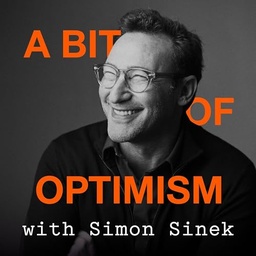
 Simon Sinek
The Beautiful Brilliance of Boredom with creative polymath Elle Cordova | A Bit of Optimism Podcast
Simon Sinek and Elle Cordova on how boredom, curiosity, and space unlock creativity and meaning.
In this episode of Simon Sinek, featuring Elle Cordova and Simon Sinek, The Beautiful Brilliance of Boredom with creative polymath Elle Cordova | A Bit of Optimism Podcast explores how boredom, curiosity, and space unlock creativity and meaning Elle Cordova describes curiosity—shaped by introversion, books, and a restrictive environment—as the engine behind her polymath creativity across music, poetry, and comedy.
At a glance
WHAT IT’S REALLY ABOUT
How boredom, curiosity, and space unlock creativity and meaning
- Elle Cordova describes curiosity—shaped by introversion, books, and a restrictive environment—as the engine behind her polymath creativity across music, poetry, and comedy.
- The pandemic’s forced downtime created the “space” that helped her rediscover playfulness, leading to viral poems and sketches that expanded her career beyond touring musician life.
- Sinek and Cordova argue that modern life eliminates the mental gaps where subconscious rumination produces ideas, so creators must intentionally schedule “good nothing” time (walks, phone-free moments, unscheduled days).
- They discuss how humor can be a learning catalyst: Cordova’s nerdy jokes nudge audiences to Google concepts to “get the joke,” turning entertainment into curiosity-driven education.
- The conversation extends to AI and authenticity—predicting increased demand for proof of human authorship—while concluding with Cordova performing her historically detailed song “Roswell,” born from being stuck in a small town for 10 days.
- They also touch on Cordova’s panic disorder, her approach to mental-health openness, and the tension between rule-following and her card-counting hobby that got her banned from Vegas casinos.
IDEAS WORTH REMEMBERING
7 ideasCreativity needs space more than pressure.
Both describe their best ideas arriving when they’re not actively “thinking” (walks, showers, traffic), because the subconscious keeps working once a question is posed.
Boredom is misbranded; “good nothing” is a practice.
They suggest reframing boredom as intentional openness—time with no goal—because making “creative time” too performative defeats the purpose.
Ask better questions before you seek better ideas.
Sinek argues brainstorming is for generating questions, not immediate solutions; Cordova adds the brain needs clear inputs (specific problems) to ruminate productively.
Replace algorithmic consumption with chosen nourishment.
Cordova limits social scrolling and returns to reliably energizing inputs (e.g., rereading Virginia Woolf) to improve the quality of her output and restore creative momentum.
Humor can be a gateway to learning.
Cordova “dangles the joke as a carrot,” prompting people to look up concepts (like the Higgs boson) not out of duty, but to participate in the joke/community.
Constraint and isolation can trigger creative breakthroughs.
Lockdown—and later, being stranded in Roswell for 10 days—functioned as “mini quarantines” that forced idle time and led directly to new work and new directions.
In an AI era, audiences increasingly buy the story of authorship.
They predict more contracts and norms requiring creators to affirm human authorship; the perceived value comes from human drama, imperfection, and provenance, not just output quality.
WORDS WORTH SAVING
7 quotesI would call myself an advantage player. There’s a difference.
— Elle Cordova
The way I come up with ideas is when I’m not thinking.
— Simon Sinek
The muse is not patient.
— Elle Cordova
You dangle the joke as a carrot.
— Simon Sinek
I won’t schedule anything in my calendar for Fridays… it has to be blank.
— Simon Sinek
We need to create spaces where we can allow our brains to be freed of distraction.
— Elle Cordova
Maybe we shouldn’t call it good nothing… Maybe we should call it Roswell time.
— Simon Sinek
QUESTIONS ANSWERED IN THIS EPISODE
5 questionsCordova distinguishes “basic strategy” from “counting cards”—what’s the practical boundary between them, and what got casinos to finally back you off?
Elle Cordova describes curiosity—shaped by introversion, books, and a restrictive environment—as the engine behind her polymath creativity across music, poetry, and comedy.
You both argue boredom enables creativity; what are the most realistic “good nothing” habits for someone with kids, shift work, or constant caregiving demands?
The pandemic’s forced downtime created the “space” that helped her rediscover playfulness, leading to viral poems and sketches that expanded her career beyond touring musician life.
Sinek claims he doesn’t believe in writer’s block—what are concrete examples of “systems” you’ve changed that immediately restored idea flow?
Sinek and Cordova argue that modern life eliminates the mental gaps where subconscious rumination produces ideas, so creators must intentionally schedule “good nothing” time (walks, phone-free moments, unscheduled days).
Cordova, you said you consume fewer algorithm-fed hours and more intentional inputs—what are your top 5 ‘refill’ sources (books, music, routines) when you’re creatively depleted?
They discuss how humor can be a learning catalyst: Cordova’s nerdy jokes nudge audiences to Google concepts to “get the joke,” turning entertainment into curiosity-driven education.
You noted a decline in patents and idea quality—what evidence would convince you that the cause is actually attention fragmentation versus economic or institutional barriers?
The conversation extends to AI and authenticity—predicting increased demand for proof of human authorship—while concluding with Cordova performing her historically detailed song “Roswell,” born from being stuck in a small town for 10 days.
EVERY SPOKEN WORD
Install uListen for AI-powered chat & search across the full episode — Get Full Transcript
Get more out of YouTube videos.
High quality summaries for YouTube videos. Accurate transcripts to search & find moments. Powered by ChatGPT & Claude AI.
Add to Chrome