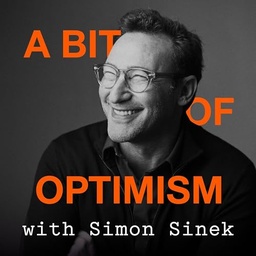
 Simon Sinek
Live Like You Have 2 Years Left with dancer and cancer survivor Angela Trimbur | A Bit of Optimism
Simon Sinek and Angela Trimbur on living with two-year urgency through joyful, accessible, community-centered dance art.
In this episode of Simon Sinek, featuring Simon Sinek and Angela Trimbur, Live Like You Have 2 Years Left with dancer and cancer survivor Angela Trimbur | A Bit of Optimism explores living with two-year urgency through joyful, accessible, community-centered dance art Angela Trimbur explains how surviving breast cancer shifted her from control, perfectionism, and codependence toward softness, self-trust, and prioritizing joy.
At a glance
WHAT IT’S REALLY ABOUT
Living with two-year urgency through joyful, accessible, community-centered dance art
- Angela Trimbur explains how surviving breast cancer shifted her from control, perfectionism, and codependence toward softness, self-trust, and prioritizing joy.
- She introduces the “two-year mindset” as a practical middle ground between bucket-list panic and long-horizon procrastination, motivating meaningful life changes like moving to New York to teach dance.
- Trimbur’s “sentimental weird” classes remove elitism from dance by eliminating skill barriers, using costumes, role-play, and storytelling to help adults reclaim childlike play.
- Sinek and Trimbur discuss boundaries—especially saying no without over-explaining—as a core practice for reducing stress and living intentionally.
- The episode frames art as something made for others, arguing that accessible, communal experiences (like her recitals and camps) can create visible and invisible healing through confidence and belonging.
IDEAS WORTH REMEMBERING
7 ideasTreat “two years left” as an intention-setting time horizon.
Trimbur describes two years as a sweet spot: urgent enough to stop stagnating, but long enough to invest in real life changes (e.g., moving cities, building a practice) rather than chasing one-off thrills.
Stress reduction can be a decision framework, not just a wellness goal.
Her cancer therapist advised choosing “whatever makes you the least amount of stress,” which Trimbur translated into everyday choices—dropping obligations, loosening control, and allowing life to unfold.
Boundaries work better when they don’t require a performance.
Sinek shares that the breakthrough wasn’t only saying no—it was realizing he doesn’t owe an explanation, which prevents self-justification spirals and reduces people-pleasing behavior.
Adults often need “permission structures” to play.
From Slightly Guided Dance Parties to balletcore characters, Trimbur uses gentle prompts, games, and roles to relieve social anxiety and help people “take up space” without fear of judgment.
Storytelling can replace technical mastery as the engine of participation.
Instead of counts and rigid technique, Trimbur anchors choreography in narratives (e.g., the widowed spider artist), letting students remember meaning and emotion rather than steps—making difficulty feel achievable.
Community goals create transformation faster than solo self-improvement.
Recitals and camps provide shared stakes, practice rhythms, and new friendships; Trimbur even “Cupids” relationships by casting people for emotional journeys, not talent.
Healing is partly invisible—and shows up as changed reactions later.
Trimbur distinguishes visible healing (therapy, classes) from invisible healing (less sting, fewer regressions into old traits), reinforcing the value of experiences whose benefits appear only with time.
WORDS WORTH SAVING
5 quotesIf I only operate as if I had two years left… you don’t stay stagnant.
— Angela Trimbur
Whatever makes you the least amount of stress, that’s the decision that you make.
— Angela Trimbur
I’m better at saying no, but the more important part is I don’t owe anybody an explanation.
— Simon Sinek
Imagine we’re all 13 years old again… the stakes are so low.
— Angela Trimbur
If I only had two years left, I would change nothing.
— Simon Sinek
QUESTIONS ANSWERED IN THIS EPISODE
5 questionsAngela, how did you convert the “keep stress low” guidance into concrete daily rules—what do you actually do when anxiety spikes now?
Angela Trimbur explains how surviving breast cancer shifted her from control, perfectionism, and codependence toward softness, self-trust, and prioritizing joy.
What’s the practical difference between a bucket-list mentality and your “two-year mindset” when you’re choosing projects, money, or relationships?
She introduces the “two-year mindset” as a practical middle ground between bucket-list panic and long-horizon procrastination, motivating meaningful life changes like moving to New York to teach dance.
You mention “ballet trauma” and exclusivity—what parts of traditional dance culture do you think are most harmful, and which parts are worth preserving?
Trimbur’s “sentimental weird” classes remove elitism from dance by eliminating skill barriers, using costumes, role-play, and storytelling to help adults reclaim childlike play.
How do you design a class so beginners can handle non-beginner choreography—what are your specific teaching cues that make it work?
Sinek and Trimbur discuss boundaries—especially saying no without over-explaining—as a core practice for reducing stress and living intentionally.
When you ‘Cupid’ people through casting, what signals tell you two students will help each other grow (and what do you do if it backfires)?
The episode frames art as something made for others, arguing that accessible, communal experiences (like her recitals and camps) can create visible and invisible healing through confidence and belonging.
EVERY SPOKEN WORD
Install uListen for AI-powered chat & search across the full episode — Get Full Transcript
Get more out of YouTube videos.
High quality summaries for YouTube videos. Accurate transcripts to search & find moments. Powered by ChatGPT & Claude AI.
Add to Chrome