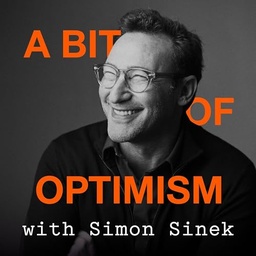
 Simon Sinek
Ask Yourself "What If?" with Milk Bar Founder Christina Tosi | A Bit of Optimism Podcast
Simon Sinek and Christina Tosi on baking as optimism: Christina Tosi on “what if” experimentation mindset.
In this episode of Simon Sinek, featuring Simon Sinek and Christina Tosi, Ask Yourself "What If?" with Milk Bar Founder Christina Tosi | A Bit of Optimism Podcast explores baking as optimism: Christina Tosi on “what if” experimentation mindset Christina Tosi explains that her baking began as childhood trial-and-error, shaping a lifelong comfort with experimentation rather than strict recipe-following.
At a glance
WHAT IT’S REALLY ABOUT
Baking as optimism: Christina Tosi on “what if” experimentation mindset
- Christina Tosi explains that her baking began as childhood trial-and-error, shaping a lifelong comfort with experimentation rather than strict recipe-following.
- The conversation frames baking as a “what if?” practice where curiosity, iteration, and learning from disappointment are core skills for both kitchens and companies.
- Tosi connects dessert-making to community and introversion, describing baking as her love language and a way to make people feel seen and cared for.
- They build a bespoke “compost cookie” from Simon’s pantry items to demonstrate playful constraints, flavor storytelling, and risk-taking without fear of imperfection.
- They also make (and taste) chocolate stout beer bread as an “idiot-proof” crowd-pleaser, using it to illustrate reverse-engineering complexity into simple, repeatable processes.
IDEAS WORTH REMEMBERING
7 ideasCuriosity beats precision when you’re building a creative practice.
Tosi’s earliest baking wasn’t recipe-based; it was iterative experimenting, which trained her to treat outcomes as data rather than judgment—an approach she still uses professionally.
Great creators build multiple prototypes at once.
Sinek notes Tosi’s habit of running A/B/C/D versions simultaneously; it accelerates learning and reduces attachment to any single outcome.
Being “good at disappointment” is a competitive advantage.
Tosi argues that frequent mismatch between expectation and result is normal; resilience comes from extracting the lesson and trying again, not avoiding risk.
Innovation often comes from refusing inherited rules.
Milk Bar’s identity was built by intentionally not doing “standard bakery” defaults (e.g., cereal milk ice cream, unconventional pies, unfrosted cake sides), reinforcing that differentiation is a choice.
Constraints can unlock originality—use what’s already on hand.
The compost cookie model turns scarcity (not enough chocolate chips) into a creative engine by repurposing pantry odds-and-ends into texture and flavor contrast.
Small technical levers can dramatically change outcomes.
Tosi introduces glucose/invert sugar to keep cookies dense and moist for days, showing how a single ingredient choice can systematize quality.
Care can be delivered through simple rituals, not grand gestures.
Baking becomes a vehicle for belonging and support—echoed by Sinek’s “eight minutes” idea that short, intentional time with a friend can make someone feel less alone.
WORDS WORTH SAVING
5 quotesFor me, baking and the approach to life is always walking around with this sense of what if.
— Christina Tosi
Being a great chef, a great baker, you have to be so good at disappointment.
— Christina Tosi
Dessert is my relationship to the world, to community… that’s how I say, ‘I got you.’
— Christina Tosi
Creativity is finding order in chaos.
— Simon Sinek
If we’re not experimenting and trying and falling flat on our faces… we’re suffocating ourselves.
— Christina Tosi
QUESTIONS ANSWERED IN THIS EPISODE
5 questionsChristina, you say you’re “good at disappointment”—what’s your practical process for deciding whether a failed experiment gets iterated or abandoned?
Christina Tosi explains that her baking began as childhood trial-and-error, shaping a lifelong comfort with experimentation rather than strict recipe-following.
When you run A/B/C/D versions at once, what variables do you change first (sweetness, fat, texture, bake time), and why?
The conversation frames baking as a “what if?” practice where curiosity, iteration, and learning from disappointment are core skills for both kitchens and companies.
Milk Bar’s early choices broke bakery norms—what’s one rule you refused that turned out to be a mistake (or at least costly) in hindsight?
Tosi connects dessert-making to community and introversion, describing baking as her love language and a way to make people feel seen and cared for.
In the compost cookie, how do you build a “flavor story” from random pantry items so it tastes intentional rather than chaotic?
They build a bespoke “compost cookie” from Simon’s pantry items to demonstrate playful constraints, flavor storytelling, and risk-taking without fear of imperfection.
You mention glucose keeps cookies fudgy for days—what’s the best home-friendly substitute if someone can’t find glucose?
They also make (and taste) chocolate stout beer bread as an “idiot-proof” crowd-pleaser, using it to illustrate reverse-engineering complexity into simple, repeatable processes.
EVERY SPOKEN WORD
Install uListen for AI-powered chat & search across the full episode — Get Full Transcript
Get more out of YouTube videos.
High quality summaries for YouTube videos. Accurate transcripts to search & find moments. Powered by ChatGPT & Claude AI.
Add to Chrome