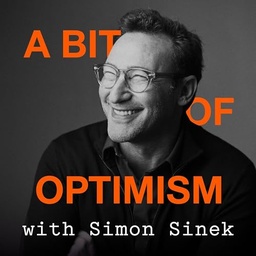
 Simon Sinek
The Future You Avoid Is Riskier Than the One You Face with Reid Hoffman | A Bit of Optimism Podcast
Simon Sinek and Reid Hoffman on reid Hoffman and Simon Sinek reclaim optimistic visions for AI.
In this episode of Simon Sinek, featuring Simon Sinek and Reid Hoffman, The Future You Avoid Is Riskier Than the One You Face with Reid Hoffman | A Bit of Optimism Podcast explores reid Hoffman and Simon Sinek reclaim optimistic visions for AI Reid Hoffman argues that modern science fiction has become overly dystopian and that avoiding feared futures is riskier than pursuing a clearly articulated, better one.
At a glance
WHAT IT’S REALLY ABOUT
Reid Hoffman and Simon Sinek reclaim optimistic visions for AI
- Reid Hoffman argues that modern science fiction has become overly dystopian and that avoiding feared futures is riskier than pursuing a clearly articulated, better one.
- The discussion frames today’s AI discourse as dominated by downside narratives, while Hoffman contends the right stance is mostly trust with targeted skepticism focused on blind spots and incentives.
- They explore how AI may change human skills and work, suggesting the core shift will be in what is measured and valued (strategy, judgment, collaboration) rather than the disappearance of struggle or learning.
- Sinek proposes that sci-fi’s earlier optimism was fueled by Cold War ideological competition, and that today’s internal societal conflict has helped drive darker, self-versus-self narratives.
- Hoffman connects optimism to concrete, high-stakes benefits—like near-universal low-cost medical “second opinions”—and calls for leaders and creators to promote credible, uplifting future visions alongside safeguards.
IDEAS WORTH REMEMBERING
7 ideasYou don’t reach a good future by only avoiding bad ones.
Hoffman’s driving-to-LA analogy argues that obsession with eliminating every risk prevents action; progress requires a destination and ongoing adjustment, not paralysis.
Treat AI builders as mostly well-intentioned, but watch for blind spots.
Hoffman recommends roughly “85% trust, 15% cynicism,” emphasizing that the biggest danger is not cartoonish malice but unrecognized failure modes, incentive mismatches, and rushed deployment.
Precaution should mean safeguards, not stopping the world.
They distinguish acceptable risk from paralysis: red-teaming, inspections, and governance are like brakes and pilot checklists—necessary to proceed responsibly, not reasons to halt entirely.
AI will change what competence looks like at work.
As drafting and routine production become easier, performance signals shift toward strategy, judgment, accuracy of inputs, coordination, and the ability to steer tools toward real outcomes.
Education may become more rigorous if AI makes assessment cheap and continuous.
Hoffman predicts near-zero-cost, on-demand testing could push learning toward deeper mastery (PhD-style oral defense dynamics) rather than predict-and-cram exam tactics.
Optimism is strongest when tied to tangible human-welfare wins.
Hoffman grounds his pro-AI stance in outcomes like low-cost, widely accessible medical assistance and faster cancer research—not just productivity gains like better code or faster writing.
Leaders and storytellers have a moral duty to articulate a compelling ‘why.’
Both argue that idealism must be voiced publicly; enemies can rally people quickly, but enduring progress depends on a positive vision that outlasts any single opponent.
WORDS WORTH SAVING
5 quotesYou don't get a future that you want by avoiding the futures you don't want.
— Reid Hoffman
If I first have to plan to avoid all possible traffic accidents... I'll never get to LA.
— Reid Hoffman
Call it 85% trust, 15% cynicism.
— Reid Hoffman
I am smarter... not because I have a book, but because I wrote a book.
— Simon Sinek
We evolve through technology. We're Homo techni more than Homo sapiens.
— Reid Hoffman
QUESTIONS ANSWERED IN THIS EPISODE
5 questionsIf science fiction shapes public imagination, what are 2–3 concrete “optimistic future” story archetypes you’d commission today to counter dystopian defaults?
Reid Hoffman argues that modern science fiction has become overly dystopian and that avoiding feared futures is riskier than pursuing a clearly articulated, better one.
Hoffman says ‘85% trust, 15% cynicism’ for AI companies—what specific blind spots make up that 15%, and how would you detect them early?
The discussion frames today’s AI discourse as dominated by downside narratives, while Hoffman contends the right stance is mostly trust with targeted skepticism focused on blind spots and incentives.
What AI use-cases should be treated like ‘no AI in nuclear defense’—i.e., hard red lines—and who should have authority to enforce them?
They explore how AI may change human skills and work, suggesting the core shift will be in what is measured and valued (strategy, judgment, collaboration) rather than the disappearance of struggle or learning.
Sinek worries about losing craft through outsourcing writing and thinking—what new “struggle” replaces that, and how do we ensure it builds wisdom rather than shallow dependence?
Sinek proposes that sci-fi’s earlier optimism was fueled by Cold War ideological competition, and that today’s internal societal conflict has helped drive darker, self-versus-self narratives.
If AI makes examination near-zero cost, what would an ideal AI-enabled assessment system look like in practice (privacy, cheating, bias, feedback loops)?
Hoffman connects optimism to concrete, high-stakes benefits—like near-universal low-cost medical “second opinions”—and calls for leaders and creators to promote credible, uplifting future visions alongside safeguards.
EVERY SPOKEN WORD
Install uListen for AI-powered chat & search across the full episode — Get Full Transcript
Get more out of YouTube videos.
High quality summaries for YouTube videos. Accurate transcripts to search & find moments. Powered by ChatGPT & Claude AI.
Add to Chrome