Sam Harris's podcast appearances: which to watch and why
Start with his Huberman Lab conversation on meditation and the self, or sample eight stretches in a 75-minute crash course.
Every quote checked against its transcript
If you watch one
His fullest case that the self is an illusion
 Play episode
By playing, you agree to uListen's Terms and Privacy Policy and YouTube's Terms of Service.
The illusory self, 11:27 · Free will, 1:38:32 · The missing tourist, 1:57:29
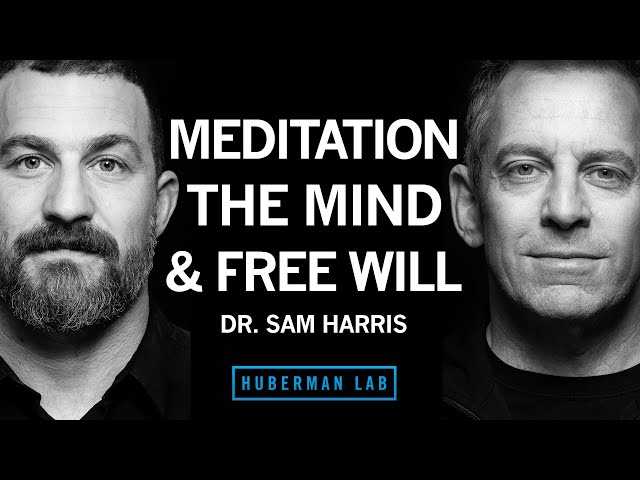
Huberman Lab with Andrew Huberman (January 2, 2023). Andrew Huberman sets up each turn with a neuroscience framing, and Harris answers with perceptual analogies, from saccades to the optic blind spot, to explain non-dual meditation and the illusory self. Along the way he runs a live free will demonstration on the host, weighs what psychedelics can and can't do, risks included, and closes with a candid account of why he deleted Twitter. No other episode here lays out his contemplative core so completely, or ties it so closely to how perception works.
On uListen: summary · chapters · transcript
Or start with
 20 min
Worried about AI
The Diary of a CEO with Steven Bartlett (August 7, 2023). His fullest single-sitting case on AI, from alignment and the lost off switch to jobs and UBI, opening with why he thinks superhuman AI is inevitable (2:40 to 22:44, 20 min).
 11 min
Ready to try meditating
Tim Ferriss (November 19, 2018). Not an interview but a preview of his Waking Up app: readings from his book and two guided meditations, starting with the breath (52:20 to 1:03:28, 11 min).
 1 hr
Following his politics
On with Kara Swisher (December 15, 2025). In 60 min he gives his sharpest critique of Elon Musk and Silicon Valley's turn toward Trump, then turns to AI risk and quitting Twitter.
one course
Want the best stretches back to back
The crash course. Eight clips from eight episodes, played one after another.
A guided watch
The Sam Harris crash course
Eight stretches from eight episodes: the mind first, then free will and how to live, then the world outside.
Total: about 75 minutes.
Play all · 75 minThe mind
- Where it started 9 min
10:31 to 19:24, 9 min of Tim Ferriss (November 19, 2018): a miserable teenage wilderness solo, then the MDMA night that convinced him love is impersonal and the mystics were onto something real.
- Which self is the illusion 8 min
10:21 to 18:08, 8 min of Huberman Lab with Andrew Huberman (January 2, 2023): his cleanest statement of the illusory self, and why seeing through it, not stress relief, is the real point of meditation.
- Mindfulness for anxiety 9 min
37:55 to 46:47, 9 min of Peter Attia MD (March 24, 2020): mindfulness as a trainable skill that shortens anxiety, and his rule that anxiety is pointless whether or not you can act.
Free will and a good life
- Free will and forgiveness 10 min
1:47:52 to 1:58:06, 10 min of The Joe Rogan Experience (February 8, 2019): a compact version of his argument, from the hurricane and the hanged circus elephant to an imagined pill that cures psychopathy.
- The moving goalposts 6 min
18:16 to 24:14, 6 min of Modern Wisdom with Chris Williamson (July 31, 2023): why reaching a goal never brings lasting satisfaction, and why happiness has to be about the process.
- Stop lying 13 min
1:28:37 to 1:41:28, 13 min of The Diary of a CEO with Steven Bartlett (August 7, 2023): his case for giving up even white lies, with examples from sport, a Stanford seminar and a casual lie told by his wife's friend.
The world outside
- The paradox of expertise 12 min
1:23:05 to 1:34:38, 12 min of Lex Fridman Podcast (March 14, 2023): why truth ignores credentials yet experts still matter, with the pilot in a storm and the doctor who drank H. pylori.
- AI risk and quitting Twitter 9 min
43:31 to 52:50, 9 min of On with Kara Swisher (December 15, 2025): his two levels of AI risk, the builders' game of Russian roulette, AI slop restoring gatekeepers, and why deleting Twitter changed his life.
Lately
His three most recent appearances here, from July 31, 2023, August 7, 2023 and December 15, 2025, build on the case for AI risk he made in earlier episodes, such as Lex Fridman Podcast (May 20, 2021) (2:10:10), with what AI could do to work, wealth and shared facts. On Modern Wisdom with Chris Williamson (July 31, 2023), AI comes up only in passing, as a near-term threat to agreeing on facts (2:24:02). The newest is also an unusually personal political conversation, about tech figures he once counted as friends.
- 1:21:53Offered a button to pause AI, he says he would press it, at least until alignment is understood, adding that humanity doesn't need superhuman intelligence to solve its biggest problems
- 1:13:23He argues that even if AI goes perfectly, society will need, in his view, an economics in which no one has to work to survive, with UBI as one option
- 58:18He says the First Amendment gives no right to algorithmic amplification of the craziest content
- 1:51:26He credits Stoic tools but says the Greeks lacked a method for training attention, and calls Buddhism the best tradition to draw from
- 50:18He suggests AI slop could push people back toward trusted gatekeepers
- 5:26He sets out his case against Elon Musk's conduct at DOGE, from the foreign aid cuts to what he describes as apparent Nazi salutes
“they all acknowledge that we're playing a game of Russian roulette, that they're playing a game of Russian roulette, and that there's at least one bullet in the cylinder”
Harris on ...
Sam Harris on meditation, mindfulness and difficult emotions
Harris treats mindfulness as a trainable skill, like fitness: the aim is not to banish fear, anxiety or anger but to shorten them, because, he says, an emotion felt as bare sensation, without the story behind it, fades within seconds.
“And if you can't do anything about it, well, then, you know, why suffer twice, right?”
Go deeper: 1:22:39 to 1:53:07, 30 min · Modern Wisdom with Chris Williamson (July 31, 2023).
More on meditation, mindfulness and difficult emotions 4 moments
On The Joe Rogan Experience (February 8, 2019) he says mental training today is where physical training was a century ago (2:08:16). On Tim Ferriss (May 19, 2020) he argues anxiety is useful only while you still face real uncertainty about what to do (16:10), and on Peter Attia MD (January 7, 2020) that long, still sits teach the difference between pain and suffering (19:47). On Modern Wisdom with Chris Williamson he adds that you get no credit for this morning's session: your whole life is the practice (1:44:28).
Sam Harris on the illusion of the self
The self Harris calls an illusion is not the person with a history but the felt sense of a subject behind the face, standing apart from experience; seeing through it, he argues, is the real point of meditation, and it is already true of ordinary consciousness.
“what you discover in meditation ultimately is that the self is what it feels like to be thinking without knowing that you're thinking, right?”
Go deeper: 28:24 to 1:18:35, 50 min · Huberman Lab with Andrew Huberman (January 2, 2023).
More on the illusion of the self 3 moments
On Huberman Lab with Andrew Huberman he uses the optic blind spot to argue that the insight is hard to see because it is too close, not too deep (46:07). On Peter Attia MD (January 7, 2020) he says the ego is already an illusion that can be recognized directly, which he ties to the Tibetan tradition of Dzogchen (1:46:05). On Tim Ferriss (November 19, 2018) he credits the teacher who showed him: “I came to Tulku Urgyen yearning for the experience of self-transcendence, and in a few minutes, he showed me that I had no self to transcend.” (45:23).
Sam Harris on consciousness and free will
Harris argues that you cannot author your next thought, since you would have to think it before you think it, and that you made neither your genes, your brain nor the influences that shaped you; free will, in his view, makes no sense, though a deliberate act still differs from a tremor.
“it's not merely that free will is an illusion. The illusion of free will is an illusion, right?”
Go deeper: 52:21 to 1:34:40, 42 min · Lex Fridman Podcast (May 20, 2021).
More on consciousness and free will 5 moments
On Huberman Lab with Andrew Huberman he runs the argument live on the host, starting with the names of cities (1:38:32). On Lex Fridman Podcast (May 20, 2021) he says losing the sense of free will undercuts the basis for hatred (57:45), and that consciousness itself cannot be an illusion, because it just means that anything seems at all (16:12). On The Joe Rogan Experience (February 8, 2019) he says punishment, in his view, makes sense only as a deterrent (1:52:59). On Lex Fridman Podcast (March 14, 2023) he floats an idea he admits is still incoherent: that only the actual is possible (4:08:31).
Sam Harris on psychedelics and altered states
Harris says psychedelics were indispensable for him, because they proved to his skeptical teenage self that looking inward was worth doing; MDMA was his gateway, but he treats meditation and psychedelics as different projects and names real risks.
“Love was at bottom impersonal and deeper than any personal history could justify.”
Go deeper: 3:08:23 to 3:38:40, 30 min · Huberman Lab with Andrew Huberman (January 2, 2023).
More on psychedelics and altered states 4 moments
On Huberman Lab with Andrew Huberman he says they are almost certainly not for anyone prone to schizophrenia or bipolar disorder (3:13:39). On Tim Ferriss (May 19, 2020) he describes his first significant trip in more than 25 years, a high dose of mushrooms, and argues that for some people a larger dose may be psychologically safer than a small one (53:47). On Peter Attia MD (January 7, 2020) he says he remains somewhat concerned that MDMA may be neurotoxic and hasn't taken it for years (1:12:25). On The Diary of a CEO with Steven Bartlett he hopes for something like the mysteries of Eleusis, rites of passage built on psychedelics and meditation (1:42:20).
Sam Harris on artificial intelligence and its risks
Harris argues that superhuman AI follows from two assumptions, that intelligence need not be made of meat and that progress continues, and that a smarter party is dangerous to a dumber one, since there are more ways to build such a mind unaligned than aligned.
“my intuition is that there is something inherently dangerous for the dumber party in that relationship.”
Go deeper: 2:40 to 22:44, 20 min · The Diary of a CEO with Steven Bartlett (August 7, 2023).
More on artificial intelligence and its risks 6 moments
He makes the case in nearly the same words on Lex Fridman Podcast (May 20, 2021) (2:09:57) and Lex Fridman Podcast (March 14, 2023) (3:35:49), where he says his concern is unchanged since his TED talk (3:25:10). On The Diary of a CEO with Steven Bartlett he adds that AI was released into the wild with no off switch (23:44). On On with Kara Swisher he separates misuse by bad actors from unaligned superintelligence (47:19), and says the builders themselves put existential risk around 20 percent (47:57).
Sam Harris on social media, attention and Twitter
Harris deleted his Twitter account after 12 years and calls it unambiguously good: he says nearly every bad thing in his past decade, apart from family health issues, came from it, and that it made ordinary people look like sociopaths.
“the reason why I deleted my Twitter account in the end was that it was obviously making me a worse person”
Go deeper: 59:48 to 1:20:55, 21 min · Lex Fridman Podcast (March 14, 2023).
More on social media, attention and Twitter 4 moments
On The Joe Rogan Experience (April 19, 2018) he says Twitter was clearly making him a worse person and that he had taken it off his phone (32:38); on Lex Fridman Podcast (May 20, 2021) he says he uses it about 5% as much as he did (2:00:27). On On with Kara Swisher, three years after deleting it, he calls quitting the greatest life hack he has found in a decade or more (51:16). On Modern Wisdom with Chris Williamson he widens the point: “Your true wealth is the quality of your attention. And we have, we've now interfaced with machinery that has systematically degraded our ability to pay attention.” (8:54).
Sam Harris on honesty, lying and apology
Harris calls deciding not to lie the highest-leverage change he ever made: he puts lying at the first stage of a continuum of violence, justified only in extremis, and argues that even white lies fail the golden rule.
“Where is it that you want to lie to yourself or lie to your kids? Like, where is honesty a liability?”
Go deeper: 1:28:37 to 1:41:28, 13 min · The Diary of a CEO with Steven Bartlett (August 7, 2023).
More on honesty, lying and apology 5 moments
On Peter Attia MD (January 7, 2020) he traces the commitment to a college seminar on lying (2:07:20), and on Peter Attia MD (March 24, 2020) he says his daughters know he will never lie to them, which doesn't mean telling them everything (50:56). He keeps returning to what makes an apology acceptable: on Peter Attia MD (January 7, 2020), that it be sincere and believable (2:34:07); on The Joe Rogan Experience (February 8, 2019), a transparent account of how you are now different (1:31:34); on On with Kara Swisher, a rational path from who you were to who you are now, which he applies to a hypothetical Musk mea culpa (57:16).
Sam Harris on COVID, conspiracy theories and trust in experts
Harris calls COVID a failed dress rehearsal for a deadlier pandemic: what alarmed him was less the disease than society's failure to agree on what was real, and his answer is to repair institutions until they deserve trust, not tear them down.
“There is no future worth wanting where we don't have institutions that are trustworthy, right?”
Go deeper: 2:25:53 to 2:40:35, 15 min · Modern Wisdom with Chris Williamson (July 31, 2023).
More on COVID, conspiracy theories and trust in experts 7 moments
He calls COVID a dress rehearsal for something much worse as early as Tim Ferriss (May 19, 2020) (1:41:30), and a failed one on Lex Fridman Podcast (May 20, 2021) (2:03:25) and The Diary of a CEO with Steven Bartlett (54:08). On Lex Fridman Podcast (March 14, 2023), where he calls it a failed one too (1:43:26), he argues that truth ignores credentials yet in a storm you want the trained pilot (1:23:16), and that conspiracy theories are a pile of anomalies, not a thesis (2:32:56). On On with Kara Swisher he describes conspiracy belief this way: “it's a kind of pornography of doubt, in my view, and, and a k- and a kind of religion that gets spun up around achieving cognitive closure” (31:28).
Stories he tells
The stories that return, and where he tells them most fully.
Told in 3 episodes
Quitting Twitter
After 12 years on the platform, he deleted his account and says it felt like leaving a bad relationship.
11 min · Fullest tellingTold in 2 episodes
A family vacation wrecked by Twitter
On a family trip to Hawaii, he saw a burst of attacks on Twitter and, he says, basically torpedoed the holiday.
2 min · Fullest tellingTold in 2 episodes
The clipped laptop remark
A clip of his comments on Hunter Biden's laptop spread widely; he calls it misleading, though he admits he hadn't spoken well even in context.
2 min · Fullest tellingTold in 2 episodes
The wilderness solo at 16
Three fasting days alone by an alpine lake were misery for him, while older participants came out transformed.
4 min · Fullest tellingTold in 4 episodes
His first MDMA experience
Talking with a close friend, he felt envy vanish and saw that even a stranger would be included in the same love.
5 min · Fullest tellingTold in 2 episodes
Mushrooms after 25 years
After a hiatus of more than 25 years, he took a high dose of mushrooms in the dark and found it almost entirely positive.
6 min · Fullest tellingTold in 2 episodes
Ron Howard's seminar on lying
In a Stanford seminar, the professor shot down the white lies students proposed, and most left convinced that lying was almost always wrong.
2 min · Fullest tellingTold in 2 episodes
Charles Whitman's tumor
The tower shooter suspected something was wrong with his brain and asked for an autopsy, which found a tumor; Harris uses it to argue that a full understanding of evil would reduce it to bad luck.
1 min · Fullest tellingTold in 2 episodes
AlphaZero teaching itself chess
Given only the rules, it played itself for about four hours and beat every human and every earlier engine.
2 min · Fullest tellingWhere else he tells each story
- Quitting Twitter. After 12 years on the platform, he deleted his account and says it felt like leaving a bad relationship. Fullest on The Diary of a CEO with Steven Bartlett (August 7, 2023) (34:08 to 45:34); also on Huberman Lab with Andrew Huberman (January 2, 2023) (4:05:27) and On with Kara Swisher (December 15, 2025) (51:06).
- A family vacation wrecked by Twitter. On a family trip to Hawaii, he saw a burst of attacks on Twitter and, he says, basically torpedoed the holiday. Fullest on The Joe Rogan Experience (April 19, 2018) (32:45 to 34:45); on Modern Wisdom with Chris Williamson (July 31, 2023) the host brings it up and Harris agrees it was one of the bad things Twitter caused (4:08).
- The clipped laptop remark. A clip of his comments on Hunter Biden's laptop spread widely; he calls it misleading, though he admits he hadn't spoken well even in context. Fullest on Lex Fridman Podcast (March 14, 2023) (1:15:56 to 1:17:43); also on Modern Wisdom with Chris Williamson (July 31, 2023) (45:18).
- The wilderness solo at 16. Three fasting days alone by an alpine lake were misery for him, while older participants came out transformed. Fullest on Peter Attia MD (January 7, 2020) (59:19 to 1:03:13); also on Tim Ferriss (November 19, 2018) (10:31).
- His first MDMA experience. Talking with a close friend, he felt envy vanish and saw that even a stranger would be included in the same love. Fullest on Tim Ferriss (November 19, 2018) (14:01 to 19:24); also told on Peter Attia MD (January 7, 2020) (1:03:47). On Huberman Lab with Andrew Huberman (January 2, 2023) (3:10:09) and Tim Ferriss (May 19, 2020) (45:16) he credits it as what opened him to meditation, without retelling it.
- Mushrooms after 25 years. After a hiatus of more than 25 years, he took a high dose of mushrooms in the dark and found it almost entirely positive. Fullest on Tim Ferriss (May 19, 2020) (30:46 to 37:02); also on Huberman Lab with Andrew Huberman (January 2, 2023) (3:21:28).
- Ron Howard's seminar on lying. In a Stanford seminar, the professor shot down the white lies students proposed, and most left convinced that lying was almost always wrong. Fullest on Peter Attia MD (January 7, 2020) (2:07:20 to 2:09:00); also on The Diary of a CEO with Steven Bartlett (August 7, 2023) (1:36:00).
- Charles Whitman's tumor. The tower shooter suspected something was wrong with his brain and asked for an autopsy, which found a tumor; Harris uses it to argue that a full understanding of evil would reduce it to bad luck. Fullest on Peter Attia MD (January 7, 2020) (2:37:22 to 2:38:47); also on The Joe Rogan Experience (February 8, 2019) (1:55:18).
- AlphaZero teaching itself chess. Given only the rules, it played itself for about four hours and beat every human and every earlier engine. Fullest on The Diary of a CEO with Steven Bartlett (August 7, 2023) (59:30 to 1:01:14); also, more briefly, on Lex Fridman Podcast (May 20, 2021) (2:19:00).
Every episode
Across these conversations Harris keeps returning to meditation and the illusion of the self, free will, psychedelics, honesty, AI and the state of public debate. The two Joe Rogan episodes, from April 19, 2018 and February 8, 2019, lean toward Islamism, race and IQ, cancel culture and redemption, while the Tim Ferriss and Peter Attia episodes from November 19, 2018 to May 19, 2020 center on mindfulness, psychedelics and, by the end, the early pandemic. From January 2, 2023 on, every episode covers his decision to quit Twitter, and the newest, from December 15, 2025, is mostly about Elon Musk and Silicon Valley's turn toward Trump. This guide helps you pick where to start, find his best stretches and see what each episode teaches.
12 conversations · About 31 hours · Videos from YouTube
20251 episodes
1 hrMusk, the tech right and the physics of apology
“He behaved like a total maniac” Sam Harris on Elon & Big Tech’s turn towards Trump
Who it’s for, and what you’ll learn
Best for: Listeners who want his sharpest critique of Elon Musk and Silicon Valley's turn toward Trump.
On uListen: summary · chapters · transcript
A like-minded, fairly gloomy political conversation: Kara Swisher sets up each question with a news peg, and Harris answers in long, structured riffs.
You'll learn:
- Why he prefers other words to fascism: “I think it's much easier to say something like authoritarianism, you know, or tyranny” (3:06).
- What he thinks drives conspiracy belief: discomfort without cognitive closure (30:19).
- Why he calls forgiveness the best software we have (57:44).
Harris speaks 68% of the words
20234 episodes
1 hr 51 minHis fullest case on AI, from alignment to jobs
WARNING: ChatGPT Could Be The Start Of The End! Sam Harris
Who it’s for, and what you’ll learn
Best for: Viewers who want AI risk from superintelligence to misinformation and jobs, plus quitting Twitter and a practical case against lying.
On uListen: summary · chapters · transcript
A long, mostly serious in-person interview: Steven Bartlett asks broad questions, lets Harris answer in monologues and pushes back now and then.
You'll learn:
- Why speed alone would leave us behind: “Well, two weeks for us is 20,000 years of analogous progress for them.” (15:51).
- Why he says art and conversation matter only if a real person is behind them (1:07:42).
- Why he expects we will have to treat anything lurid as fake until proven otherwise (48:47).
Harris speaks 81% of the words
 3 hr 12 min
Twitter, COVID trust and the voice in your head
Your Mind Has Been Lying to You - Sam Harris (4K)
Who it’s for, and what you’ll learn
Best for: Listeners who want the culture commentator and the meditation teacher in one sitting.
On uListen: summary · chapters · transcript
A loose, long conversation in which Chris Williamson moves between culture-war figures and prompts about death and the inner voice.
You'll learn:
- Why he likens being lost in thought to psychosis, while saying he isn't trivializing psychosis itself: “And so, your thought is only really different from psychosis in that you have the good sense to keep your mouth shut in public, right?” (1:21:25).
- Why a life that is going well should be treated as dessert (1:28:14).
- How a goodbye kiss as he rushed out late shows small moments of presence adding up (1:29:58).
Harris speaks 76% of the words
 4 hr 28 min
Trump, COVID, Twitter and broken friendships
Sam Harris: Trump, Pandemic, Twitter, Elon, Bret, IDW, Kanye, AI & UFOs | Lex Fridman Podcast #365
Who it’s for, and what you’ll learn
Best for: Listeners who want his fullest defense of his own views on Trump, the Hunter Biden laptop remark and COVID, and his falling-outs with Elon Musk and Bret Weinstein.
On uListen: summary · chapters · transcript
A long, friendly but contentious conversation in which Lex Fridman presses empathy and love against Harris's insistence on reason and expertise.
You'll learn:
- Why he tells the host, to his face, that the Kanye interview should have stayed private (2:09:38).
- His uncanny valley rule for which bad people to interview (2:23:52).
- Why, in his view, conspiracy theories assume impossible competence: “No one can tie their shoes, you know, expertly anywhere else. But over here, people are perfectly competent” (2:33:27).
Harris speaks 80% of the words
 4 hr 22 min
Meditation and the self, through neuroscience
Using Meditation to Focus, View Consciousness & Expand Your Mind | Dr. Sam Harris
Who it’s for, and what you’ll learn
Best for: Listeners who want the illusion of the self explained through perception, plus free will, psychedelics and leaving Twitter.
On uListen: summary · chapters · transcript
A long, warm conversation in which Andrew Huberman frames each turn with neuroscience and Harris answers in analogy-rich monologues.
You'll learn:
- Why, in his view, you cannot author your next thought: “there's no place from which you are authoring your next thought because you would have to think it before you think it, right?” (1:42:57).
- Why he recommends practicing with eyes open (2:43:04).
- Why the seeking self can't arrive, like a fist trying to become an open hand (2:05:36).
Harris speaks 70% of the words
20211 episodes
 3 hr 17 min
Free will at full length, and the meaning of life
Sam Harris: Consciousness, Free Will, Psychedelics, AI, UFOs, and Meaning | Lex Fridman Podcast #185
Who it’s for, and what you’ll learn
Best for: Listeners who want his free will argument and how it erodes hatred, plus consciousness, dreams and AI risk.
On uListen: summary · chapters · transcript
A long, admiring philosophical conversation in which Lex Fridman lets Harris talk at length and pushes back with engineering-minded alternatives.
You'll learn:
- His own test inside dreams: text changes when you look away and back (34:16).
- Why jiu-jitsu is his model of honest knowledge (2:48:06).
- His answer on happiness and meaning: “you, you can't actually become happy. You can only be happy” (3:14:00).
Harris speaks 79% of the words
20203 episodes
 1 hr 50 min
Fear, mushrooms and the first weeks of lockdown
Sam Harris - Psychedelics, Meditation, and The Bigger Picture | The Tim Ferriss Show
Who it’s for, and what you’ll learn
Best for: Meditators and the psychedelic-curious who want his practical take on fear, anxiety and dosage.
On uListen: summary · chapters · transcript
A loose, impromptu talk between friends after their South by Southwest event was canceled, opening with a question deck and then drifting.
You'll learn:
- Why he calls the amygdala a salience center more than a fear center (9:51).
- What an iPad box taught him about anxiety: “you do not have your shit together at all, right? You're in the middle of your living room opening a box of virus.” (15:20).
- Why someone who has only had good trips is, he says, almost the worst judge of risk (1:08:21).
Harris speaks 63% of the words
 1 hr 33 min
Anxiety, anger and shame in a crisis
#100 – Sam Harris, Ph.D.: COVID-19-Comprehending the crisis and managing our emotions
Who it’s for, and what you’ll learn
Best for: Listeners who want practical mindfulness tools for hard emotions, his candor about his own irritability and an early-pandemic snapshot of his views on risk and expertise.
On uListen: summary · chapters · transcript
A relaxed early-lockdown talk between friends: Harris opens as co-interviewer on Peter Attia's COVID models, then Attia turns the questions on him.
You'll learn:
- How mindfulness becomes like any physical skill (40:03).
- Why he treats shame as the next boss fight in a video game (1:03:42).
- How an apology to a child can leave things better than before: “It's not just a matter of getting back to zero, but you can actually get past zero” (1:05:45).
Harris speaks 54% of the words
 2 hr 44 min
A practical, personal primer on mindfulness
#34 – Sam Harris, Ph.D.: The transformative power of mindfulness
Who it’s for, and what you’ll learn
Best for: Listeners who want a practical introduction to mindfulness, then Vipassana versus Dzogchen.
On uListen: summary · chapters · transcript
A long, warm conversation in Harris's studio, with Peter Attia as an admiring student who shares his own stories and asks Harris to extend them.
You'll learn:
- His reframe for grief over a dog: “The dog leaves the room. There's no greater absence from a room than simply leaving it, right?” (1:38:56).
- How metta moves from a loved one to a neutral person to an enemy (1:17:26).
- Why, in his view, luck separates the texting driver who kills from the one who doesn't (1:28:19).
Harris speaks 59% of the words
20191 episodes
 2 hr 43 min
Redemption, free will and martial arts
Joe Rogan Experience #1241 - Sam Harris
Who it’s for, and what you’ll learn
Best for: Listeners who want his views on cancel culture and redemption, and martial arts material he rarely covers.
On uListen: summary · chapters · transcript
A loose, friendly conversation between old friends that runs through recent controversies before Harris goes long on free will, meditation and martial arts.
You'll learn:
- Why he chose not to read ads on his podcast (22:05).
- What he thinks redemption should require (1:31:34).
- Why he says avoiding violence is the most important thing a martial artist can train (2:22:13).
Harris speaks 64% of the words
20182 episodes
1 hr 39 minReadings and guided meditations from Waking Up
Sam Harris, Ph.D. - How to Master Your Mind | The Tim Ferriss Show (Podcast)
Who it’s for, and what you’ll learn
Best for: Listeners who want his contemplative core rather than debate, with meditations to practice along with.
On uListen: summary · chapters · transcript
Not an interview: after Tim Ferriss's introduction, Harris gives a calm, scripted preview of his Waking Up app, with readings, guided meditations and short lessons.
You'll learn:
- How Tulku Urgyen tested a woman's claim to have had no thoughts for a week (38:41).
- A simple test of attention: “Just try to count the next ten breaths without getting distracted.” (58:16).
- Why road rage can't survive awareness of how short life is (1:07:02).
Harris speaks 87% of the words
 1 hr 58 min
With Maajid Nawaz on Islamism, Murray and Twitter
Joe Rogan Experience #1107 - Sam Harris & Maajid Nawaz
Who it’s for, and what you’ll learn
Best for: Listeners who want his position on race, IQ and Charles Murray, and the story behind his partnership with Nawaz.
On uListen: summary · chapters · transcript
A loose three-way conversation in which Harris, as co-guest, often draws out Maajid Nawaz's story himself while Joe Rogan keeps it jokey.
You'll learn:
- His case for keeping group averages out of policy: “The, the average of a population is meaningless with respect to you.” (41:49).
- How a pointed question at a debate dinner led to two years of silence with Nawaz (25:53).
- Why he calls publishing his Ezra Klein emails a pragmatic mistake (1:13:14).
Harris speaks 40% of the words
What others say about him
Naval Ravikant, a guest on Tim Ferriss's show, counts Harris among the rational teachers of how to train the mind
PlayDavid Wolpe, a guest on the Lex Fridman Podcast in an episode on Judaism, sees a seeking spirit in Harris's meditation and his appreciation of Buddhism
PlayRobert Plomin, a guest on Modern Wisdom with Chris Williamson, on the Waking Up app
PlayJocko Willink, a guest on Modern Wisdom with Chris Williamson, agrees with a point Harris made about courage
Play
The full quotes
- Naval Ravikant, a guest on Tim Ferriss's show, counts Harris among the rational teachers of how to train the mind: “I pay a lot of attention to what I consider rational Buddhists, where they can make the case very intelligently with reasoning along the way as to how you should train your mind to work or how you should observe your mind. Sam Harris, who you mentioned earlier, is great.” (Naval Ravikant, Tim Ferriss, October 29, 2015, at 40:06)
- David Wolpe, a guest on the Lex Fridman Podcast in an episode on Judaism, sees a seeking spirit in Harris's meditation and his appreciation of Buddhism: “So I think that in, in some deep way, for example, Sam Harris is a religious personality. I don't even think that he would, he wouldn't like the word religious, but I don't even think that he would take issue with that. Um, I think that he would say his is a purely material-based spirituality, but, I mean, his, his orientation towards meditation and, and appreciation of Buddhism, there's something deeply seeking spiritual about him.” (David Wolpe, Lex Fridman Podcast, March 16, 2022, at 18:17)
- Robert Plomin, a guest on Modern Wisdom with Chris Williamson, on the Waking Up app: “you can be happy, be here now, that sort of thing. I mean, as hokey as these things sound, like y- we mentioned Sam Harris, we were talking before, and you know, I think his app, Waking Up app is- I- it's really changed my life in a lot of ways.” (Robert Plomin, Modern Wisdom with Chris Williamson, August 2, 2021, at 50:52)
- Jocko Willink, a guest on Modern Wisdom with Chris Williamson, agrees with a point Harris made about courage: “I think courage has to have some kind of risk involved. And then, yes, I agree with Sam Harris when he pointed out that if you're acting, if you're doing the thing, then that's courage, no matter how you feel inside your, your little brain.” (Jocko Willink, Modern Wisdom with Chris Williamson, July 21, 2022, at 36:43)
Questions people ask
Which Sam Harris podcast should I watch first?
Start with Huberman Lab with Andrew Huberman (January 2, 2023), his fullest account of meditation and the illusion of the self. If AI is what you came for, try The Diary of a CEO with Steven Bartlett (August 7, 2023); for his politics, On with Kara Swisher (December 15, 2025) covers Elon Musk and the tech right in 60 min.
Can I try a guided meditation with Sam Harris?
Yes: Tim Ferriss (November 19, 2018) previews his Waking Up app with two complete guided meditations, a beginner breath practice (52:20 to 1:03:28, 11 min) and an open-eyed exercise, after Douglas Harding, that looks for the one who is looking (1:20:09 to 1:33:39, 14 min).
What does Sam Harris think about AI?
He says he would press a button to pause AI, at least until alignment is understood: “I take the existential risk scenario seriously enough that I would, I would pause it, you know?” (1:22:42). He also worries about nearer harms, such as narrow AI flooding the internet with fake science (22:44 to 33:21, 11 min), and, on On with Kara Swisher, a forced reckoning with wealth inequality if AI cancels the need for most human labor, white-collar jobs first (37:13).
What happened between Sam Harris and Elon Musk?
On Lex Fridman Podcast (March 14, 2023) he describes a long private text exchange in which he tried, and failed, to get Musk to walk back an early-pandemic tweet (3:16:44). On On with Kara Swisher (December 15, 2025) he says criticizing friends with huge platforms ended those friendships, and that he can't tell whether he misjudged them or they changed (2:04); his case against Musk's conduct at DOGE starts at 5:26.
What does Sam Harris think of Donald Trump?
On Lex Fridman Podcast (March 14, 2023) he answers the charge of Trump derangement syndrome at length, arguing that a president refusing a peaceful transfer of power should have been a bright line (24:01 to 41:35, 18 min), while saying he shares or sympathizes with about 80% of the policy concerns Trump's supporters celebrated (44:50). On On with Kara Swisher he says he always judged Trump a graver danger to society than the far left (12:43).
How this guide is made
uListen wrote this guide with AI from the full, speaker-labeled transcripts of the 12 episodes above, all from uListen's catalog, plus the four episodes quoted under What others say about him. Every quotation is checked word for word against its transcript, and every time comes from it. We update the guide when a new episode with him joins the catalog. To report a problem, email support@ulisten.ai.