Andrew Huberman's podcast interviews: which to watch and why
Start with his Diary of a CEO walk through his book Protocols, or sample eight stretches in a crash course of about 82 minutes.
Every quote checked against its transcript
If you watch one
His whole day, protocol by protocol
 Play episode
By playing, you agree to uListen's Terms and Privacy Policy and YouTube's Terms of Service.
Morning light, 4:08 · The physiological sigh, 46:50 · Faith and prayer, 1:14:23
The Diary of a CEO with Steven Bartlett (September 3, 2026). Working from a hand-drawn diagram of the day, Huberman walks Steven Bartlett through the protocols in his book Protocols in roughly the order you would do them: morning daylight and the cortisol peak, the brain area he ties to tenacity, his lab's breathing study, an eye-movement routine for falling back asleep, learning through errors and, at the end, his five supplement picks. Long digressions take in peptides, low-dose GLP-1 drugs and an extended account of his faith and nightly prayer. It is the widest tour of his toolkit in a single sitting, and one of his most recent.
On uListen: summary · chapters · transcript
Or start with
 9 min
Short on time
Feel Better, Live More with Dr Rangan Chatterjee (May 19, 2025). In 23 min he explains why short-term stress switches the immune system on, then teaches the physiological sigh step by step (7:02 to 16:10, 9 min).
 17 min
Want the person behind the protocols
The Diary of a CEO with Steven Bartlett (August 29, 2024). Before he gets to dopamine and energy protocols, he tells the story of being locked up at 14 and the letter that turned him around (21:41 to 38:35, 17 min), and later talks about the friends who showed up in a hard year.
 9 min
Curious where brain science is heading
Invest Like The Best (October 6, 2026). Mostly neurotech after an opening on sleep: why he expects AI labs to become biotech companies, and a memory experiment he says unsettles neuroscience (33:49 to 43:17, 9 min).
one course
Want the best stretches back to back
The crash course. Eight clips from eight episodes, played one after another.
A guided watch
The Andrew Huberman crash course
Eight stretches from eight episodes: the body clock and sleep first, then tools for stress, focus and learning, then drive, willpower and meaning.
Total: about 82 minutes.
Play all · 82 minClock and sleep
- Why morning cortisol is the first domino 14 min
0:07 to 14:16, 14 min of Modern Wisdom with Chris Williamson (January 5, 2026): why he says cortisol is not simply bad, how bright light in the first hour boosts the morning spike, and how burnout and poor sleep follow from a flattened curve.
- Shutting your brain off at night 11 min
6:52 to 18:15, 11 min of Invest Like The Best (October 6, 2026): his three-part method for falling asleep (quiet the thoughts, slow the heart, lose track of your limbs), with the neuroscience behind each step.
Stress, focus and learning
- The physiological sigh 9 min
7:02 to 16:10, 9 min of Feel Better, Live More with Dr Rangan Chatterjee (May 19, 2025): the double inhale and long exhale, why he says it works on collapsed air sacs and carbon dioxide, and his case for calming the body before thinking through a problem.
- Guarding your focus windows 7 min
35:48 to 42:48, 7 min of a16z (Andreessen Horowitz) (November 3, 2026): how to find your two daily peaks of cognition, why he keeps exercise out of them, and a daily check-in that helps with switching tasks.
- How learning actually happens 12 min
18:36 to 30:47, 12 min of Modern Wisdom with Chris Williamson (September 14, 2026): his sequence from alertness to errors, agitation, sleep and self-testing, and why he says exercise alone won't make you smarter.
Drive and meaning
- Why we quit, and why a joke helps 6 min
46:32 to 52:55, 6 min of The Joe Rogan Experience (July 23, 2020): dopamine as a buffer against the noradrenaline that builds with effort, and the study he cites on the moment the brain gives up.
- Building willpower with micro-sucks 14 min
8:29 to 22:24, 14 min of Modern Wisdom with Chris Williamson (October 30, 2023): how beliefs shape stress and willpower, and why he says only the things you don't want to do grow the brain's hub for tenacity.
- Peace, prayer and cynicism 8 min
10:15 to 17:50, 8 min of Lewis Howes (September 29, 2025): his account of nightly prayer bringing peace, Christof Koch's perception boxes, and why he calls cynicism the enemy of brain change.
Lately
His six appearances from January 5, 2026 to November 3, 2026 include two tours for his book Protocols. Alongside the familiar protocols, they add what he sees coming next, from sleep devices and peptides to GLP drugs and brain technology, and he says he wants to stop repeating himself.
- 1:11:49He says the case for morning light is made and he won't keep repeating it, as his interest turns to defining waking brain states
- 44:41He predicts 2027 will be the year the idea that cortisol is bad finally dies
- 15:28He guesses more than half of Americans will take GLP drugs within five years, often below prescribed doses
- 28:50He teaches an eye-movement routine for falling asleep with a racing mind, a tool that doesn't come up in the earlier episodes here
- 1:15:26He says the core principles of health and performance are now understood and that he is thinking about when to retire
- 4:21He starts each day with a five-minute timed breath meditation, a practice he says he hasn't talked about much, aimed at watching the mind's chaos
“I didn't podcast and do all this for the last six, seven years so that I could be in the exact same place and regurgitate the same things.”
Huberman on ...
Andrew Huberman on light, cortisol and circadian rhythm
Huberman's core advice is bright outdoor light in your eyes early in the day and dim light in the last hours. In his account, a high cortisol peak in the first hour lifts mood and focus and sets up the low evening cortisol that sleep needs.
“think about this morning cortisol spike as the first domino in establishing essentially all the rhythms that you're interested in”
Go deeper: 2:25 to 15:24, 13 min · Peter Attia MD (January 22, 2024).
More on light, cortisol and circadian rhythm 5 moments
On Peter Attia MD (January 22, 2024) he explains that the clock adds up light over hours rather than reacting to a moment: “the circadian clock, the suprachiasmatic nucleus, it sums photons. It's a photon summing system.” (5:55). He suggests about ten minutes of sunlight early and ten later on clear days (7:05), and calls evening sunlight a Netflix inoculation against screens later at night (14:46). On Modern Wisdom with Chris Williamson (January 5, 2026) he says bright light in the first hour can raise the morning cortisol spike by up to 50% (2:51), and on The Diary of a CEO with Steven Bartlett (September 3, 2026) he cites UK Biobank data that bright days and dark nights each help and add up (11:41).
Andrew Huberman on sleep, naps and deep rest
Huberman says falling asleep takes three things: quieting your thoughts, slowing your heart and losing track of where your limbs are. For short nights he leans on non-sleep deep rest (NSDR), the name he gave yoga nidra and similar practices, which he insists is not a nap.
“You can say, "Just wake up," but you can't say, "Just go to sleep." There's a weird asymmetry built into our autonomic nervous system that way.”
Go deeper: 6:40 to 17:03, 10 min · Invest Like The Best (October 6, 2026).
More on sleep, naps and deep rest 4 moments
On The Diary of a CEO with Steven Bartlett (September 3, 2026) he gives his eye-movement sequence for falling back asleep: side to side, up and down, circles both ways, then eyes toward the nostrils with a long exhale (59:00). On Lex Fridman Podcast (February 28, 2021) he argues that worry about sleep has gone too far: “There's no evidence that eight is better than six, that you could very well do better on six than on eight.” (23:26). On the same show he cites a Danish study in which a 20-minute NSDR protocol restored dopamine in the basal ganglia to post-sleep levels (26:04). On a16z (Andreessen Horowitz) (November 3, 2026) he admits that he typically doesn't get enough sleep, though people are shocked to hear it from the sleep guy (17:34).
Andrew Huberman on stress, anxiety and breathing tools
Huberman's fastest tool for acute stress is the physiological sigh, two inhales through the nose and one long exhale, and his wider rule is to calm the body first, because thinking your way out of a racing mind rarely works. In his view, short bursts of stress are not the enemy: adrenaline switches the immune system on.
“when your mind isn't where you want it to be, use your body to control your mind.”
Go deeper: 46:50 to 56:04, 9 min · The Diary of a CEO with Steven Bartlett (September 3, 2026).
More on stress, anxiety and breathing tools 5 moments
On The Diary of a CEO with Steven Bartlett (September 3, 2026) he describes his lab's study of about 100 people doing five minutes a day of breathing or meditation, in which the sigh group did best (47:35), and says one sigh is enough: “And turns out you don't need to do it for five minutes. Do it once.” (54:25). On Lewis Howes (September 29, 2025) he reduces all breathwork to one rule: longer exhales calm you and emphasized inhales alert you (37:46). On Feel Better, Live More with Dr Rangan Chatterjee (May 4, 2025) he adds panoramic vision, a covert way to ease off the accelerator rather than slam the brake (11:02). On Feel Better, Live More with Dr Rangan Chatterjee (May 19, 2025) he says anxiety, stress, trauma, fear and PTSD are, at a biological level, the same thing (3:24).
Andrew Huberman on focus, learning and neuroplasticity
Huberman's model of adult learning has two steps: hard focus, where the errors and frustration are the signal for change, then sleep or deep rest, when the rewiring happens. He adds that self-testing beats rereading and that a phone anywhere in the room costs focus.
“So a, a curiosity and willingness to learn gets you to the gate of learning. The making of errors through genuine attempts puts the key in and turns the key.”
Go deeper: 51:55 to 1:06:26, 15 min · Modern Wisdom with Chris Williamson (January 5, 2026).
More on focus, learning and neuroplasticity 6 moments
On The Joe Rogan Experience (July 23, 2020) he says “Neural plasticity is not an event, it's a process, and it has two parts.” (34:32), and on The Diary of a CEO with Steven Bartlett (August 29, 2024) that after about 25 the brain changes only with a marked shift in its chemistry (44:48). On The Diary of a CEO with Steven Bartlett (September 3, 2026) he puts the ideal error rate around 15% (1:42:16) and says he has ChatGPT quiz him (1:44:08). On Modern Wisdom with Chris Williamson (January 5, 2026) he argues for boring breaks and silence around work (53:54), and on Feel Better, Live More with Dr Rangan Chatterjee (May 4, 2025) that mental focus follows visual focus (17:13).
Andrew Huberman on dopamine, motivation and doing hard things
Huberman calls dopamine a molecule of motivation more than reward, released mostly on the way to a goal, so his advice is to attach reward to the effort itself. Big dopamine peaks, he says, are followed by troughs below baseline that deepen with the height of the peak, while doing things you don't want to do grows a brain area he ties to tenacity, the anterior midcingulate cortex.
“no one comes along and drips dopamine in your ear, even if you get a billion dollars, or you win a Nobel Prize, or you win the presidency. It's all internal.”
Go deeper: 1:09:53 to 1:40:26, 31 min · The Diary of a CEO with Steven Bartlett (August 29, 2024).
More on dopamine, motivation and doing hard things 7 moments
On Lewis Howes (October 7, 2020) he says most dopamine is released while you pursue a goal, not when you reach it (43:13). On The Diary of a CEO with Steven Bartlett (August 29, 2024) he flags big increases not preceded by effort as potentially problematic (2:31:14) and says 30 to 60 days of abstinence resets most compulsive behavior (1:18:34). The anterior midcingulate cortex is his subject on The Joe Rogan Experience (August 27, 2024) (1:18:05) and Modern Wisdom with Chris Williamson (October 30, 2023) (18:37). He says he changed his mind on dopamine detox: on The Joe Rogan Experience (July 23, 2020) he called the Bay Area version baseless (1:29:39), and on Modern Wisdom with Chris Williamson (July 7, 2022), after hearing from Anna Lembke, he says a break from social media and high-intensity rewards can help reset baseline (1:00:31).
Andrew Huberman on cold, heat and sauna
Huberman treats deliberate cold as a way to raise dopamine and adrenaline for hours and to practice staying calm while the body is flooded, and sauna as a tool for sleep, growth hormone and heart health. His weekly targets come from Susanna Søberg's work: about 11 minutes of cold and 57 minutes of sauna, ending on cold.
“To my knowledge, there is no drug nor is there any form of exercise, conventional forms of exercise, that increase the catecholamines to that level for that long.”
Go deeper: 23:00 to 38:33, 16 min · The Joe Rogan Experience (June 27, 2024).
More on cold, heat and sauna 5 moments
On The Joe Rogan Experience (June 27, 2024) he cites a 2.5-fold dopamine rise lasting hours (1:39:40). On Tim Ferriss (March 9, 2023) he warns against ice baths in the hours after hypertrophy training, since blocking inflammation can blunt growth (46:48), and on Lex Fridman Podcast (April 17, 2022) he cites sauna studies in which four or more sessions a week halved the risk of cardiovascular death (2:50:39). For sleep, he says on The Joe Rogan Experience (August 27, 2024) that warming the skin makes the brain cool the core, while cold wakes you (1:13:26). On The Diary of a CEO with Steven Bartlett (August 29, 2024) he adds that heat lowers viable sperm for the following 60 to 90 days (2:18:44).
Andrew Huberman on supplements, peptides and hormones
Huberman puts behaviors first, then nutrition, supplements and prescription drugs, and he presents what he takes as his own practice, not a prescription. He avoids melatonin for sleep and uses magnesium threonate, apigenin and theanine instead.
“obviously I'm not a doctor, I'm a professor so I profess things, I'm not prescribing anything.”
Go deeper: 23:32 to 30:46, 7 min · a16z (Andreessen Horowitz) (November 3, 2026).
More on supplements, peptides and hormones 5 moments
He explains his doubts about melatonin and gives his sleep stack's doses on Tim Ferriss (July 14, 2021) (32:11). On Tim Ferriss (March 9, 2023) he covers tongkat ali, Fadogia, rhodiola and ashwagandha with timing and caveats (1:24:23). He is candid about peptide self-experiments: on The Diary of a CEO with Steven Bartlett (September 3, 2026) he says pinealon boosted his REM sleep while growth hormone secretagogues wiped it out (1:02:49), and on Lex Fridman Podcast (June 27, 2024) he worries that continual BPC-157 use could help a tumor grow blood vessels (31:28). On a16z (Andreessen Horowitz) (March 9, 2026) he lays out a sourcing ladder from black market to pharma (25:22).
Andrew Huberman on faith, prayer and science
Huberman says he prays every night and sees no conflict with being a scientist: in his view the brain can't solve everything, and some needs lie outside what biology and psychology can satisfy. He stresses that he is not pushing religion on anyone.
“Faith is the infrared goggles of, of human understanding about why we're here.”
Go deeper: 1:14:23 to 1:37:02, 23 min · The Diary of a CEO with Steven Bartlett (September 3, 2026).
More on faith, prayer and science 6 moments
On Lex Fridman Podcast (August 17, 2023) he describes a daily prayer asking God to remove his character defects (50:09) and says “I still make mistakes, um, but it's a, it's becoming a bigger and bigger part of my life, and I never thought I'd talk like this.” (51:30). On Modern Wisdom with Chris Williamson (September 9, 2024) he calls prayer the cornerstone of a period of intense media scrutiny (1:53:32), and on Lewis Howes (September 29, 2025) he cites research that acting on faith, not merely stating belief, is linked to health benefits (3:55). On Modern Wisdom with Chris Williamson (January 5, 2026) he credits prayer for the deep peace he spoke of at his 50th birthday (1:22:02). On The Diary of a CEO with Steven Bartlett (September 3, 2026) he calls being absolutely convinced there is no God a sort of spiritual anorexia (1:25:36).
Stories he tells
The stories that return, and where he tells them most fully.
Told in 5 episodes
Air failure in a shark cage
Filming great whites for his lab's VR fear research, he lost air alone in the deep cage with the reserve tanks empty, then went back the next day and left the cage so the fear wouldn't stay stuck.
8 min · Fullest tellingTold in 3 episodes
Locked up at 14
After his parents split, he skipped school to skate at the Embarcadero and was placed in a locked facility; his release required weekly therapy, the start of his work with a therapist he says he still sees.
7 min · Fullest tellingTold in 3 episodes
The fight that turned him around
At 19, after a fight at an Isla Vista party, he wrote a letter to himself and his parents, took a leave of absence and began studying obsessively.
6 min · Fullest tellingTold in 2 episodes
Jim Thiebaud at the Embarcadero
Just out of the facility at 14, pro skater Jim Thiebaud sat with him, gave him books and told him to write, and decades later showed up again when everything crashed.
4 min · Fullest tellingTold in 5 episodes
Three advisors lost
His undergraduate, graduate and postdoctoral advisors all died young, one by suicide and two of cancer, and he says he turned the pain into the mission behind his podcast.
Play · Fullest tellingTold in 2 episodes
Mike Mentzer on the phone
As a teenager he bought Mike Mentzer's training program and got coached by phone: low set volume, Ayn Rand books, no steroids and a push to develop his mind.
3 min · Fullest tellingTold in 2 episodes
The handshake that started his teaching
His friend Pat Dossett, a former SEAL, asked what he would do to serve the world in 2019 and made him shake on it, which led to his Instagram teaching and then the podcast.
4 min · Fullest tellingTold in 4 episodes
The Nobel laureate and the Nicorette
A Nobel Prize-winning neuroscientist, Richard Axel in the fullest telling, chews Nicorette through meetings for focus after quitting smoking.
1 min · Fullest tellingWhere else he tells each story
- Air failure in a shark cage. Filming great whites for his lab's VR fear research, he lost air alone in the deep cage with the reserve tanks empty, then went back the next day and left the cage so the fear wouldn't stay stuck. Fullest on Tim Ferriss (July 14, 2021) (1:39:30 to 1:47:00); told in many of the same words on The Joe Rogan Experience (June 27, 2024); also on Lex Fridman Podcast (June 27, 2024), Modern Wisdom with Chris Williamson (July 7, 2022) and The Diary of a CEO with Steven Bartlett (August 29, 2024).
- Locked up at 14. After his parents split, he skipped school to skate at the Embarcadero and was placed in a locked facility; his release required weekly therapy, the start of his work with a therapist he says he still sees. Fullest on Tim Ferriss (July 14, 2021) (1:17:58 to 1:25:02); also on Peter Attia MD (April 3, 2023) and The Diary of a CEO with Steven Bartlett (August 29, 2024).
- The fight that turned him around. At 19, after a fight at an Isla Vista party, he wrote a letter to himself and his parents, took a leave of absence and began studying obsessively. Fullest on Tim Ferriss (July 14, 2021) (1:08:53 to 1:15:01); also on The Diary of a CEO with Steven Bartlett (August 29, 2024) and Peter Attia MD (April 3, 2023).
- Jim Thiebaud at the Embarcadero. Just out of the facility at 14, pro skater Jim Thiebaud sat with him, gave him books and told him to write, and decades later showed up again when everything crashed. Fullest on The Diary of a CEO with Steven Bartlett (August 29, 2024) (3:45:29 to 3:49:53); also on Modern Wisdom with Chris Williamson (September 9, 2024).
- Three advisors lost. His undergraduate, graduate and postdoctoral advisors all died young, one by suicide and two of cancer, and he says he turned the pain into the mission behind his podcast. Fullest on Peter Attia MD (April 3, 2023) (2:23:15); also on The Diary of a CEO with Steven Bartlett (August 29, 2024), The Joe Rogan Experience (June 27, 2024), Lex Fridman Podcast (August 17, 2023) and Lex Fridman Podcast (November 16, 2020).
- Mike Mentzer on the phone. As a teenager he bought Mike Mentzer's training program and got coached by phone: low set volume, Ayn Rand books, no steroids and a push to develop his mind. Fullest on Modern Wisdom with Chris Williamson (January 5, 2026) (1:47:51 to 1:51:18); also on Peter Attia MD (April 3, 2023).
- The handshake that started his teaching. His friend Pat Dossett, a former SEAL, asked what he would do to serve the world in 2019 and made him shake on it, which led to his Instagram teaching and then the podcast. Fullest on Peter Attia MD (April 3, 2023) (2:28:07 to 2:31:52); also on Lex Fridman Podcast (November 16, 2020).
- The Nobel laureate and the Nicorette. A Nobel Prize-winning neuroscientist, Richard Axel in the fullest telling, chews Nicorette through meetings for focus after quitting smoking. Fullest on Lex Fridman Podcast (June 27, 2024) (34:19 to 35:16); also on The Joe Rogan Experience (July 23, 2020), Lex Fridman Podcast (February 28, 2021) and Lewis Howes (October 7, 2020).
Every episode
Across these conversations Huberman returns to the same core subjects: light and the body clock, sleep, stress and breathing, focus and learning, dopamine and drive, cold and heat, and supplements and hormones, along with his own life story. The earliest here, from July 23, 2020, October 7, 2020 and November 16, 2020, come from before he launched his own podcast and set out his models of stress, dopamine and learning; faith and prayer first come up on August 17, 2023 and return on several later shows. The appearances from January 5, 2026 on add sleep technology and a long look at neurotech, return to peptides and GLP drugs, and include two tours for his book Protocols. This guide shows where to start, the best stretches to watch, what each episode teaches and which stories he tells on more than one show.
29 conversations · About 69 hours · Videos from YouTube
20266 episodes
 48 min
His day hour by hour, from lifting to supplements
Andrew Huberman on Focus, Energy, and Performing at Your Best
Who it’s for, and what you’ll learn
Best for: People who want his routine in concrete terms, supplement doses and sponsor disclosures included, and founders guarding their focus.
On uListen: summary · chapters · transcript
A brisk interview in which Daisy Wolf has him walk through his previous day hour by hour, then asks for ranked top-three lists.
You'll learn:
- His lifting protocol: a light set, a medium set of about three reps, then two all-out sets (11:06).
- Why meditation, for him, means watching the chaos: “But I always thought that meditation was about achieving a really peaceful state. Turns out it's about observing the chaos.” (5:33).
- Neurologist Bob Knight's rule of sustainable daily work plus a weekly reset (46:54).
Huberman speaks 94% of the words
1 hr 20 minNeurotech, AI labs and writing to the brain
Why Every AI Lab Will Become a Biotech Company | Andrew Huberman
Who it’s for, and what you’ll learn
Best for: Investors and technologists curious about brain interfaces, and anyone who lies awake replaying the day.
On uListen: summary · chapters · transcript
A long, mostly monologue interview: Patrick O'Shaughnessy frames big open questions about energy, neuroscience and neurotech, then lets him run.
You'll learn:
- His prediction for OpenAI, Anthropic and Meta: “Every single one of those is going to be a biotech company.” (25:24).
- The experiments in which tagged memory neurons, fired in any order, still produced the learned behavior (37:32).
- How his graduate advisor's push to follow curiosity made him switch labs (1:13:28).
Huberman speaks 87% of the words
 2 hr 32 min
Book-tour protocols and candid self-experiments
Why You’re Tired, Stressed & Unfocussed (and how to fix it) - Dr Andrew Huberman
Who it’s for, and what you’ll learn
Best for: Listeners who want his core daily protocols in a relaxed style, plus personal reports that go beyond his book.
On uListen: summary · chapters · transcript
A loose book-tour conversation between friends and neighbors who had trained together that morning, built on short practical questions.
You'll learn:
- His two-minute health tip: “Make the first hour of your day high cortisol and the last hour, hour of your day low cortisol.” (0:17).
- A presence tool: trivial questions about your surroundings, then choosing your next move (45:28).
- His four steps for getting over a bad experience (1:07:12).
Huberman speaks 78% of the words
 2 hr 17 min
A guided tour of his book Protocols
Andrew Huberman: The Real Reason You Can't Get Deep Sleep & Wake Up Exhausted
Who it’s for, and what you’ll learn
Best for: Anyone who wants his daily toolkit in order in one sitting, and science-minded listeners curious about faith.
On uListen: summary · chapters · transcript
A long, lecture-style book tour worked from a hand-drawn diagram of the day, with Steven Bartlett asking short clarifying questions.
You'll learn:
- Why, in his view, starches lower cortisol and help you fall and stay asleep (42:41).
- His eye-movement sequence for falling back asleep (56:04).
- How, in his view, you find a calling: “You find it while working your butt off doing something else. That's how.” (1:54:13).
Huberman speaks 84% of the words
 51 min
Peptides, GLP drugs and the next five years
Andrew Huberman: Peptides, Sleep Tech, and the End of Obesity
Who it’s for, and what you’ll learn
Best for: People weighing peptides, GLP drugs or focus drugs who want his risk tiers. His stance on MAHA and mRNA funding is at 7:03 to 13:04, 6 min.
On uListen: summary · chapters · transcript
A brisk, investor-flavored interview in which Daisy Wolf asks short, forward-looking prompts and lets him run long.
You'll learn:
- His peptide sourcing ladder, from black market to pharma (25:22).
- Why no drug raises focus as such, in his view: “Alertness gates focus. Um, sleep gates alertness, unless you take a drug like Adderall or modafinil.” (27:40).
- His wish to bank his own blood after exercise for infusions later in life (44:15).
Huberman speaks 90% of the words
 3 hr 6 min
Cortisol, sleep, focus and his faith
How to Reclaim Your Brain in 2026 - Dr Andrew Huberman (4K)
Who it’s for, and what you’ll learn
Best for: Listeners who want a clear refresher of his core protocols and his open account of nightly prayer.
On uListen: summary · chapters · transcript
A long, loose conversation between podcaster friends in a garage that ends with a half hour on Chris Williamson's own illness.
You'll learn:
- Why breaks should be boring and work bracketed by silence (53:54).
- His view of learning: “All learning is, and this will sound like a giant duh, but all learning is anti-forgetting.” (55:17).
- Why he thinks handing control to a higher power makes self-control easier (1:16:24).
Huberman speaks 70% of the words
20253 episodes
 1 hr
Prayer, cynicism and one framework for the day
Andrew Huberman: SCIENCE Is NOT Enough! Prayer and Faith Matter!
Who it’s for, and what you’ll learn
Best for: Viewers curious how he reconciles faith and science, and anyone who wants a concrete focus routine.
On uListen: summary · chapters · transcript
A warm, live on-stage interview at Lewis Howes's Summit of Greatness that opens on prayer and leaves most of the host's prepared questions unasked.
You'll learn:
- Why he calls cynicism the enemy of brain change: “Cynicism is the way you make your brain filled with cement.” (16:51).
- His activations practice with Rick Rubin: short voice memos in your own voice (25:20).
- His one framework for the day: cortisol high after waking, low at night (49:11).
Huberman speaks 86% of the words
23 minThe physiological sigh, and body before mind
The Fastest Way To Calm Anxiety & Recharge Energy In Minutes | Andrew Huberman
Who it’s for, and what you’ll learn
Best for: Anyone who wants one free tool for acute anxiety, and a body-first view that still values therapy.
On uListen: summary · chapters · transcript
A short, calm clip from a longer conversation, with Rangan Chatterjee framing each section with one clinician's question.
You'll learn:
- Why short-term stress, in his view, turns immunity on: “stress is actually the way that your immune system knows that it should turn on” (0:41).
- The exact sigh: a long nasal inhale, a short second one, then a full exhale (11:46).
- His definition of a mentally healthy person (22:41).
Huberman speaks 89% of the words
 22 min
Vision tools for calm and focus
This 5-Second Trick Instantly Calms Anxiety & Boosts Focus (Backed by Science) | Andrew Huberman
Who it’s for, and what you’ll learn
Best for: People who want free, invisible calming tools, and parents worried about screens and nearsightedness.
On uListen: summary · chapters · transcript
A short, tool-dense clip in which Rangan Chatterjee stresses that the tools are free and frames vision and breathing as two-way levers.
You'll learn:
- How to enter panoramic vision without moving head or eyes (9:06).
- The crosshatch drill for when you can't concentrate (17:33).
- His view of social media: “when you're on social media, it's the equivalent of watching 50 movies in two minutes” (20:31).
Huberman speaks 89% of the words
20248 episodes
 3 hr 27 min
Caffeine timing, then a year of public scrutiny
The Biology Of Focus, Success & Long-Term Energy - Dr Andrew Huberman (4K)
Who it’s for, and what you’ll learn
Best for: Night owls and afternoon crashers, and anyone who wants his own account of handling public criticism.
On uListen: summary · chapters · transcript
A long, warm talk in a garage full of vintage cars that moves from adenosine and light to press scrutiny, prayer and intuition.
You'll learn:
- Who should delay caffeine, advice he stands by despite a review finding no evidence it is necessary: “I started suggesting that people consider if they have an afternoon crash in energy, that they delay their morning caffeine intake for 90 minutes after waking.” (5:41).
- How to become a morning person in about three days (24:09).
- Why anyone in a crisis needs a small committee of trusted people (1:59:38).
Huberman speaks 77% of the words
4 hr 2 minDopamine, his life story and a hard year
Andrew Huberman: You Must Control Your Dopamine! The Shocking Truth Behind Cold Showers!
Who it’s for, and what you’ll learn
Best for: Viewers who want his dopamine model alongside a personal account of his youth, friends and mentors.
On uListen: summary · chapters · transcript
A long sit-down that grows more intimate as Steven Bartlett's personal questions steer it from dopamine to friendship and loss.
You'll learn:
- His point, from Anna Lembke, that the dip after a dopamine peak tracks how high the peak was (1:17:58).
- His simplest social protocol: “One of the most powerful things that anyone can do, believe it or not, is to have someone each morning that they text good morning to.” (2:44:57).
- How to break an identity habit by writing the opposite story (57:33).
Huberman speaks 87% of the words
 3 hr 8 min
Smell, willpower and the press, with Rogan
Joe Rogan Experience #2195 - Andrew Huberman
Who it’s for, and what you’ll learn
Best for: Fans of relaxed, friend-mode Huberman; long stretches are Rogan narrating fight footage.
On uListen: summary · chapters · transcript
A loose three-hour hangout that drifts from dog breeds and smell science to fight footage, media distortion and creativity.
You'll learn:
- Noam Sobel's case, as he relays it, that the human nose has about a bloodhound's potential resolution and dogs simply sniff more (14:15).
- How to use skin temperature to fall asleep or wake up (1:13:26).
- His definition of curiosity: “And I think the definition of curiosity, to me, is that you're not attached to the outcome.” (2:17:28).
Huberman speaks 62% of the words
 3 hr
Hormones, temperature and animal instincts
Joe Rogan Experience #1683 - Andrew Huberman
Who it’s for, and what you’ll learn
Best for: Listeners who want his hormone and temperature material in depth, with long animal-behavior tangents.
On uListen: summary · chapters · transcript
A loose three-hour conversation that wanders from supplements to UFC weight cutting and predators; its references suggest it was recorded well before the listed date.
You'll learn:
- Why he never suggests melatonin for sleep (2:10).
- His case that standard TRT dosing mismatches biology (42:11).
- His view of temperature: “To me, temperature is the untapped power tool. It's just amazing what you can do with temperature.” (1:08:47).
Huberman speaks 55% of the words
 3 hr 1 min
Cold, heat, psychedelics and a shark cage
Joe Rogan Experience #1842 - Andrew Huberman
Who it’s for, and what you’ll learn
Best for: Viewers who want a wide sampler of his toolkit, plus his account of an MDMA clinical study.
On uListen: summary · chapters · transcript
A loose three-hour hangout, possibly recorded earlier than listed, in which he gets long uninterrupted runs on the science.
You'll learn:
- The weekly cold and sauna thresholds he takes from Susanna Søberg (1:37:58).
- What he says the research shows about gratitude: “It turns out it's not sitting there and being thankful, it's receiving gratitude or observing someone else receiving gratitude.” (2:26:24).
- His air failure in a great white shark cage (2:33:30).
Huberman speaks 65% of the words
 1 hr 47 min
Criticism, corrections, peptides and family plans
Andrew Huberman: Focus, Controversy, Politics, and Relationships | Lex Fridman Podcast #435
Who it’s for, and what you’ll learn
Best for: Listeners who want the unguarded Huberman on criticism, nicotine and peptides, and his hopes for a family.
On uListen: summary · chapters · transcript
A relaxed, rambling talk between close friends on his fifth visit, with electrolytes, yerba mate and Nicorette on the table.
You'll learn:
- How he answered an online pile-on by inviting his critic onto his show (10:48).
- His rule for public errors: “If you make a mistake that's substantive and relate to data, you, you apo- you apologize and correct the mistake, use it as a teaching moment.” (45:07).
- His self-experimentation rule: one new compound at a time (32:29).
Huberman speaks 83% of the words
 2 hr 47 min
How science really works, plus heat and cold
Joe Rogan Experience #1958 - Andrew Huberman
Who it’s for, and what you’ll learn
Best for: Skeptics curious how academia works, and anyone after heat, cold and temperature-for-sleep protocols.
On uListen: summary · chapters · transcript
A sprawling conversation, probably recorded well before the listed date, in which Rogan has charts and articles pulled up, pushes back bluntly and needles him about his warmer cold plunge.
You'll learn:
- His estimate that 10 to 15 percent of top-tier papers don't replicate (1:20:59).
- His walls approach to cold plunges: getting past each urge to get out instead of going for time (32:20).
- His view of psychedelics now: “I think they have tremendous power if done responsibly. I think that they hold the greatest promise for drug-based psychiatric treatments” (1:52:17).
Huberman speaks 76% of the words
 2 hr 57 min
Light and mental health, read figure by figure
286‒Journal club with Andrew Huberman: light exposure on mental health & an immunotherapy for cancer
Who it’s for, and what you’ll learn
Best for: Listeners who want his fullest light case and a lesson in reading studies; the second half is mostly Attia.
On uListen: summary · chapters · transcript
A two-person journal club: he presents a UK Biobank light study, then becomes the questioner as Peter Attia presents a cancer immunotherapy trial.
You'll learn:
- Why midday light can lift mood but can't shift your clock (12:22).
- His takeaway from the study: “my takeaway from this study is that darkness at night is the fourth key light stimulus.” (53:13).
- His estimate, with a bias disclosure, of how much of the effect is light itself (1:22:27).
Huberman speaks 46% of the words
20235 episodes
 3 hr 4 min
Willpower, micro-sucks and his neck routine
Understanding Stress, Willpower & Discipline - Dr Andrew Huberman (4K)
Who it’s for, and what you’ll learn
Best for: Anyone who wants a reason to do what they avoid, and fans curious how he handles controversy and fame.
On uListen: summary · chapters · transcript
A loose, friendly long-form talk of long monologues and comic tangents, with Chris Williamson pushing for tactical takeaways.
You'll learn:
- Why hard workouts you enjoy don't build tenacity (18:37).
- His trick for procrastination: “But the way to overcome procrastination is to do something harder than the hard thing that you're putting off.” (2:15:35).
- His neck training routine with a towel-wrapped plate (1:16:14).
Huberman speaks 77% of the words
 2 hr 11 min
How to read a paper, and belief effects
270 ‒ Journal club with Andrew Huberman: metformin, power of belief, & how to read scientific papers
Who it’s for, and what you’ll learn
Best for: Anyone who wants to learn to read and critique scientific papers.
On uListen: summary · chapters · transcript
A relaxed journal club between friends: he plays the learner on a metformin paper, then presents a nicotine belief preprint.
You'll learn:
- His four questions for reading a scientific paper (1:23:52).
- The difference between belief and placebo: “Belief effects are different. Belief effects are not A or B, placebo or non-placebo.” (1:33:25).
- The preprint's finding that the dose people were told shaped brain responses to the same nicotine (1:43:23).
Huberman speaks 49% of the words
 2 hr 12 min
Prayer, partners, covert contracts and grief
Andrew Huberman: Relationships, Drama, Betrayal, Sex, and Love | Lex Fridman Podcast #393
Who it’s for, and what you’ll learn
Best for: Listeners who want his personal side: faith, grief for his bulldog Costello and choosing a partner.
On uListen: summary · chapters · transcript
A warm, late-night birthday conversation between close friends, recorded on short notice, that drifts from fitness to prayer and grief.
You'll learn:
- His overt versus covert contracts: “Covert contracts are the signature of everything bad. Overt contracts are the signature of all things good.” (1:04:53).
- The lesson he draws from friends in long, happy relationships (1:35:04).
- His rules for training injury-free for decades (1:10:22).
Huberman speaks 82% of the words
 3 hr 4 min
His fullest life story, and the brain's rulesets
249 ‒ How the brain works, Andrew’s fascinating backstory, improving scientific literacy, and more
Who it’s for, and what you’ll learn
Best for: Listeners who want his backstory and how he thinks about the brain; a poor pick for practical tools.
On uListen: summary · chapters · transcript
A loose, long talk between friends that drifts from brain circuits and animal vision to his life story; Peter Attia's planned topics never come up.
You'll learn:
- The prefrontal cortex as a context-dependent ruleset switcher (7:31).
- How to learn biology: “most of the time when you're paying attention to science, forget the nouns, focus on the verbs, right?” (2:55:22).
- What turned him around at 19 (1:44:06).
Huberman speaks 85% of the words
 2 hr 59 min
His full training week and dosed protocols
Dr. Andrew Huberman - The Foundations of Physical and Mental Performance
Who it’s for, and what you’ll learn
Best for: Lifters and runners who want a concrete weekly template, and anyone curious about clinical MDMA therapy.
On uListen: summary · chapters · transcript
A long, relaxed conversation between friends, with Tim Ferriss pressing for exact sets, doses and timing and asking for top-two picks.
You'll learn:
- His five daily foundations, re-upped every 24 hours (5:24).
- Why seated calf raises matter: “it's only 1% of the body's total musculature, can account for well over 15%, well over, it depends on the person, but at least 15% of your total energy expenditure during the day” (1:13:07).
- His account of three physician-guided MDMA sessions (2:39:09).
Huberman speaks 77% of the words
20222 episodes
 2 hr 39 min
Heartbreak, grief and rebuilding yourself
Breakups, Sadness, Focus & Rebuilding Yourself - Andrew Huberman (4K)
Who it’s for, and what you’ll learn
Best for: Anyone going through a breakup or loss, and people starting a sauna or cold habit.
On uListen: summary · chapters · transcript
A long, relaxed in-person conversation in which he does most of the talking and Chris Williamson moves from fear and heartbreak to Huberman's own history.
You'll learn:
- His space, time and closeness model of grief (32:15).
- Why desire beats anger as fuel: “But it is essentially infinite how much energy you can derive out of genuine desire to engage with something or somebody.” (1:24:37).
- The 85 to 15 reward ratio he says is optimal for motivation (1:29:58).
Huberman speaks 86% of the words
 3 hr 25 min
Focus tools, sauna dosing and love
Andrew Huberman: Focus, Stress, Relationships, and Friendship | Lex Fridman Podcast #277
Who it’s for, and what you’ll learn
Best for: Listeners who want practical protocols mixed with his process, friendships and views on love.
On uListen: summary · chapters · transcript
A loose, affectionate three-hour hang on his third visit, moving from food and Rick Rubin to dense protocols and a close on love.
You'll learn:
- The pre-recording ritual Rick Rubin encouraged him to develop (23:04).
- The principle behind his focus tools: “it's very clear that mental focus follows visual focus, provided that you're a sighted person.” (2:19:38).
- Andy Galpin's three-to-five strength scheme, as he relays it (2:41:37).
Huberman speaks 68% of the words
20212 episodes
 2 hr 42 min
Core protocols, then his teenage years
Dr. Andrew Huberman - A Neurobiologist on Sleep, Performance, and Anxiety | The Tim Ferriss Show
Who it’s for, and what you’ll learn
Best for: Listeners who want his core protocols plus a full account of his adolescence and decades of therapy.
On uListen: summary · chapters · transcript
A long, friendly interview in which Tim Ferriss works through science topics, draws out his history, then fires rapid questions.
You'll learn:
- When to get morning light, and how to use your temperature minimum to shift your clock for jet lag (24:33).
- Why the body is the better entry point: “I think it is futile to try and rescue thinking with thinking.” (1:48:59).
- Why, he says, most people would benefit from waiting 90 minutes to two hours for caffeine (2:16:46).
Huberman speaks 76% of the words
 2 hr 53 min
Sleep, dreams and advice for a 48-mile run
Andrew Huberman: Sleep, Dreams, Creativity, Fasting, and Neuroplasticity | Lex Fridman Podcast #164
Who it’s for, and what you’ll learn
Best for: Listeners who want an accessible, mechanism-first tour of sleep, dreams and motivation.
On uListen: summary · chapters · transcript
A warm, rambling conversation in which Lex Fridman keeps steering back to a coming 48-mile run with David Goggins.
You'll learn:
- Why consistent sleep may matter more than total sleep (21:57).
- What REM dreams do: “You were essentially going through therapy in your sleep, self-induced therapy.” (1:23:18).
- Why, in his view, testosterone's real opposite is prolactin (59:05).
Huberman speaks 71% of the words
20203 episodes
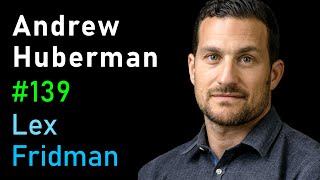 2 hr 32 min
Fear, limbic friction and the quitting circuit
Andrew Huberman: Neuroscience of Optimal Performance | Lex Fridman Podcast #139
Who it’s for, and what you’ll learn
Best for: Listeners who want the mechanisms behind fear, focus and willpower, and fans of brain-machine interfaces.
On uListen: summary · chapters · transcript
A long, unhurried, nerdy conversation in which Lex Fridman offers philosophical prompts and he riffs through lab findings.
You'll learn:
- Why advancing on a threat is the peak stress response: “that's actually not the maximum stress response. The maximum stress response is to advance, but it's associated with reward. It has positive valence.” (21:10).
- Why he says to protect the hours after waking from social media (47:22).
- How a non-negotiable contract frees energy for the effort itself (2:03:38).
Huberman speaks 78% of the words
 2 hr
Sighs, dopamine and the two steps of learning
"This Is Why You FEEL LOST & UNHAPPY In Life" - Fix This TODAY! | Andrew Huberman
Who it’s for, and what you’ll learn
Best for: Listeners who want his foundational toolkit in one sitting, with asides on his own habits, such as locking his phone in a safe to write.
On uListen: summary · chapters · transcript
A long, lecture-style conversation in which Lewis Howes often interjects with restatements and examples from his own life.
You'll learn:
- Why to reward the hardest steps: “the key is to reward the harder steps, not the easier ones, and not the ones where you get the thing that you want.” (58:22).
- Where the rewiring from learning happens (1:10:22).
- Where, in his Freudian model of wish, anxiety and defense, he says to step in: “I think our job is to intervene between anxiety and defense” (1:55:14).
Huberman speaks 79% of the words
 2 hr 45 min
His early model of learning and rest
Joe Rogan Experience #1513 - Andrew Huberman
Who it’s for, and what you’ll learn
Best for: Listeners who want his core early model of learning and a window into his vision research.
On uListen: summary · chapters · transcript
A loose three-hour conversation from before his own podcast, with Rogan steering through fighting, comedy, COVID and protests.
You'll learn:
- His rule of at least double the deep rest after a bout of hard focus (59:03).
- When dopamine is released: “dopamine is what's released any time an animal or human thinks it's on the right path.” (48:09).
- His lab's trial pairing VR stimulation with eye injections for vision loss (2:30:49).
Huberman speaks 68% of the words
What others say about him
Andy Galpin, a guest on The Diary of a CEO, on Huberman's long-running advice about morning light
PlayRussell Kennedy, a guest on Modern Wisdom, on teaching the physiological sigh to anxious patients
PlayJonny Miller, a guest on Lenny's Podcast, on NSDR and practicing it
PlayChris Voss, a guest on Lex Fridman Podcast, on listening to Huberman's podcast
PlayLex Fridman, host of Lex Fridman Podcast, on how Huberman remembers papers
Play
The full quotes
- Andy Galpin, a guest on The Diary of a CEO, on Huberman's long-running advice about morning light: “this is actually something my friend Andrew Huberman has talked about for years now, and I'm like, I've always joked and laughed at him, but then I'm like, damn, he nailed this. Like, he was way ahead in this one. Light exposure in the morning Will impact your sleep at night the next day.” (Dr. Andy Galpin, The Diary of a CEO with Steven Bartlett, August 13, 2026, at 24:12)
- Russell Kennedy, a guest on Modern Wisdom, on teaching the physiological sigh to anxious patients: “Huberman's thing about the physiological sigh, you know? Just the two sniffs in (sniffs) and then long slow breath out. Now, with my anxiety peeps, this is what I do with them. I, I get them to do it three times because there's the alveoli that Huberman explained really beautifully, uh, about the size of a tennis court if you stretched out the, the surface area of the lungs.” (Dr Russell Kennedy, Modern Wisdom with Chris Williamson, December 10, 2022, at 46:17)
- Jonny Miller, a guest on Lenny's Podcast, on NSDR and practicing it: “NSDR was a practice coined by Andrew Huberman who you mentioned earlier, and it basically, uh, it's- it's a more scientific lens on the practice of Yoga Nidra which is kind of an- an ancient yoga practice. But I- I'm a huge fan of it and I do it myself most days for kind of 15 to 20 minutes.” (Jonny Miller, Lenny's Podcast with Lenny Rachitsky, January 28, 2024, at 52:50)
- Chris Voss, a guest on Lex Fridman Podcast, on listening to Huberman's podcast: “we've come to find out that our experience as hostage negotiators is backed up by neuroscience. Another reason why I listen to Andrew Huberman's podcast all the time. Heavy, heavy, heavy, heavy on the neuroscience.” (Chris Voss, Lex Fridman Podcast, March 10, 2023, at 22:40)
- Lex Fridman, host of Lex Fridman Podcast, on how Huberman remembers papers: “Andrew Huberman is, uh, is masterful at this. This is important in academia, remembering the authors of a paper and the title of the paper as part of remembering the idea.” (Lex Fridman, Lex Fridman Podcast, August 11, 2021, at 1:05:58)
Questions people ask
Which Andrew Huberman podcast should I watch first?
Start with The Diary of a CEO with Steven Bartlett (September 3, 2026), where he walks through the protocols in his book Protocols in the order of a day. With less time, try Feel Better, Live More with Dr Rangan Chatterjee (May 19, 2025), which runs 23 min and centers on the physiological sigh.
What is Andrew Huberman's daily routine?
On a16z (Andreessen Horowitz) (November 3, 2026) he walks through his previous day, from a five-minute breath meditation, sunlight and caffeine before training to his lifting and cardio protocol (4:21 to 13:11, 9 min). On Lex Fridman Podcast (June 27, 2024) he describes NSDR when underslept, training done by 8:30 or 9, then protected blocks of deep work (1:36:43 to 1:44:05, 7 min).
What supplements does Andrew Huberman take?
His fullest list, with doses and his sponsor disclosures, is 23:32 to 30:46, 7 min of a16z (Andreessen Horowitz) (November 3, 2026). On The Diary of a CEO with Steven Bartlett (September 3, 2026) he picks five for listeners: magnesium for people not sleeping well, prescription EPA omega-3, vitamin D, alpha-GPC with garlic, and creatine (1:59:16). On The Joe Rogan Experience (June 27, 2024) he says he is a professor, not a doctor, and is not prescribing anything (10:40).
Does Andrew Huberman believe in God?
He says he does. His fullest account, including nightly prayer for nearly three years, is 1:14:23 to 1:37:02, 23 min of The Diary of a CEO with Steven Bartlett (September 3, 2026); on Lewis Howes (September 29, 2025) he says prayer has brought him peace (10:15).
How does Andrew Huberman respond to criticism?
His fullest account of the press coverage of his personal life is 1:31:46 to 1:49:17, 18 min of Modern Wisdom with Chris Williamson (September 9, 2024), where he describes what he sees as lies and missing context while acknowledging a need for reflection and change. On Lex Fridman Podcast (June 27, 2024) he walks through public errors and how he corrects them, including a math error he says he made in his fertility episode (41:13 to 57:32, 16 min).
How much sleep does Andrew Huberman get?
On a16z (Andreessen Horowitz) (November 3, 2026) he says he usually doesn't get enough and is fine on six hours because he knows how to regulate his energy (35:34). On Invest Like The Best (October 6, 2026) he says seven hours feels great, eight leaves him a little groggy, and two nights of four hours or less crater him (3:12).
How this guide is made
uListen wrote this guide with AI from the full, speaker-labeled transcripts of the 29 episodes above, all from uListen's catalog, plus the five episodes quoted under What others say about him. Every quotation is checked word for word against its transcript, and every time comes from it. We update the guide when a new episode with him joins the catalog. To report a problem, email support@ulisten.ai.